From the collection of Richard Freiherr von Krafft-Ebing (1840-1902) a German-Austrian psychiatrist + early sexologist, 1886.
IT BEARS REPEATING
The upcoming series of blog posts is in honor of ALL the women who can, who do, and who keep on doing – who persist – no matter what. They are part of “You Mean A Woman Can Open It,” MANIFEST (zine) #14.
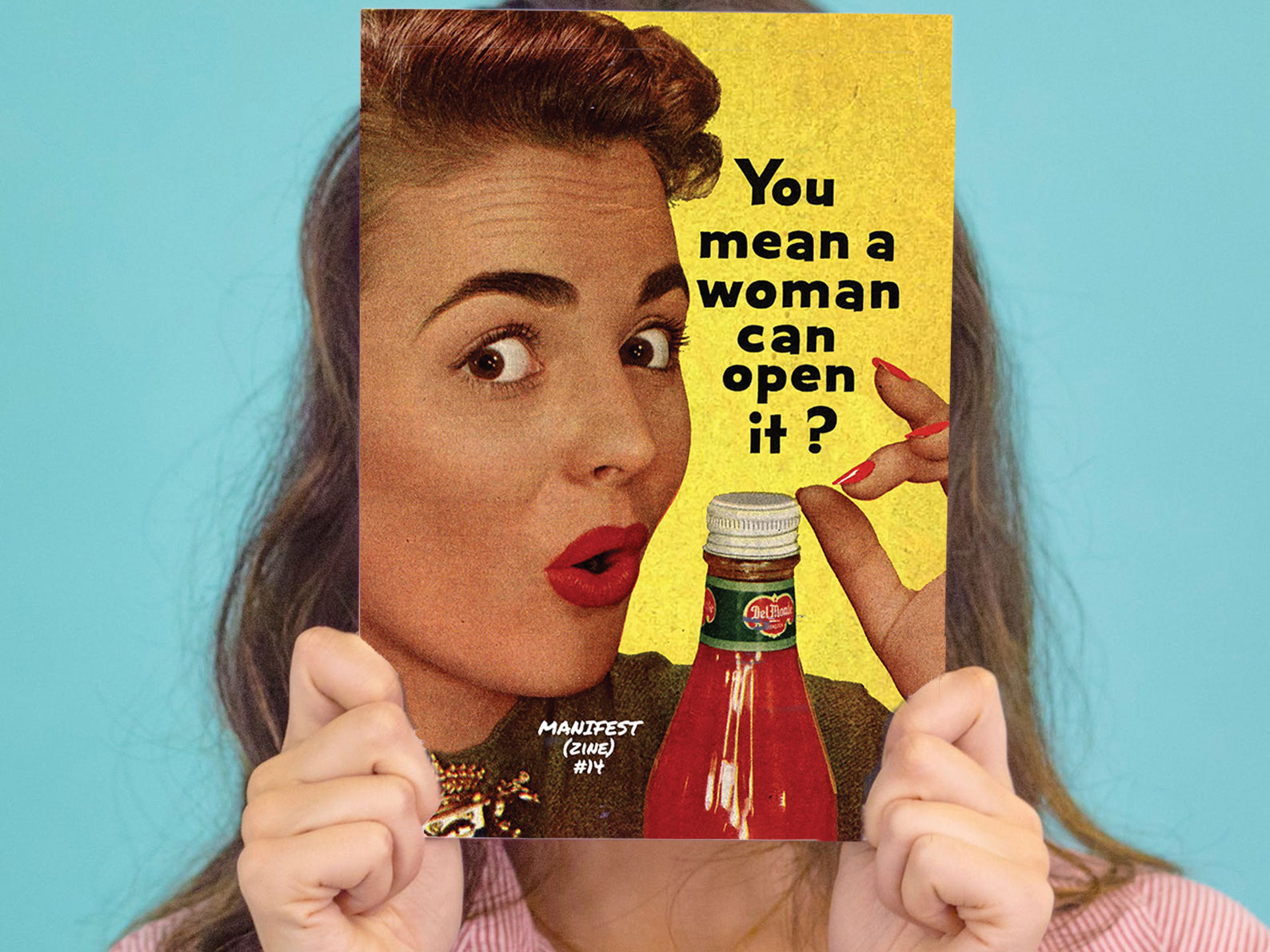
You Mean A Woman Can Open It? 1953 Alcoa Aluminum advertisement.
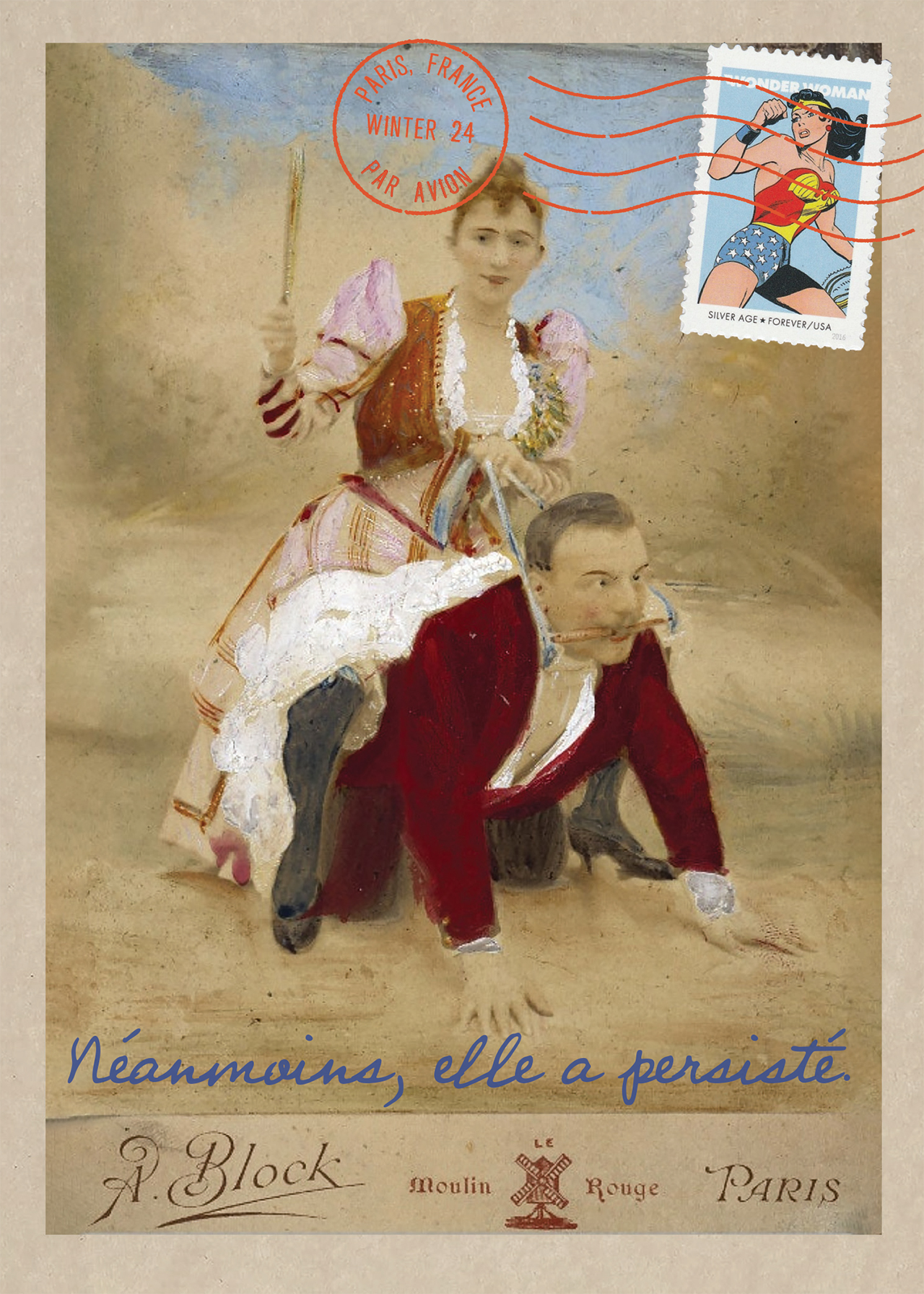
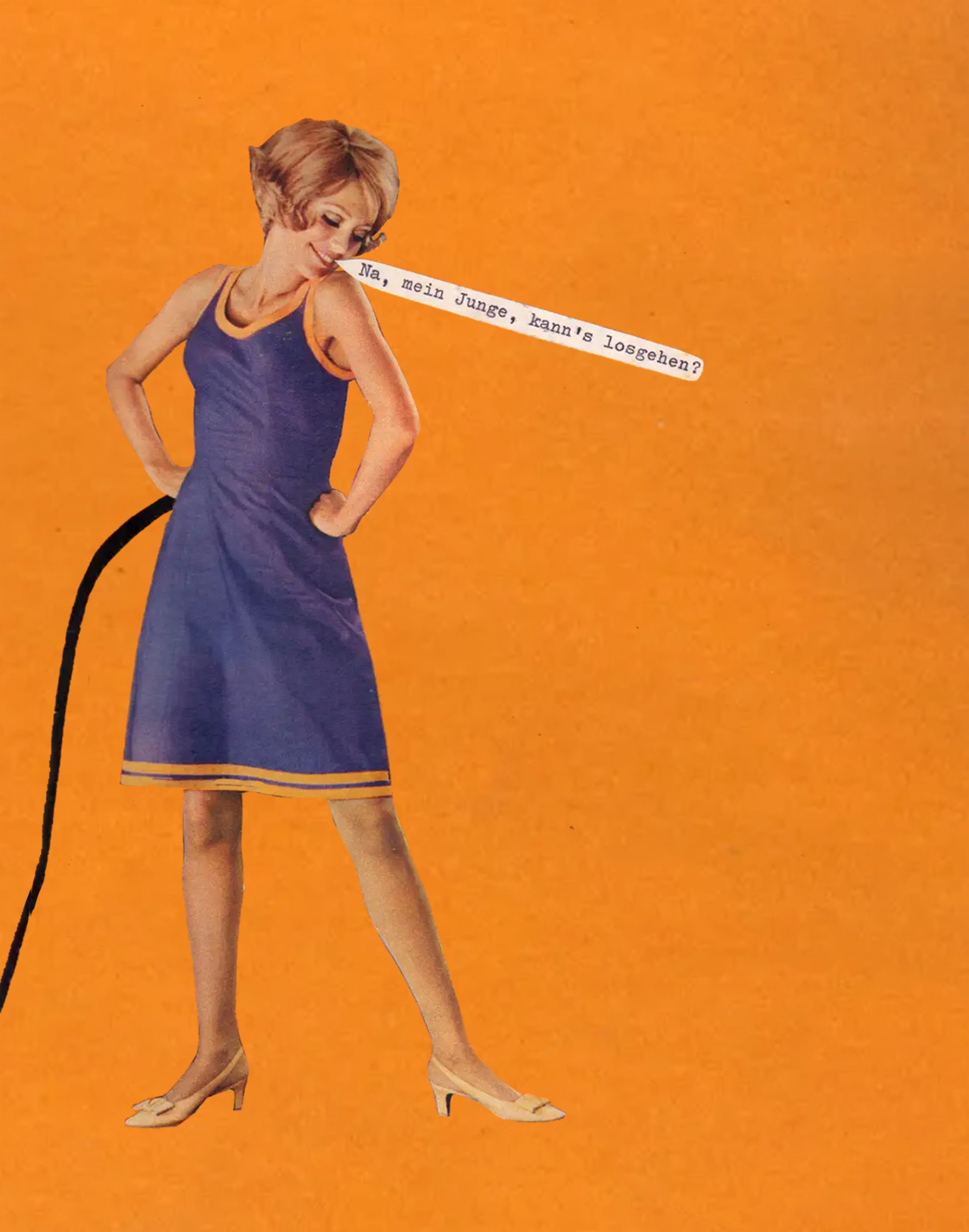
Well, my boy, let’s get started, from “For me, the perfect hostess is the lady with the whip,” German Artist’s Book, 1960s.
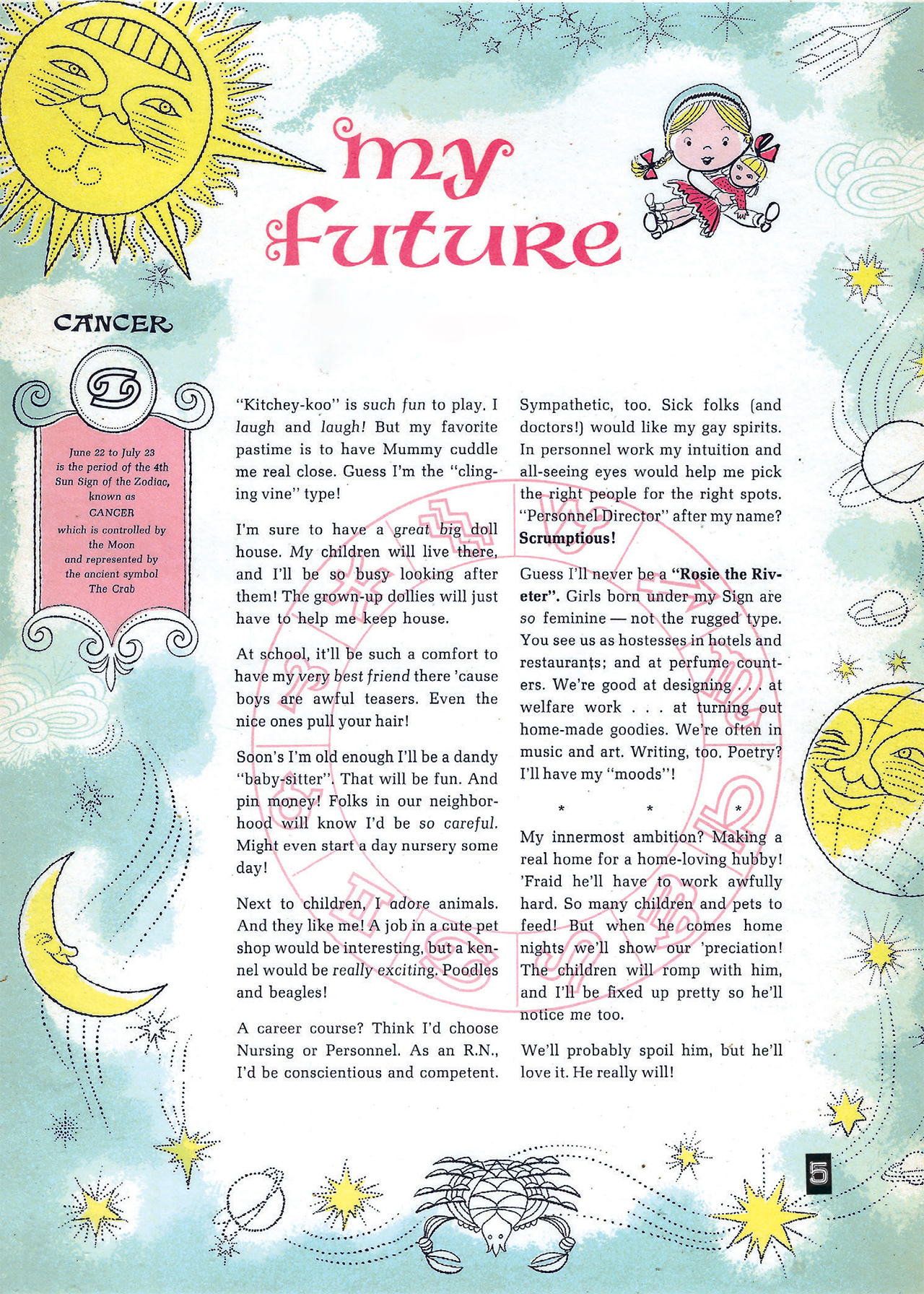
Best Loved Nursery Rhymes Picture Book, circa 1950s.
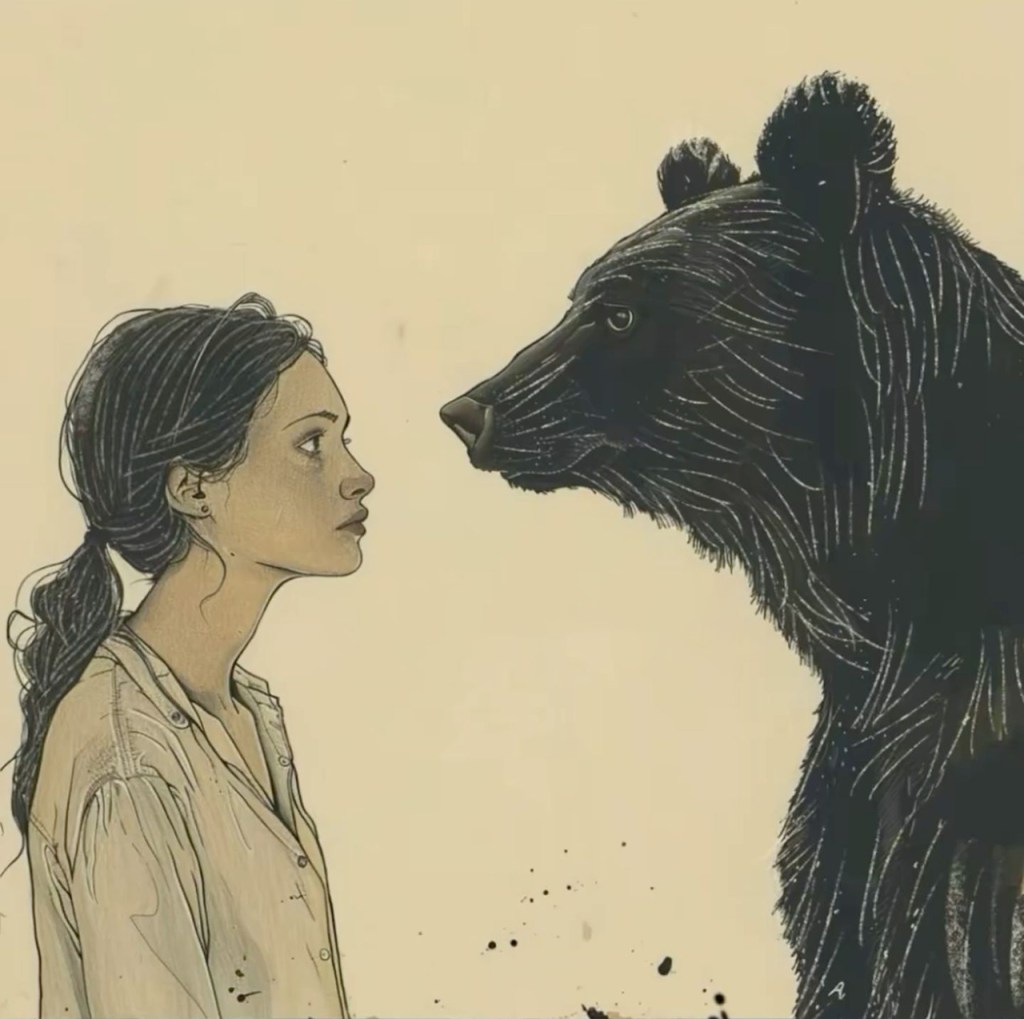
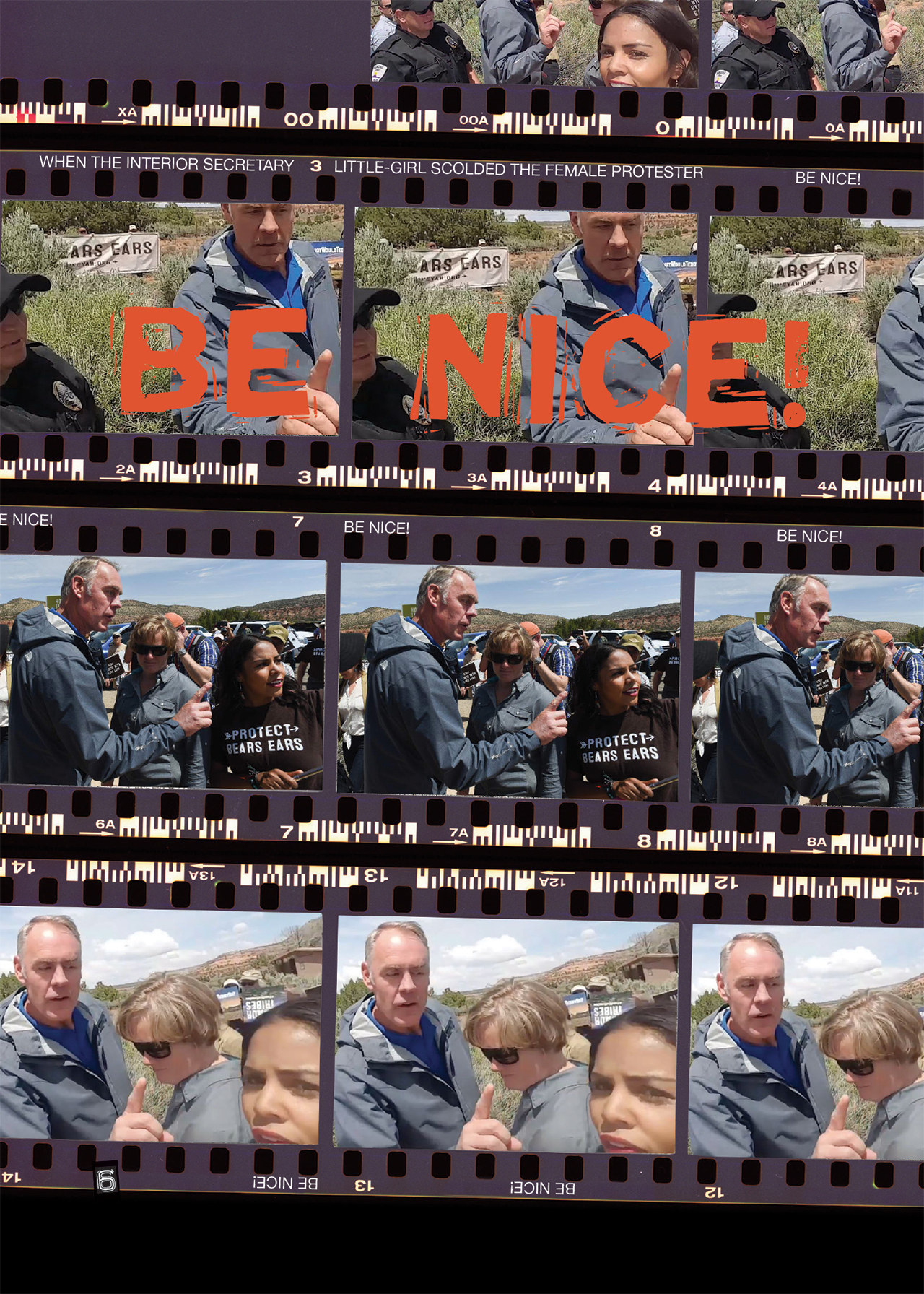
Photos of Ryan Zinke from “Interior Secretary Orders Protester To ‘Be Nice’ During Visit To Bears Ears,” Huffington Post, May 2017.
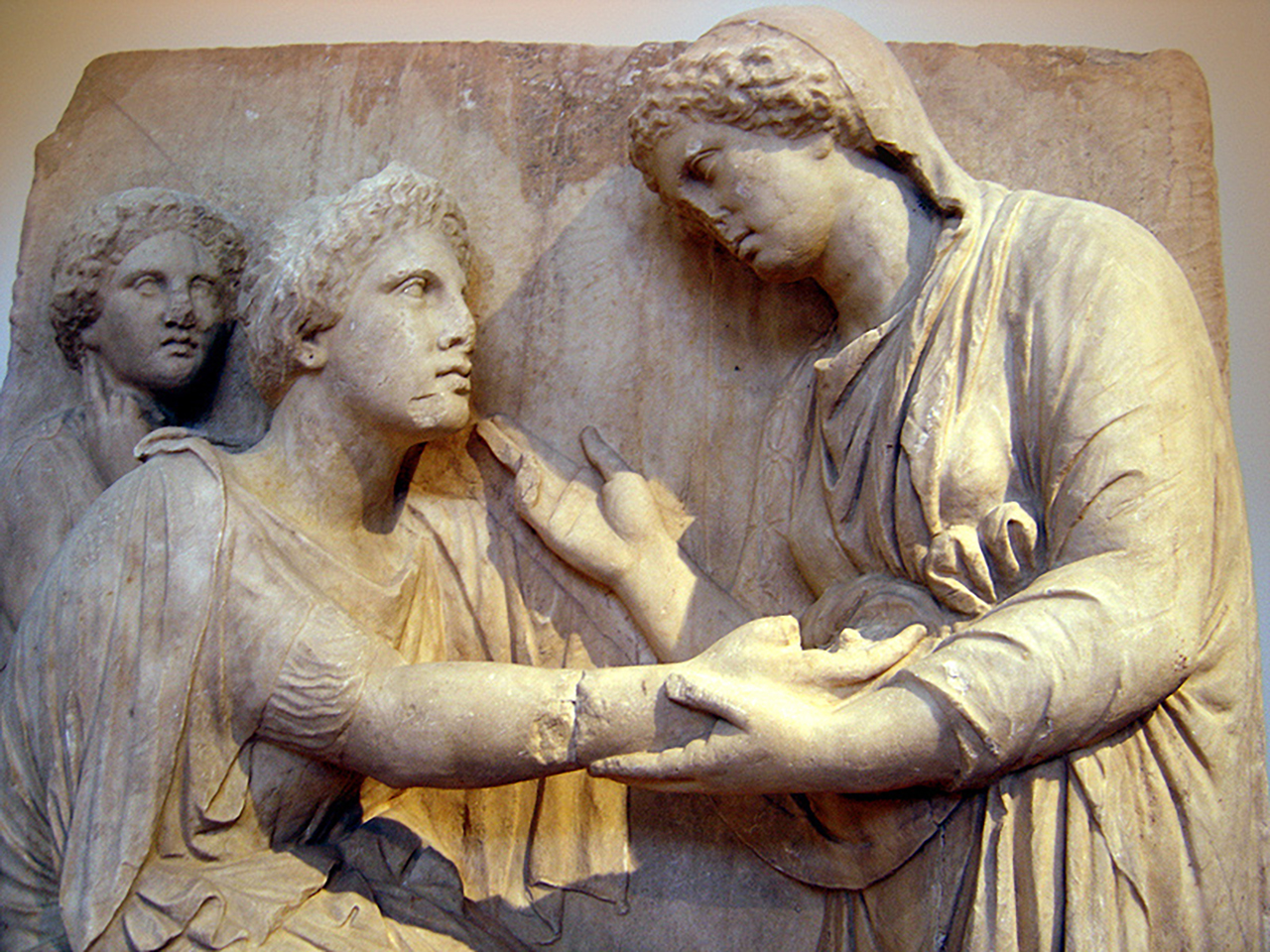
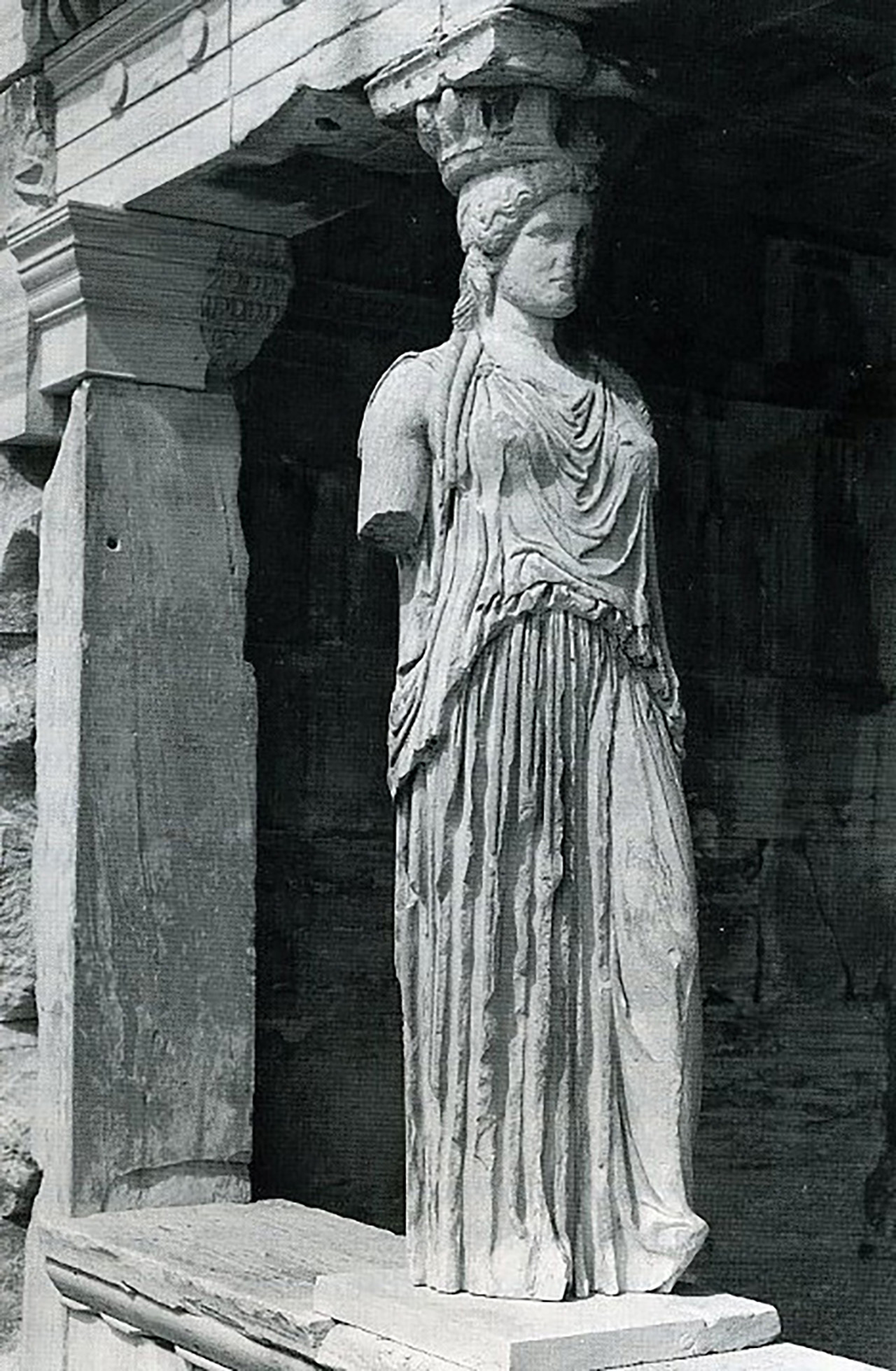
Family group on a grave marker from Athens, National Archaeological Museum, Athens
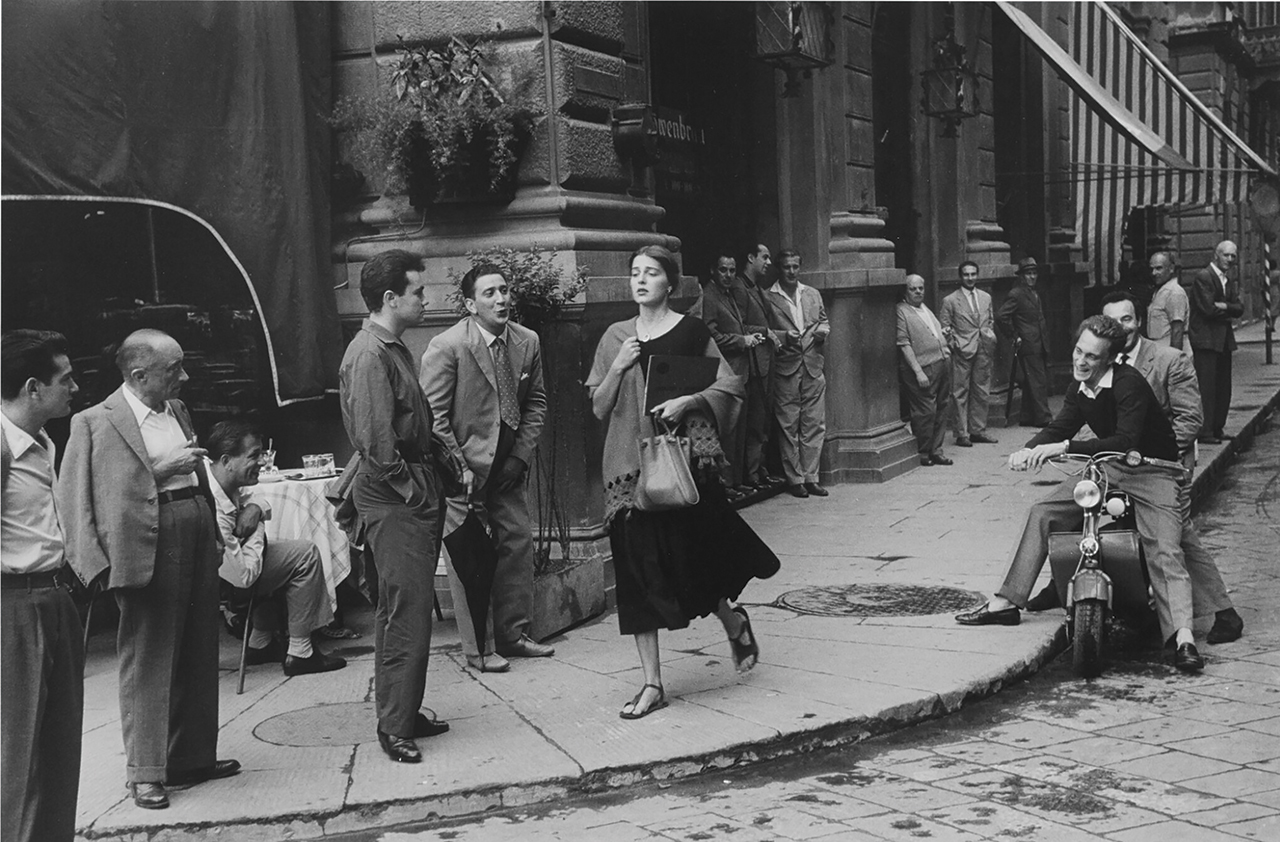
“An American Girl in Italy,” (Ninalee Craig) by Ruth Orkin, 1951.
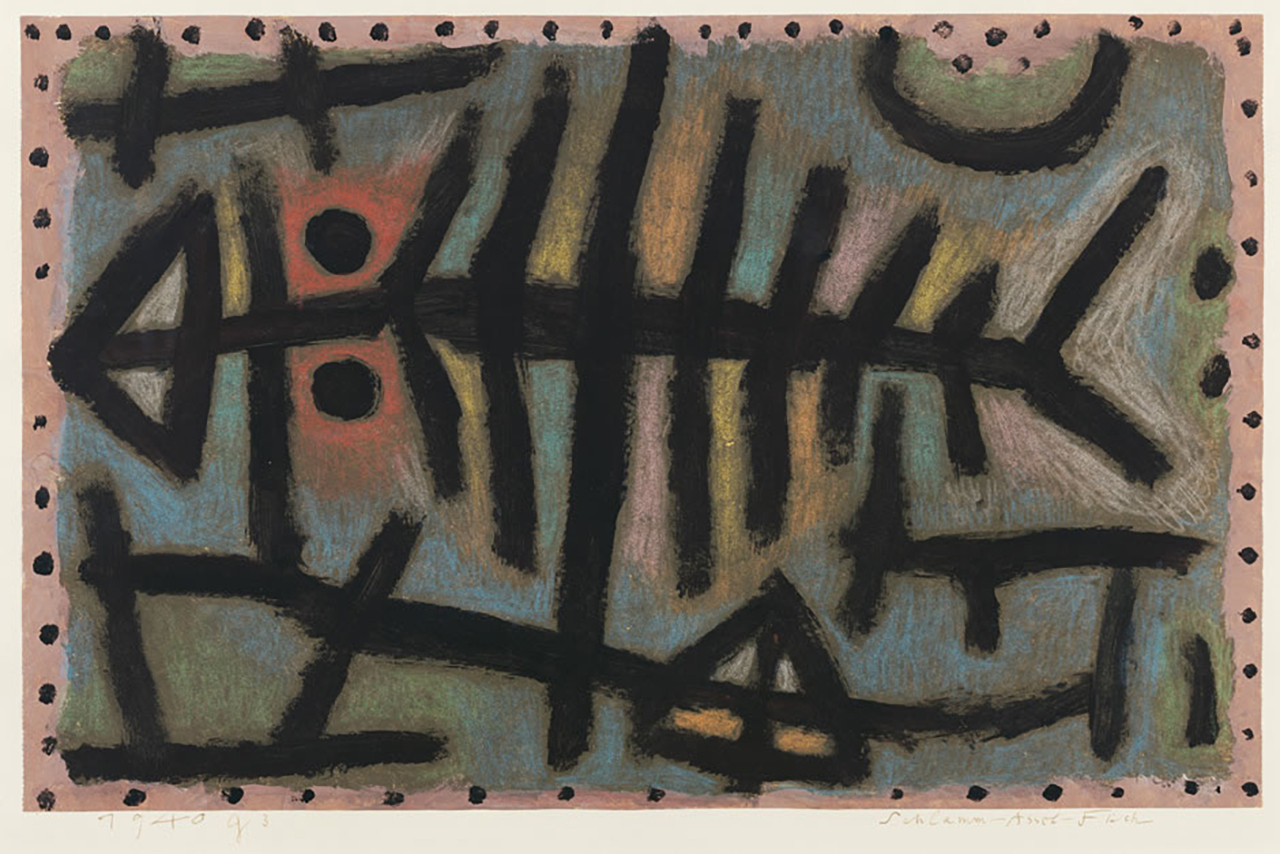
Mess of Fish, Paul Klee
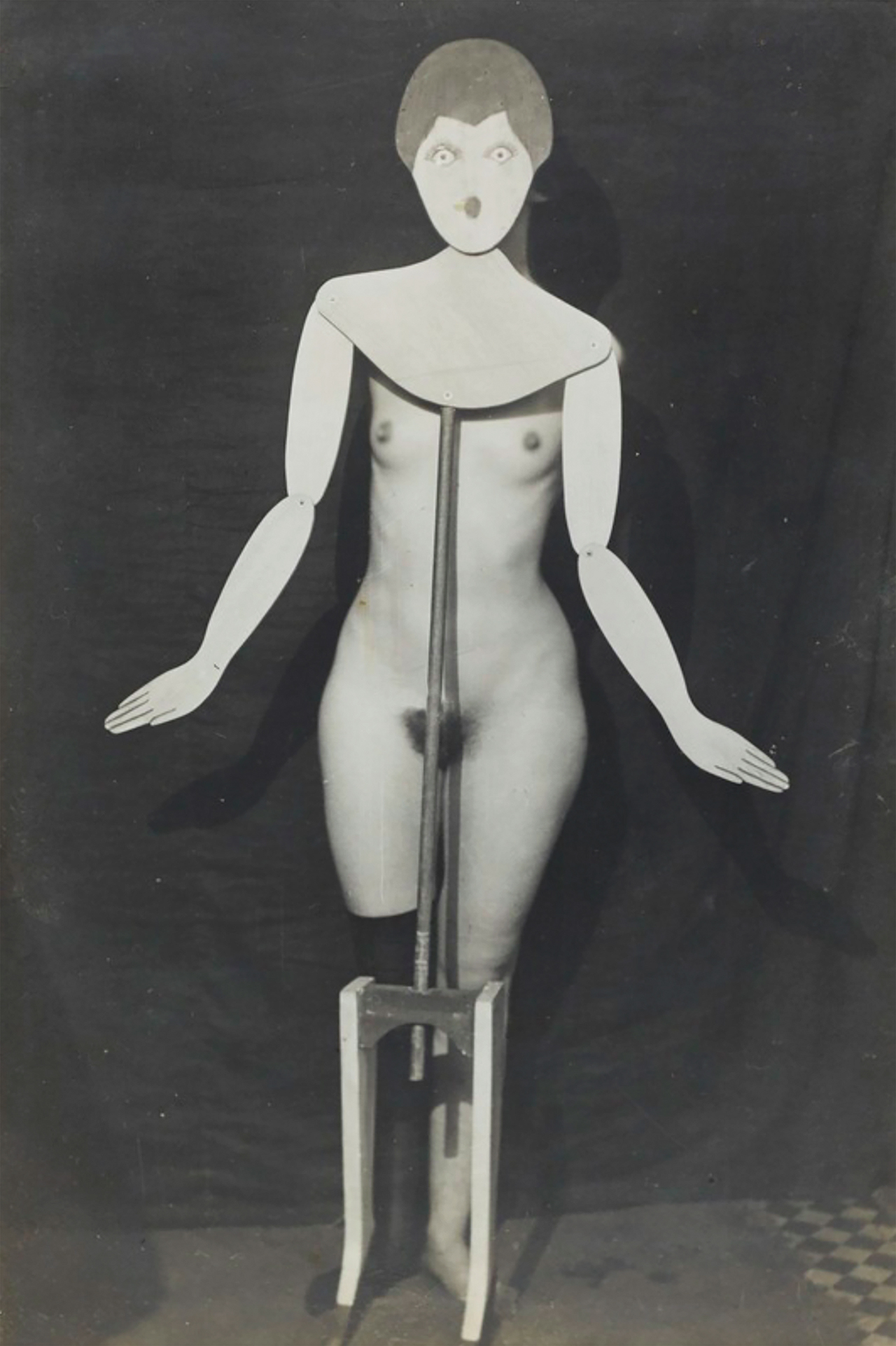
The coat-stand (Porte manteau), by Man Ray, 1920.
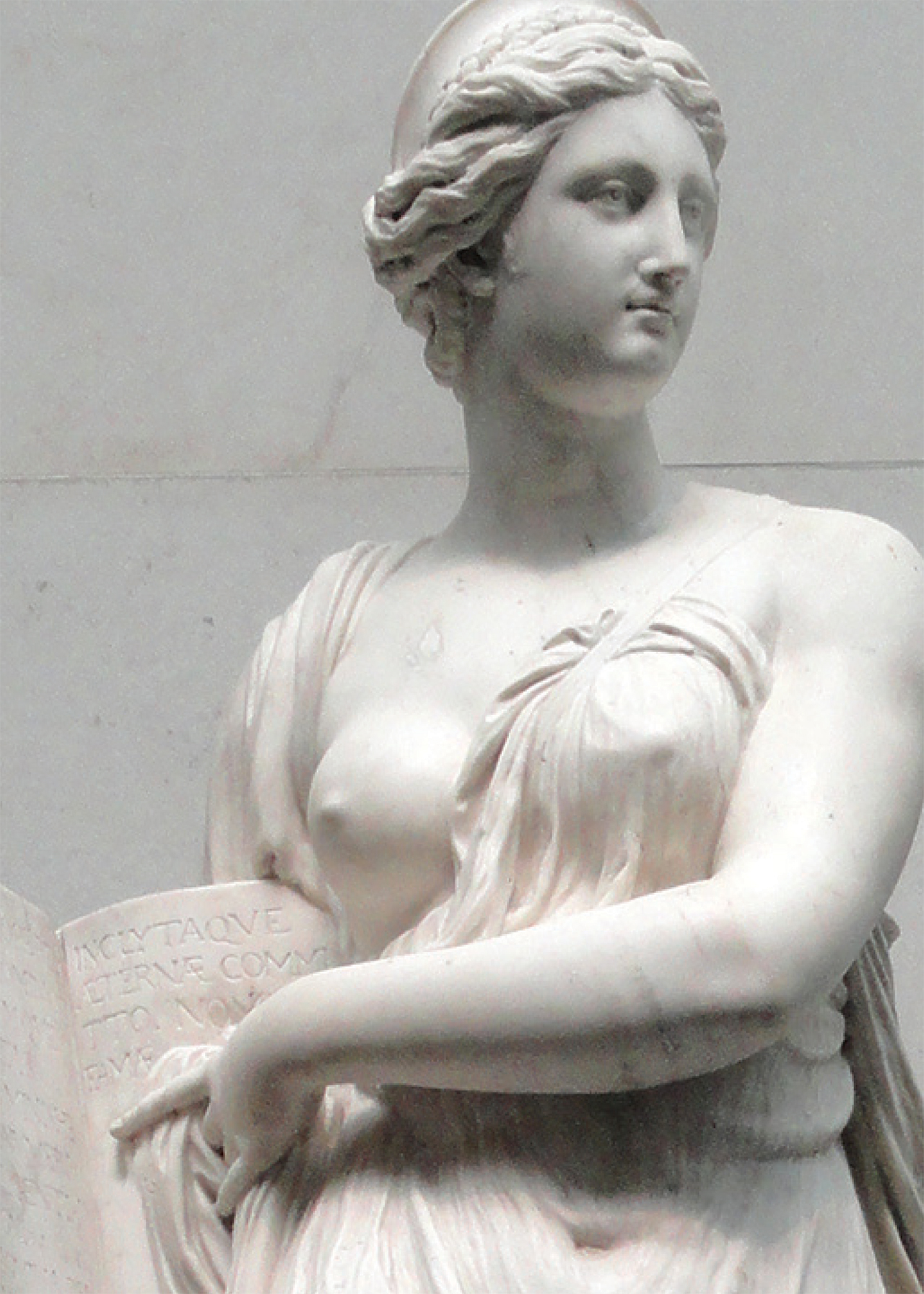
Calliope, Augustin Pajou, 1763.
Vogue sewing pattern, 1980s.
“The history of the pussy bow blouse,” Bethany Armitage, CraftWorld, March 2019.
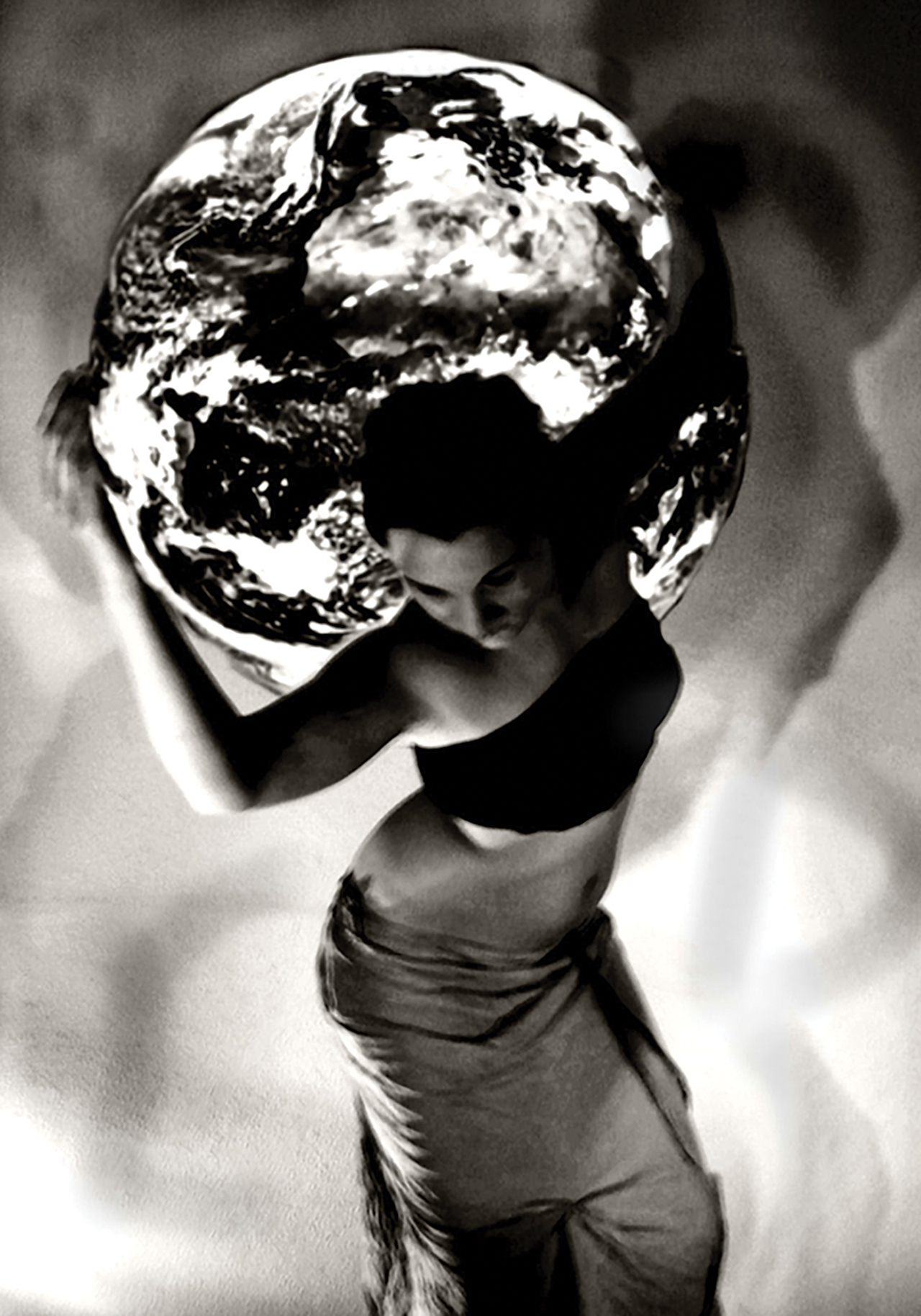
Atlas Was a Woman, by Céline (Melle-T), Deviant Art, 2007.
From the collection of Richard Freiherr von Krafft-Ebing (1840-1902) a German-Austrian psychiatrist + early sexologist, 1886.
“Nevertheless, she persisted” – an expression adopted by feminists, especially in the U.S. after the Senate voted to require Senator Elizabeth Warren to stop speaking during the confirmation of Jeff Sessions as U.S. Attorney General.
Atlas Was a Woman, by Céline (Melle-T), Deviant Art, 2007
For a friend (or two)(or three)
Even strong women break / fall apart in parking lots our lives upside down / wheels spinning Curse our way through or sleep it out / drink it out, consume it Find the weight so unbearable / our hearts just stop Sure, we can be both / strong and broken capable and crying / put together and a total fucking mess
all
at
the
same
time
Never underestimate the power in that / the force it takes to hold ourselves up while balancing the world
IT BEARS REPEATING
The upcoming series of blog posts is in honor of ALL the women who can, who do, and who keep on doing – who persist – no matter what. They are part of “You Mean A Woman Can Open It,” MANIFEST (zine) #14.
You Mean A Woman Can Open It? 1953 Alcoa Aluminum advertisement.
Well, my boy, let’s get started, from “For me, the perfect hostess is the lady with the whip,” German Artist’s Book, 1960s.
Best Loved Nursery Rhymes Picture Book, circa 1950s.
Photos of Ryan Zinke from “Interior Secretary Orders Protester To ‘Be Nice’ During Visit To Bears Ears,” Huffington Post, May 2017.
Family group on a grave marker from Athens, National Archaeological Museum, Athens
“An American Girl in Italy,” (Ninalee Craig) by Ruth Orkin, 1951.
Mess of Fish, Paul Klee
The coat-stand (Porte manteau), by Man Ray, 1920.
Calliope, Augustin Pajou, 1763.
Vogue sewing pattern, 1980s.
“The history of the pussy bow blouse,” Bethany Armitage, CraftWorld, March 2019.
Atlas Was a Woman, by Céline (Melle-T), Deviant Art, 2007.
From the collection of Richard Freiherr von Krafft-Ebing (1840-1902) a German-Austrian psychiatrist + early sexologist, 1886.
“Nevertheless, she persisted” – an expression adopted by feminists, especially in the U.S. after the Senate voted to require Senator Elizabeth Warren to stop speaking during the confirmation of Jeff Sessions as U.S. Attorney General.
(or The Time a New Client Came to My Office with Porn Streaming on His Laptop)
He thinks he is a god perhaps because he’s seen through flesh and bone, formed breasts from mounds of earth, created his own father, he says — a graven image in profile.
He pours nectar in a cup, licks ambrosia from wizened lips, insisting the indulgences please his wife, then asks if I am single, looking for collusion.
Finding no inroad, he puts his foot down with bombastic flare, digs a heel into the ground and cocks a smirk, “I know the cut of your jib,” he says with bluster.
But I am moored firmly — unmoved by gods and their theatrics, preferring mere mortals, their rough-hewn souls, and flawed finishes.
IT BEARS REPEATING
The upcoming series of blog posts is in honor of ALL the women who can, who do, and who keep on doing – who persist – no matter what. They are part of “You Mean A Woman Can Open It,” MANIFEST (zine) #14.
You Mean A Woman Can Open It? 1953 Alcoa Aluminum advertisement.
Well, my boy, let’s get started, from “For me, the perfect hostess is the lady with the whip,” German Artist’s Book, 1960s.
Best Loved Nursery Rhymes Picture Book, circa 1950s.
Photos of Ryan Zinke from “Interior Secretary Orders Protester To ‘Be Nice’ During Visit To Bears Ears,” Huffington Post, May 2017.
Family group on a grave marker from Athens, National Archaeological Museum, Athens
“An American Girl in Italy,” (Ninalee Craig) by Ruth Orkin, 1951.
Mess of Fish, Paul Klee
The coat-stand (Porte manteau), by Man Ray, 1920.
Calliope, Augustin Pajou, 1763.
Vogue sewing pattern, 1980s.
“The history of the pussy bow blouse,” Bethany Armitage, CraftWorld, March 2019.
Atlas Was a Woman, by Céline (Melle-T), Deviant Art, 2007.
From the collection of Richard Freiherr von Krafft-Ebing (1840-1902) a German-Austrian psychiatrist + early sexologist, 1886.
“Nevertheless, she persisted” – an expression adopted by feminists, especially in the U.S. after the Senate voted to require Senator Elizabeth Warren to stop speaking during the confirmation of Jeff Sessions as U.S. Attorney General.
I confess, I was a bit offended when one of the characters on my favorite television show walked on scene wearing a pussy bow blouse recently.
The show – Grey’s Anatomy – has long been known for putting women front and center. Strong female characters on screen, important topics like abortion rights and domestic violence, and women in roles from producers and directors, to writers and camera operators.
So the pussy bow surprised me. I’ve always thought of the fashion as something women had to wear in the 70s and 80s; a requisite corporate uniform to simulate the male necktie. Right?
Wrong.
Not a euphemism – originally anyhow – the pussy bow “tied high under your chin” was named after a ribbon one might tie around a kitten’s neck. It first appeared as a design in the early 20th century, and was considered highly feminine. It was a favorite of movie stars in the 1940s and 50s, and later picked up by designers like Coco Chanel and Yves Saint Laurent. But, “over the years the pussy-bow blouse has evolved into a symbol of power for women in popular culture,” writes Bethany Armitage from CraftWorld.
“In the 1960s and 70s, as new opportunities began to grow and develop for working women, so did the popularity of the blouse. Trailblazing women who led the way to the top of their corporate careers had no established examples of how to dress and so looked to their male counterparts for cues. The blouse emulated an alternative to the traditional suit and tie, combining masculine work wear with a frill of femininity which made it an ideal choice for women who were looking to stand out and make an impact in a male-dominated environment.”
Fast forward a few decades, and apparently, the pussy bow blouse is making a big comeback. Again. It’s considered retro and vintage. A fashion statement. It’s a sign of female power, as well as a humble nod to the women who boldly stepped into the workforce and never, ever, looked back.
IT BEARS REPEATING
The upcoming series of blog posts is in honor of ALL the women who can, who do, and who keep on doing – who persist – no matter what. They are part of “You Mean A Woman Can Open It,” MANIFEST (zine) #14.
You Mean A Woman Can Open It? 1953 Alcoa Aluminum advertisement.
Well, my boy, let’s get started, from “For me, the perfect hostess is the lady with the whip,” German Artist’s Book, 1960s.
Best Loved Nursery Rhymes Picture Book, circa 1950s.
Photos of Ryan Zinke from “Interior Secretary Orders Protester To ‘Be Nice’ During Visit To Bears Ears,” Huffington Post, May 2017.
Family group on a grave marker from Athens, National Archaeological Museum, Athens
“An American Girl in Italy,” (Ninalee Craig) by Ruth Orkin, 1951.
Mess of Fish, Paul Klee
The coat-stand (Porte manteau), by Man Ray, 1920.
Calliope, Augustin Pajou, 1763.
Vogue sewing pattern, 1980s.
“The history of the pussy bow blouse,” Bethany Armitage, CraftWorld, March 2019.
Atlas Was a Woman, by Céline (Melle-T), Deviant Art, 2007.
From the collection of Richard Freiherr von Krafft-Ebing (1840-1902) a German-Austrian psychiatrist + early sexologist, 1886.
“Nevertheless, she persisted” – an expression adopted by feminists, especially in the U.S. after the Senate voted to require Senator Elizabeth Warren to stop speaking during the confirmation of Jeff Sessions as U.S. Attorney General.
We sit, five of us, naked around the meeting table in the office of men who arrive, late, in suits and ties, and we laugh at how silly it is — smart women, business women, and these men — these men — insisting their way as we play along, again then he calls me girl — a little girl — and we laugh.
Later, in the lobby, as I hold up a bedsheet to my hide my self, I see across the room the lover who loved with shouts and shoves; he smiles and we embrace like old friends, then he shape-shifts bear, fox, jackal, demon holds a fist up to my face and laughs — he laughs —
And I wake up, naked deciphering dreams, their train window filmstrip passing, passing passing ever so briefly resurfacing to remind and retell stories almost forgot — but not — ever.
IT BEARS REPEATING
The upcoming series of blog posts is in honor of ALL the women who can, who do, and who keep on doing – who persist – no matter what. They are part of “You Mean A Woman Can Open It,” MANIFEST (zine) #14.
You Mean A Woman Can Open It? 1953 Alcoa Aluminum advertisement.
Well, my boy, let’s get started, from “For me, the perfect hostess is the lady with the whip,” German Artist’s Book, 1960s.
Best Loved Nursery Rhymes Picture Book, circa 1950s.
Photos of Ryan Zinke from “Interior Secretary Orders Protester To ‘Be Nice’ During Visit To Bears Ears,” Huffington Post, May 2017.
Family group on a grave marker from Athens, National Archaeological Museum, Athens
“An American Girl in Italy,” (Ninalee Craig) by Ruth Orkin, 1951.
Mess of Fish, Paul Klee
The coat-stand (Porte manteau), by Man Ray, 1920.
Calliope, Augustin Pajou, 1763.
Vogue sewing pattern, 1980s.
“The history of the pussy bow blouse,” Bethany Armitage, CraftWorld, March 2019.
Atlas Was a Woman, by Céline (Melle-T), Deviant Art, 2007.
From the collection of Richard Freiherr von Krafft-Ebing (1840-1902) a German-Austrian psychiatrist + early sexologist, 1886.
“Nevertheless, she persisted” – an expression adopted by feminists, especially in the U.S. after the Senate voted to require Senator Elizabeth Warren to stop speaking during the confirmation of Jeff Sessions as U.S. Attorney General.
I rarely thought of that night in the gatehouse that overlooked the Sound, salt air moist on lips, and wine.
You wore a white sweater, the kind mariners wear while they tear hooks from small fish and throw them overboard.
There was a fire in the fireplace, and you sat on the floor next to me with your arm around my shoulders, laughing.
I can still see your face, that smirk of a smile that made my heart swim; feel the spot in my chest where love and anxiety mixed often with you.
There was a white robe in your bathroom, a second toothbrush in a cup — the things a woman leaves behind when she is certain she will not be discarded.
They were not mine.
My things were in a pile on the floor next to your bed where you left me in the dark, gutted and alone — the sound of a door somewhere shutting.
IT BEARS REPEATING
The upcoming series of blog posts is in honor of ALL the women who can, who do, and who keep on doing – who persist – no matter what. They are part of “You Mean A Woman Can Open It,” MANIFEST (zine) #14.
You Mean A Woman Can Open It? 1953 Alcoa Aluminum advertisement.
Well, my boy, let’s get started, from “For me, the perfect hostess is the lady with the whip,” German Artist’s Book, 1960s.
Best Loved Nursery Rhymes Picture Book, circa 1950s.
Photos of Ryan Zinke from “Interior Secretary Orders Protester To ‘Be Nice’ During Visit To Bears Ears,” Huffington Post, May 2017.
Family group on a grave marker from Athens, National Archaeological Museum, Athens
“An American Girl in Italy,” (Ninalee Craig) by Ruth Orkin, 1951.
Mess of Fish, Paul Klee
The coat-stand (Porte manteau), by Man Ray, 1920.
Calliope, Augustin Pajou, 1763.
Vogue sewing pattern, 1980s.
“The history of the pussy bow blouse,” Bethany Armitage, CraftWorld, March 2019.
Atlas Was a Woman, by Céline (Melle-T), Deviant Art, 2007.
From the collection of Richard Freiherr von Krafft-Ebing (1840-1902) a German-Austrian psychiatrist + early sexologist, 1886.
“Nevertheless, she persisted” – an expression adopted by feminists, especially in the U.S. after the Senate voted to require Senator Elizabeth Warren to stop speaking during the confirmation of Jeff Sessions as U.S. Attorney General.
“An American Girl in Italy,” (Ninalee Craig) by Ruth Orkin, 1951.
the one who watched her walk to sixth grade from his front door, bathrobe open, exposed
the one who slipped a tongue when no one was watching, just a goodnight kiss to a friend’s teen daughter
the one who assumed flirt meant fuck, crushed her hard against a suddenly reclined seat
the one who grabbed her like a Happy Meal expectation after their drive-thru supper
the one who insisted on air conditioning in winter, who joked about cold nipples while pouring hot coffee in the breakroom
the one who called her “girl” in a room full of men, then ignored her while she led the meeting
the one who slammed her into a corner, left bruises as a reminder that dishes were to be done before he got home
the one who dined her, wined her, loved her, then left her alone, in the dark…and never came back
IT BEARS REPEATING
The upcoming series of blog posts is in honor of ALL the women who can, who do, and who keep on doing – who persist – no matter what. They are part of “You Mean A Woman Can Open It,” MANIFEST (zine) #14.
You Mean A Woman Can Open It? 1953 Alcoa Aluminum advertisement.
Well, my boy, let’s get started, from “For me, the perfect hostess is the lady with the whip,” German Artist’s Book, 1960s.
Best Loved Nursery Rhymes Picture Book, circa 1950s.
Photos of Ryan Zinke from “Interior Secretary Orders Protester To ‘Be Nice’ During Visit To Bears Ears,” Huffington Post, May 2017.
Family group on a grave marker from Athens, National Archaeological Museum, Athens
“An American Girl in Italy,” (Ninalee Craig) by Ruth Orkin, 1951.
Mess of Fish, Paul Klee
The coat-stand (Porte manteau), by Man Ray, 1920.
Calliope, Augustin Pajou, 1763.
Vogue sewing pattern, 1980s.
“The history of the pussy bow blouse,” Bethany Armitage, CraftWorld, March 2019.
Atlas Was a Woman, by Céline (Melle-T), Deviant Art, 2007.
From the collection of Richard Freiherr von Krafft-Ebing (1840-1902) a German-Austrian psychiatrist + early sexologist, 1886.
“Nevertheless, she persisted” – an expression adopted by feminists, especially in the U.S. after the Senate voted to require Senator Elizabeth Warren to stop speaking during the confirmation of Jeff Sessions as U.S. Attorney General.
The upcoming series of blog posts is in honor of ALL the women who can, who do, and who keep on doing – who persist – no matter what. They are part of “You Mean A Woman Can Open It,” MANIFEST (zine) #14.
You Mean A Woman Can Open It? 1953 Alcoa Aluminum advertisement.
Well, my boy, let’s get started, from “For me, the perfect hostess is the lady with the whip,” German Artist’s Book, 1960s.
Best Loved Nursery Rhymes Picture Book, circa 1950s.
Photos of Ryan Zinke from “Interior Secretary Orders Protester To ‘Be Nice’ During Visit To Bears Ears,” Huffington Post, May 2017.
Family group on a grave marker from Athens, National Archaeological Museum, Athens
“An American Girl in Italy,” (Ninalee Craig) by Ruth Orkin, 1951.
Mess of Fish, Paul Klee
The coat-stand (Porte manteau), by Man Ray, 1920.
Calliope, Augustin Pajou, 1763.
Vogue sewing pattern, 1980s.
“The history of the pussy bow blouse,” Bethany Armitage, CraftWorld, March 2019.
Atlas Was a Woman, by Céline (Melle-T), Deviant Art, 2007.
From the collection of Richard Freiherr von Krafft-Ebing (1840-1902) a German-Austrian psychiatrist + early sexologist, 1886.
“Nevertheless, she persisted” – an expression adopted by feminists, especially in the U.S. after the Senate voted to require Senator Elizabeth Warren to stop speaking during the confirmation of Jeff Sessions as U.S. Attorney General.
Family group on a grave marker from Athens, National Archaeological Museum, Athens
My mother — not content with “grandcats” tries to set me up.
A nice man, she says. Goes to church. Works at a bank. Drives a nice car.
“Does he write?” I ask. “Paint?” “Dream?”
“I don’t know, you’ll like him,” she insists. Hopes.
“I have enough,” I tell her. “My work, writing, the house, friends.”
“Think about it,” she says. “I have,” I respond.
She asks again, a week later. Three weeks later. “No, Mom.”
“I don’t understand,” she says me. “You don’t understand,” I reply.
“You meet, no?” says her boyfriend, the older Greek man from upstairs.
“You talk. You like. You get married. No?”
“NO!” I think to scream — but am polite to my elders.
“Honey,” he says, “You are alone. You get married, you are happy.”
“I am happy,” I insist, no doubt in Swahili.
IT BEARS REPEATING
The upcoming series of blog posts is in honor of ALL the women who can, who do, and who keep on doing – who persist – no matter what. They are part of “You Mean A Woman Can Open It,” MANIFEST (zine) #14.
You Mean A Woman Can Open It? 1953 Alcoa Aluminum advertisement.
Well, my boy, let’s get started, from “For me, the perfect hostess is the lady with the whip,” German Artist’s Book, 1960s.
Best Loved Nursery Rhymes Picture Book, circa 1950s.
Photos of Ryan Zinke from “Interior Secretary Orders Protester To ‘Be Nice’ During Visit To Bears Ears,” Huffington Post, May 2017.
Family group on a grave marker from Athens, National Archaeological
Museum, Athens “An American Girl in Italy,” (Ninalee Craig) by Ruth Orkin, 1951.
Mess of Fish, Paul Klee
The coat-stand (Porte manteau), by Man Ray, 1920.
Calliope, Augustin Pajou, 1763.
Vogue sewing pattern, 1980s.
“The history of the pussy bow blouse,” Bethany Armitage, CraftWorld, March 2019.
Atlas Was a Woman, by Céline (Melle-T), Deviant Art, 2007.
From the collection of Richard Freiherr von Krafft-Ebing (1840-1902) a German-Austrian psychiatrist + early sexologist, 1886.
“Nevertheless, she persisted” – an expression adopted by feminists, especially in the U.S. after the Senate voted to require Senator Elizabeth Warren to stop speaking during the confirmation of Jeff Sessions as U.S. Attorney General.
The museum is celebrating America’s 250th anniversary with themed exhibits that offer an “opportunity to pause and reflect on our nation’s past, honor the contributions of all American artists, and look ahead toward the future of our nation.”
The future. Perhaps that is why I found myself equally inspired and weepy.
I was incredibly inspired, for example, by the fabulous exhibit “Architects of Being” which showcased a collection of sculpture, painting, collage, fashion and jewelry by mid-century artists Louise Nevelson and Esphyr Slobodkina. The curation and presentation of their work was delicious — I am still savoring the flirty pop of orange that was teased throughout the gallery. And John Hitchcock’s “We are Defined by the Beat!” was an experience of color and sound and memory.
Truth be told, I am always energized by the wild, out-of-the-box minds of contemporary artists in an I-Wanna-Be-An-Artist-Too kind of way.
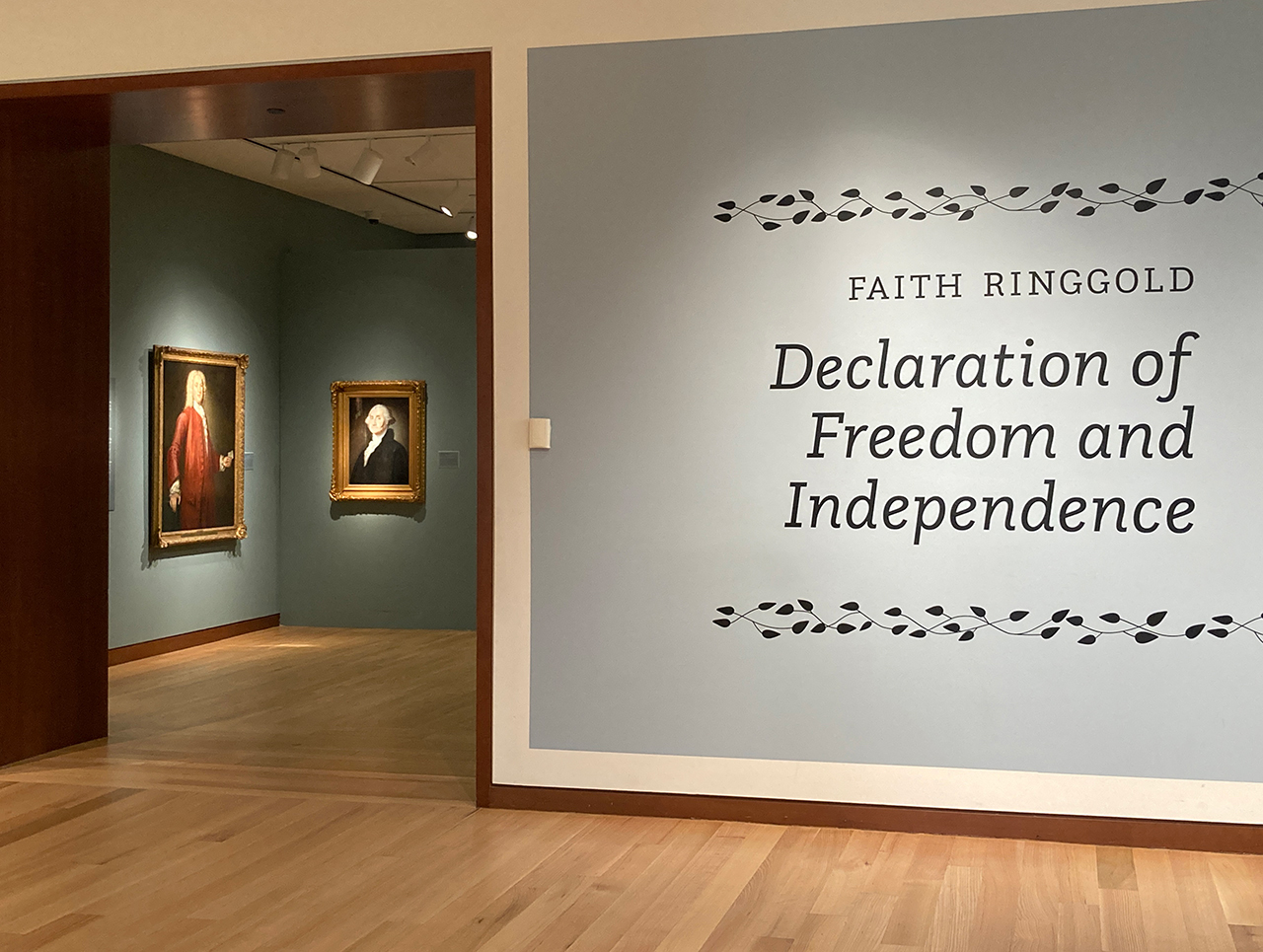
But the Faith Ringgold exhibit “Declaration of Freedom and Independence” juxtaposed to the Colonial portrait gallery featuring lots of old white guys was unsettling. The iconic George Washington portrait gave a constant side-eye to Ringgold’s print series that “considers the contradictions between America’s promises, exclusions, and ongoing efforts to achieve justice and equality for all.”
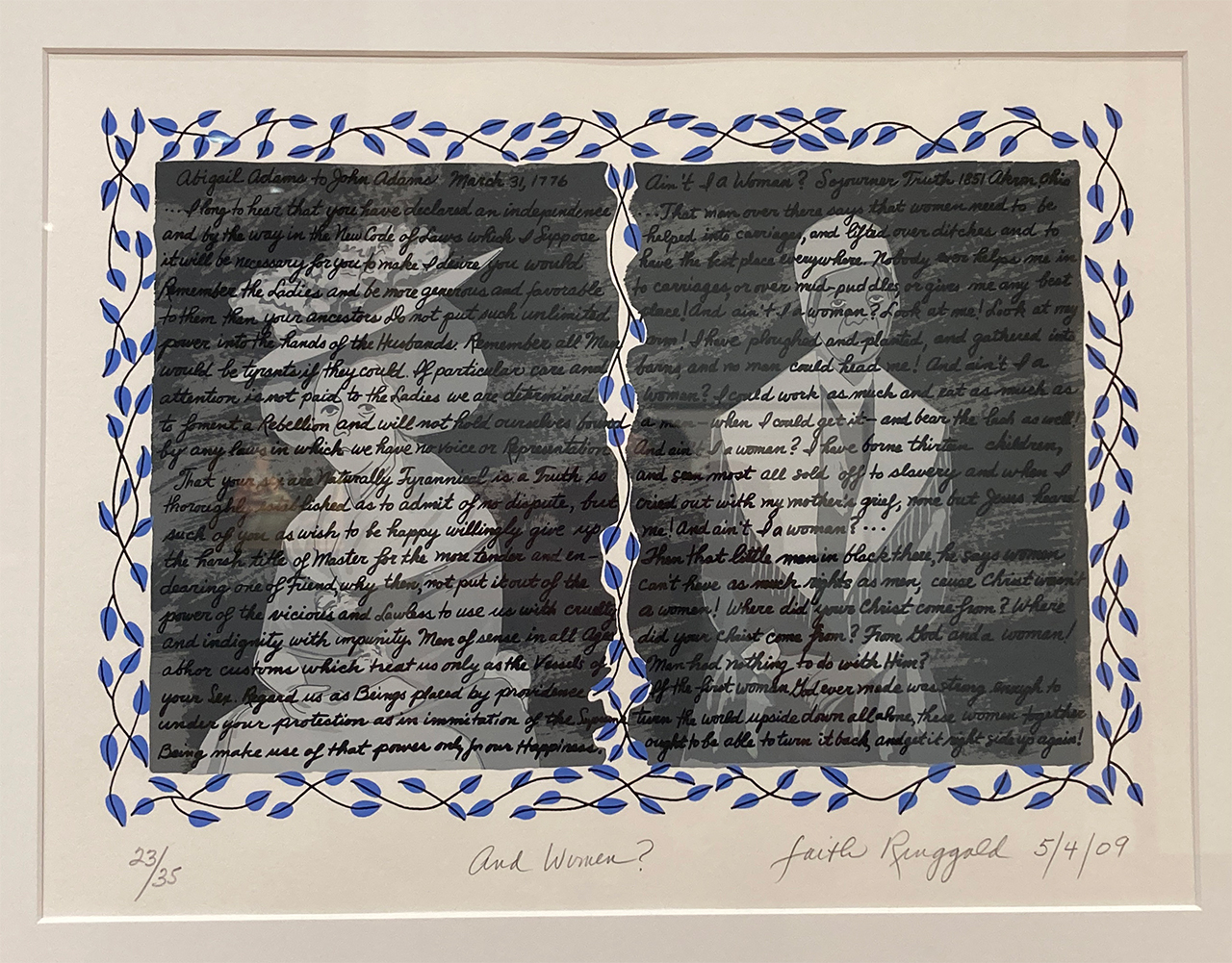
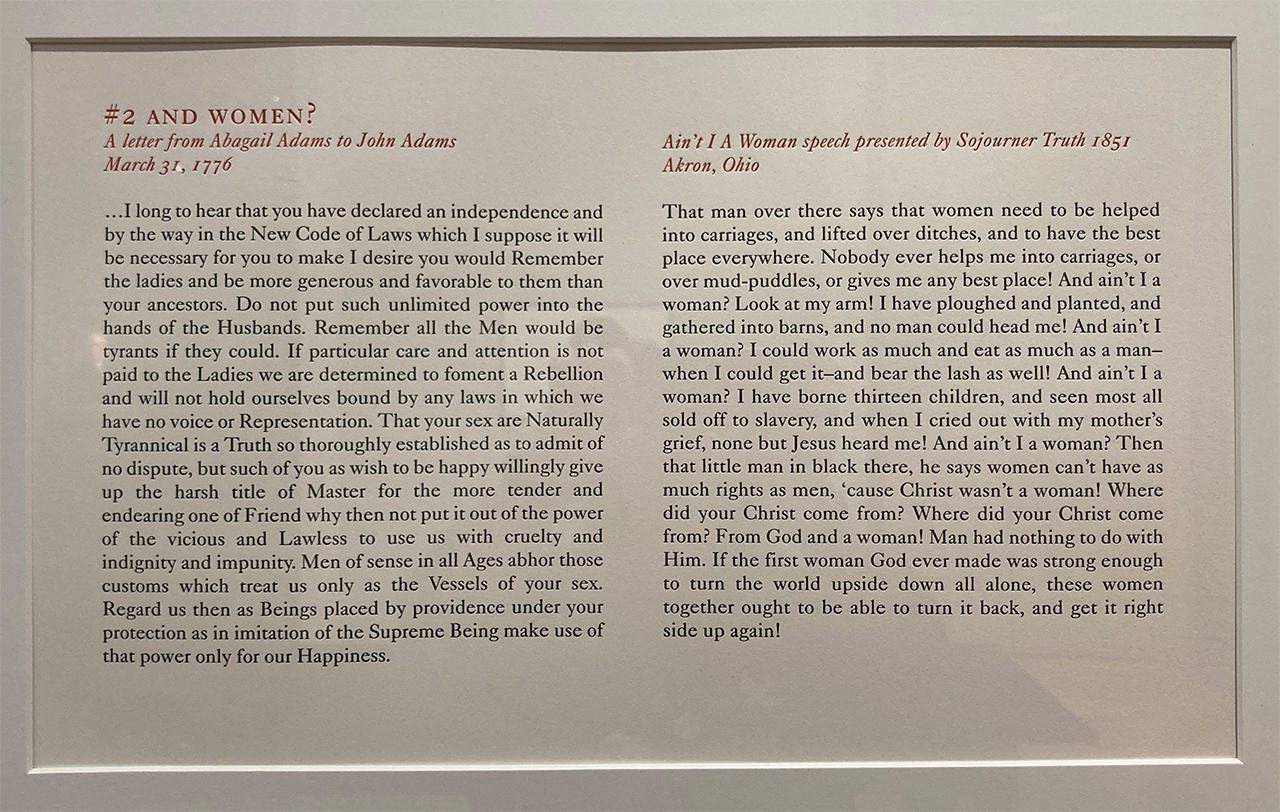
And Women?, Faith RinggoldAnd Women?, Faith Ringgold
Remember all the Men would be tyrants if they could. — Abagail Adams, 1776
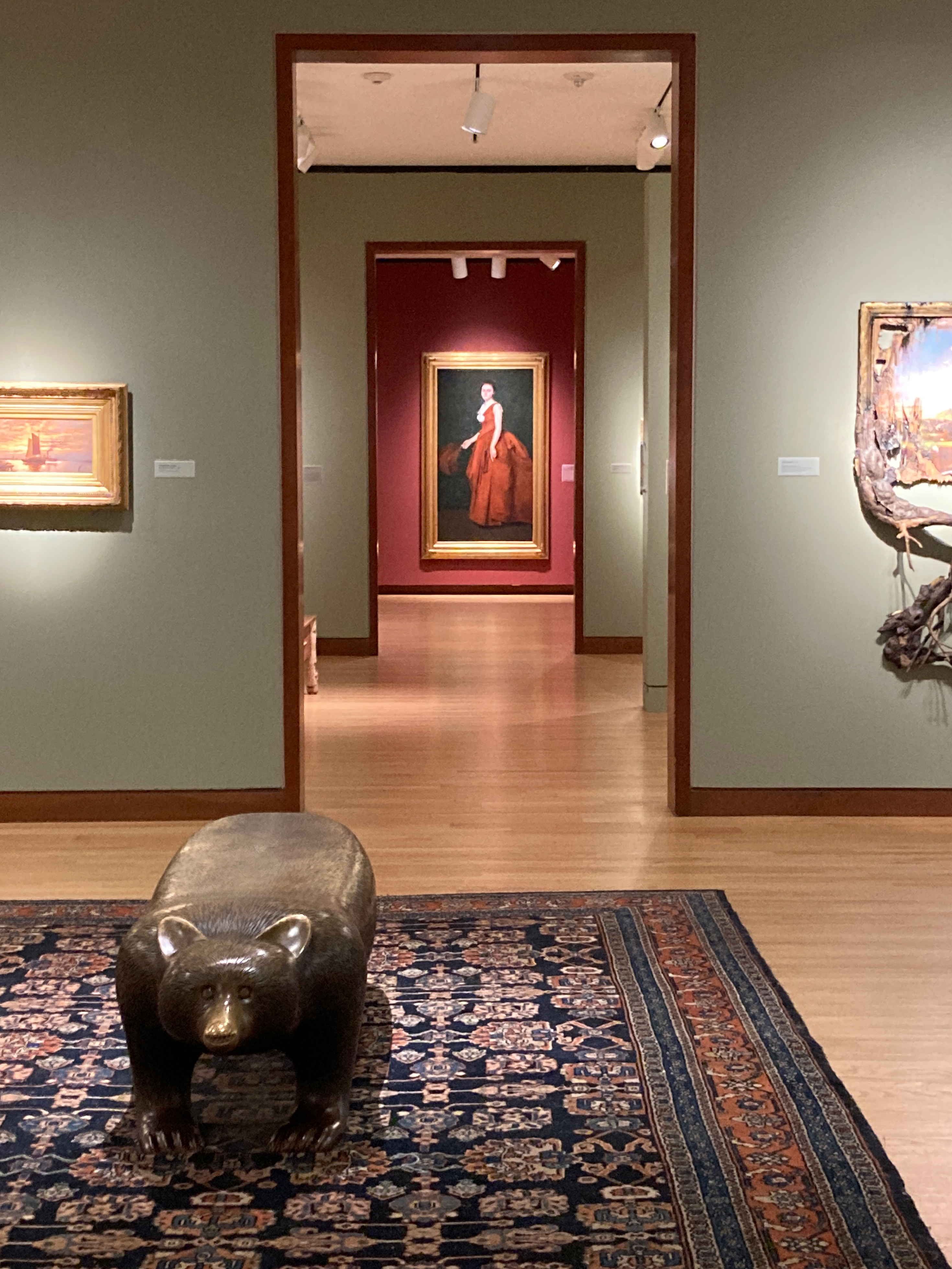
The coincidence of Portrait of Madame T in the gallery with the Grizzly Bear Bench seemed ironic, given the headlines of the day. Headlines which made Oscar Berger’s “Presidential Portraits” exhibit a non-starter for at least two museum patrons.
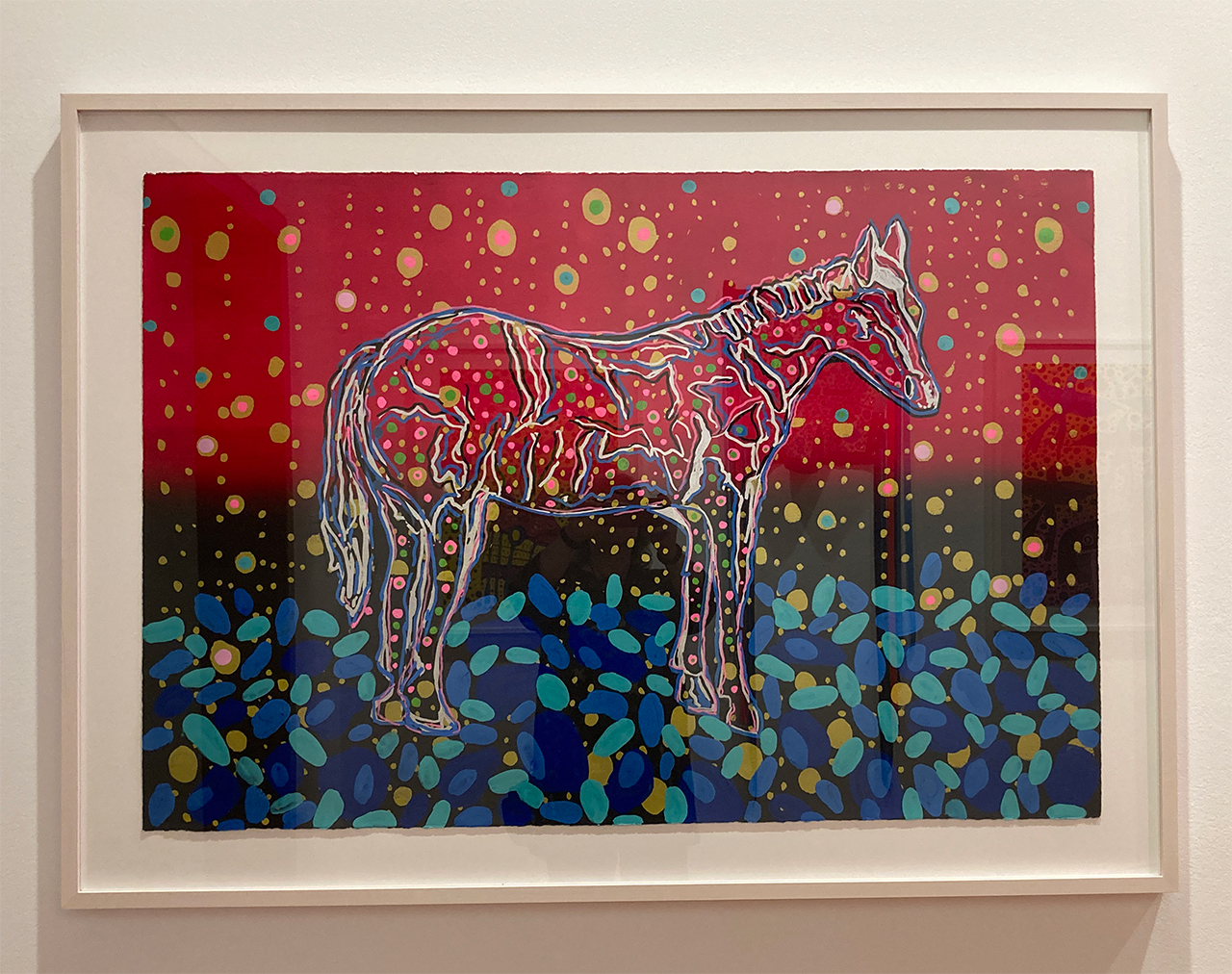
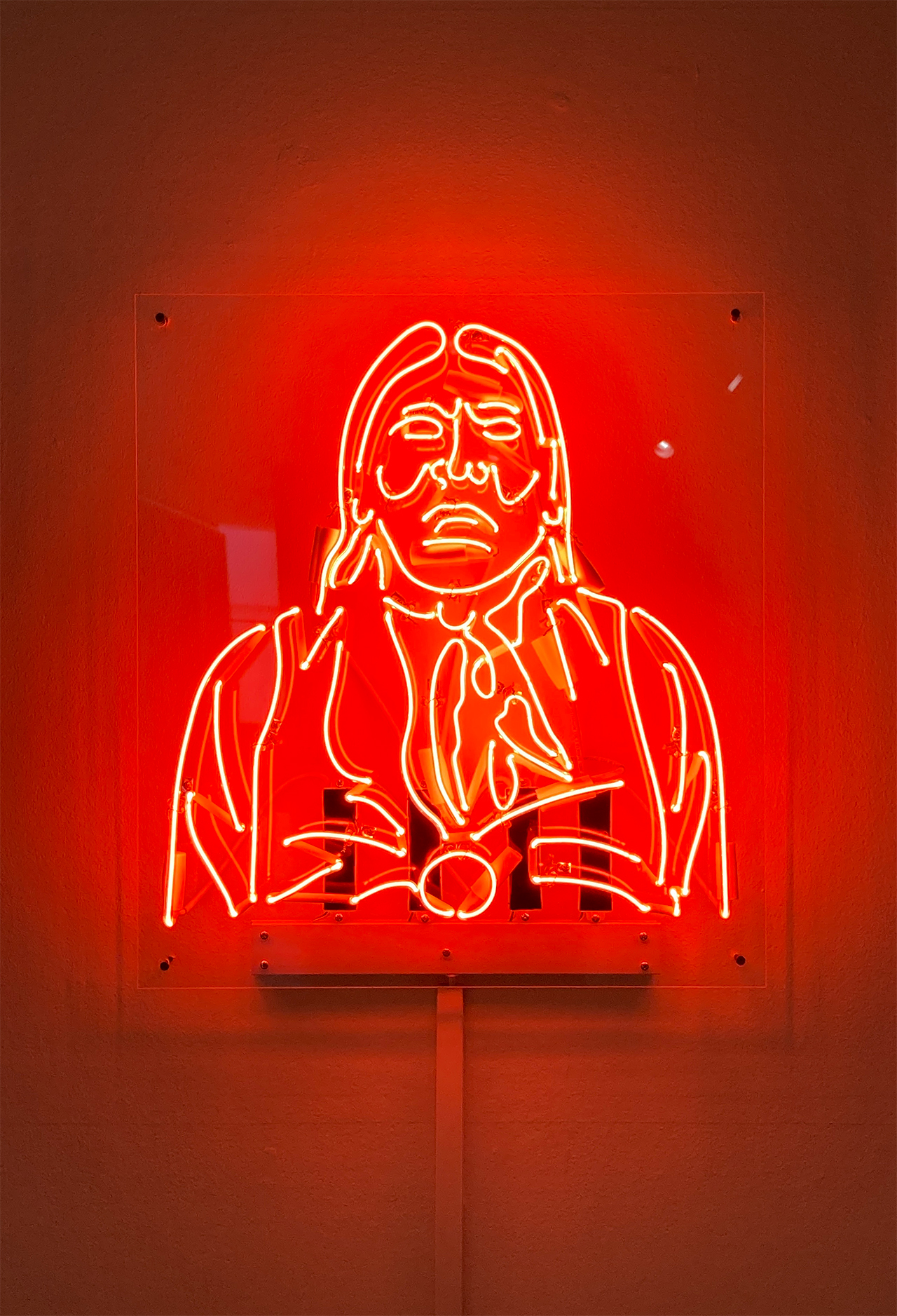
Hitchcock’s “Horse Songs” series called to mind the cruelty of the current president’s administration — from its desecration of public lands to the headlines about horse meat and horse slaughters, not to mention the hypocrisy of ostracizing immigrants while we’re all walking on Native American land.
Song for Lone Wolf, John Hitchcock, 2023Kiowa Chief Set’tainte (White Bear), John Hitchcock, 2024
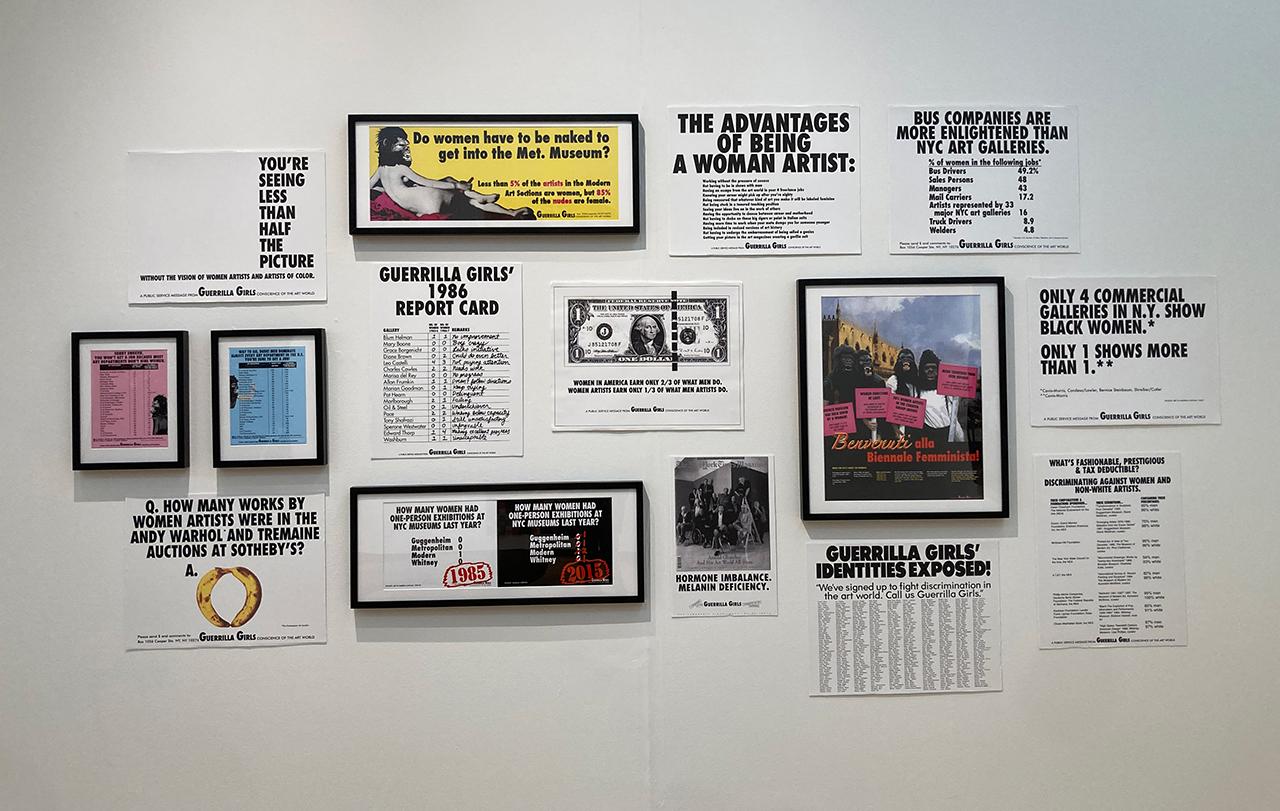
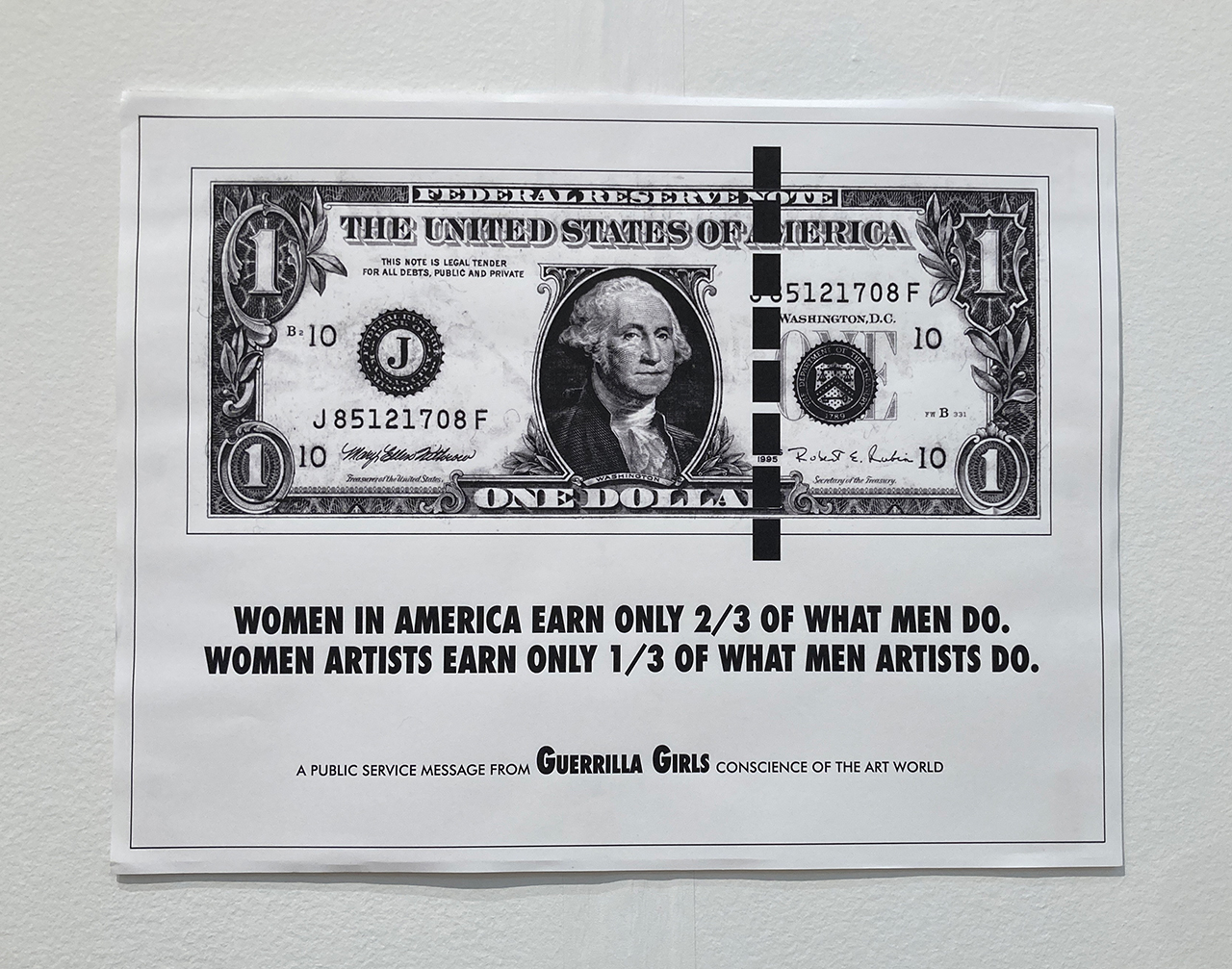
But it was the wall of Guerrilla Girls statistics from the 70s and 80s that brought me to literal tears. I remember Guerrilla Girls from my early zine-making days, when I was a twenty-something young woman making her way in a world that felt deceptively equal and evolved. A world that looks shockingly different here, now, where everything is splayed inside out, statistics for even more wrong reasons.
Guerrilla GirlsGuerrilla Girls
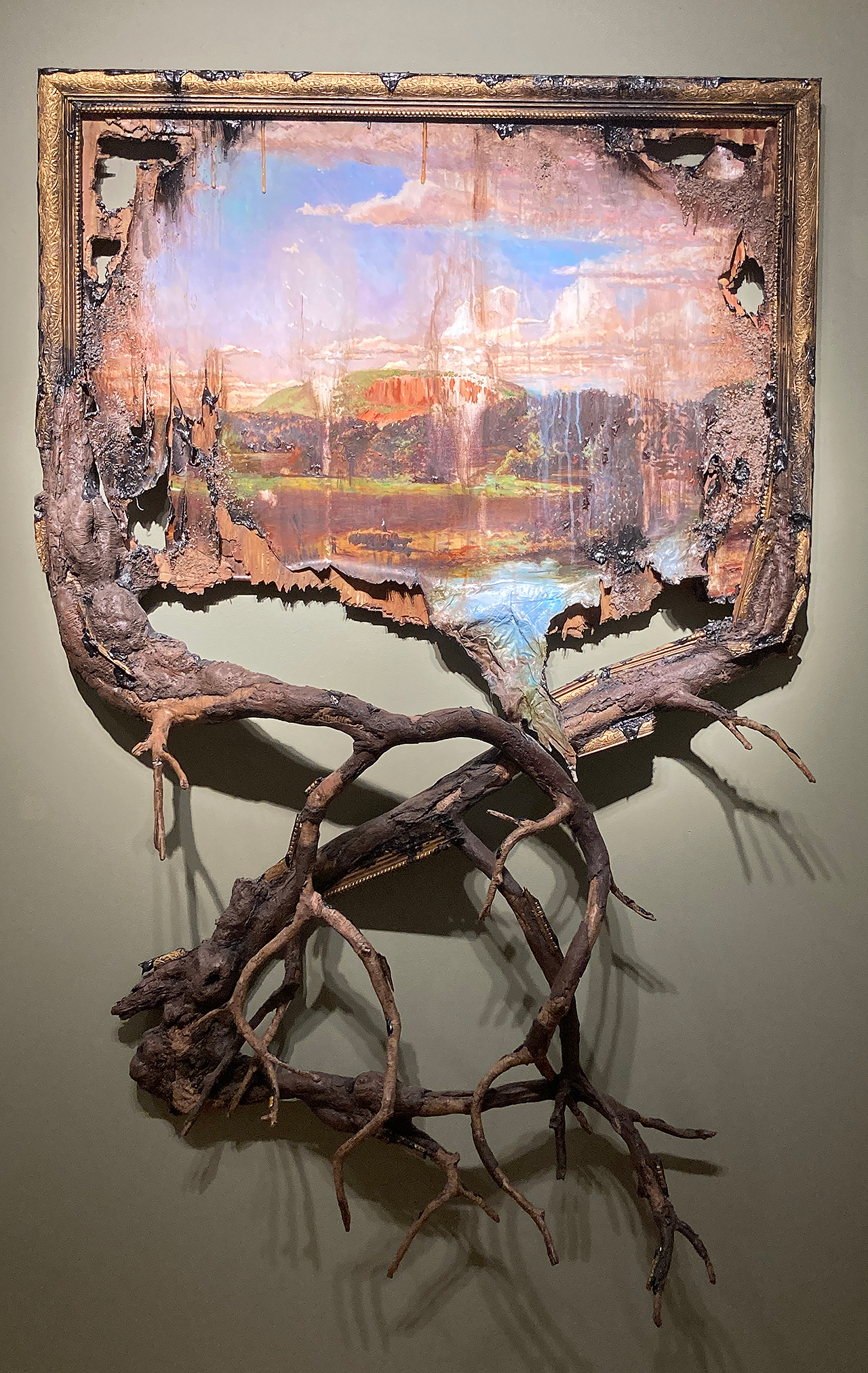
It’s not that any of this is new, really. These inequalities and injustices. They have been part of our history, here in America, since our founding days 250 years ago. It’s even written in to our beloved Constitution, and implied, perhaps in this shocking piece called West Rock with Branches by Valerie Hegarty which makes one ask: what are we? where do we come from? and what are we becoming?
The upcoming series of blog posts is in honor of ALL the women who can, who do, and who keep on doing – who persist – no matter what. They are part of “You Mean A Woman Can Open It,” MANIFEST (zine) #14.
You Mean A Woman Can Open It? 1953 Alcoa Aluminum advertisement.
Well, my boy, let’s get started, from “For me, the perfect hostess is the lady with the whip,” German Artist’s Book, 1960s.
Best Loved Nursery Rhymes Picture Book, circa 1950s.
Photos of Ryan Zinke from “Interior Secretary Orders Protester To ‘Be Nice’ During Visit To Bears Ears,” Huffington Post, May 2017.
Family group on a grave marker from Athens, National Archaeological Museum, Athens
“An American Girl in Italy,” (Ninalee Craig) by Ruth Orkin, 1951.
Mess of Fish, Paul Klee
The coat-stand (Porte manteau), by Man Ray, 1920.
Calliope, Augustin Pajou, 1763.
Vogue sewing pattern, 1980s.
“The history of the pussy bow blouse,” Bethany Armitage, CraftWorld, March 2019.
Atlas Was a Woman, by Céline (Melle-T), Deviant Art, 2007.
From the collection of Richard Freiherr von Krafft-Ebing (1840-1902) a German-Austrian psychiatrist + early sexologist, 1886.
“Nevertheless, she persisted” – an expression adopted by feminists, especially in the U.S. after the Senate voted to require Senator Elizabeth Warren to stop speaking during the confirmation of Jeff Sessions as U.S. Attorney General.
The upcoming series of blog posts is in honor of ALL the women who can, who do, and who keep on doing – who persist – no matter what. They are part of “You Mean A Woman Can Open It,” MANIFEST (zine) #14.
You Mean A Woman Can Open It? 1953 Alcoa Aluminum advertisement.
Well, my boy, let’s get started, from “For me, the perfect hostess is the lady with the whip,” German Artist’s Book, 1960s.
Best Loved Nursery Rhymes Picture Book, circa 1950s.
Photos of Ryan Zinke from “Interior Secretary Orders Protester To ‘Be Nice’ During Visit To Bears Ears,” Huffington Post, May 2017.
Family group on a grave marker from Athens, National Archaeological Museum, Athens
“An American Girl in Italy,” (Ninalee Craig) by Ruth Orkin, 1951.
Mess of Fish, Paul Klee
The coat-stand (Porte manteau), by Man Ray, 1920.
Calliope, Augustin Pajou, 1763.
Vogue sewing pattern, 1980s.
“The history of the pussy bow blouse,” Bethany Armitage, CraftWorld, March 2019.
Atlas Was a Woman, by Céline (Melle-T), Deviant Art, 2007.
From the collection of Richard Freiherr von Krafft-Ebing (1840-1902) a German-Austrian psychiatrist + early sexologist, 1886.
“Nevertheless, she persisted” – an expression adopted by feminists, especially in the U.S. after the Senate voted to require Senator Elizabeth Warren to stop speaking during the confirmation of Jeff Sessions as U.S. Attorney General.
You mean a woman can open it ? Easily — without a knife blade, a bottle opener, or even a husband! All it takes is a dainty grasp, an easy, two-finger twist-and the catsup is ready to pour.
IT BEARS REPEATING
The upcoming series of blog posts is in honor of ALL the women who can, who do, and who keep on doing – who persist – no matter what. They are part of “You Mean A Woman Can Open It,” MANIFEST (zine) #14.
You Mean A Woman Can Open It? 1953 Alcoa Aluminum advertisement.
Well, my boy, let’s get started, from “For me, the perfect hostess is the lady with the whip,” German Artist’s Book, 1960s.
Best Loved Nursery Rhymes Picture Book, circa 1950s.
Photos of Ryan Zinke from “Interior Secretary Orders Protester To ‘Be Nice’ During Visit To Bears Ears,” Huffington Post, May 2017.
Family group on a grave marker from Athens, National Archaeological Museum, Athens
“An American Girl in Italy,” (Ninalee Craig) by Ruth Orkin, 1951.
Mess of Fish, Paul Klee
The coat-stand (Porte manteau), by Man Ray, 1920.
Calliope, Augustin Pajou, 1763.
Vogue sewing pattern, 1980s.
“The history of the pussy bow blouse,” Bethany Armitage, CraftWorld, March 2019.
Atlas Was a Woman, by Céline (Melle-T), Deviant Art, 2007.
From the collection of Richard Freiherr von Krafft-Ebing (1840-1902) a German-Austrian psychiatrist + early sexologist, 1886.
“Nevertheless, she persisted” – an expression adopted by feminists, especially in the U.S. after the Senate voted to require Senator Elizabeth Warren to stop speaking during the confirmation of Jeff Sessions as U.S. Attorney General.
The upcoming series of blog posts is in honor of ALL the women who can, who do, and who keep on doing – who persist – no matter what. They are part of “You Mean A Woman Can Open It,” MANIFEST (zine) #14 from 2024.
Well, my boy, let’s get started, from “For me, the perfect hostess is the lady with the whip,” German Artist’s Book, 1960s.
“You bought yourself a job,” the 60-something male financial advisor said of my successful, 30-year-old business.
I didn’t think to explain the numerous companies I’d assisted over the years, the countless artists, editors, designers, and print shops I’d supported, or the millions of dollars I’d helped local nonprofits raise.
I didn’t think to ask if he would say the same about my male accountant and attorney – both of whom are sole proprietors like myself. No doubt they own “firms” or “practices.”
I didn’t think to say much, except curtly thank him for his time and leave.
For me, the financial planner was just one in a line of men for whom I’ve had NO COMMENT over the years – not the one who felt emasculated because I opened my own doors, the one who took credit for my success because he referred ONE client to me back in 1994, or the one who suggested my leadership abilities equated to a leather-and-whip fetish. I simply let my actions speak louder than any words I might conjure up in the moment of incredulity and outrage.
You see, my actions, always, have been based on the assumption that I can be whatever I want to be, and do whatever I want to do. It’s what my parents taught me. It’s what my role models in the 70s and 80s demonstrated for me – Mary Tyler Moore, Marlo Thomas, Judy Blume, Madeleine Blaise, Madonna, Jane Fonda. It’s what I aspired to, despite the cultural predictions for me in my birth-year horoscope.
And it’s how I’ve lived my life since I was old enough to make my own decisions about things – how I work and play, where I live and love, what I do and how. My own terms. My own expectations.
Of course, that doesn’t sit well with some folks. Mostly male folks of a certain genre. And there have always been attempts to keep me “in my place” – verbally, physically, financially, and so forth. But like so many countless women, I have persevered and succeeded, despite the obstacles and objections.
IT BEARS REPEATING
The upcoming series of blog posts is in honor of ALL the women who can, who do, and who keep on doing – who persist – no matter what. They are part of “You Mean A Woman Can Open It,” MANIFEST (zine) #14.
You Mean A Woman Can Open It? 1953 Alcoa Aluminum advertisement.
Well, my boy, let’s get started, from “For me, the perfect hostess is the lady with the whip,” German Artist’s Book, 1960s.
Best Loved Nursery Rhymes Picture Book, circa 1950s.
Photos of Ryan Zinke from “Interior Secretary Orders Protester To ‘Be Nice’ During Visit To Bears Ears,” Huffington Post, May 2017.
Family group on a grave marker from Athens, National Archaeological Museum, Athens
“An American Girl in Italy,” (Ninalee Craig) by Ruth Orkin, 1951.
Mess of Fish, Paul Klee
The coat-stand (Porte manteau), by Man Ray, 1920.
Calliope, Augustin Pajou, 1763.
Vogue sewing pattern, 1980s.
“The history of the pussy bow blouse,” Bethany Armitage, CraftWorld, March 2019.
Atlas Was a Woman, by Céline (Melle-T), Deviant Art, 2007.
From the collection of Richard Freiherr von Krafft-Ebing (1840-1902) a German-Austrian psychiatrist + early sexologist, 1886.
“Nevertheless, she persisted” – an expression adopted by feminists, especially in the U.S. after the Senate voted to require Senator Elizabeth Warren to stop speaking during the confirmation of Jeff Sessions as U.S. Attorney General.
It was an escape of connections — meaning an escape to connections, about connections.
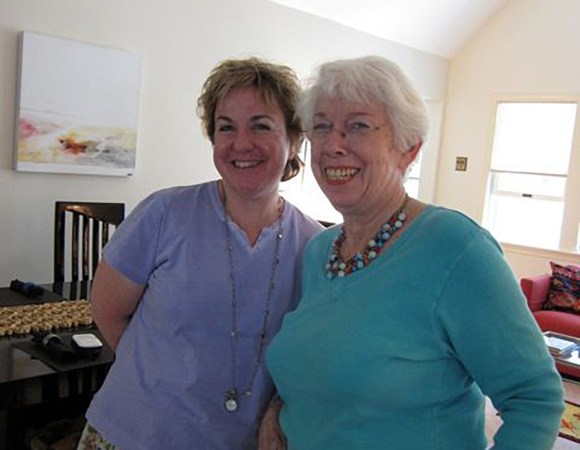
In Northampton, Massachusetts, I re-connected with my college roommate Melissa, mere miles from where we met in Amherst nearly 30 years ago.
Jen and Melissa
After a meal and the start of a conversation that would continue on until morning, we enjoyed an evening with Krishna Das at First Churches of Northampton, a stunning backdrop for a sacred concert of Sanskrit chanting.
Krishna Das, First Churches of Northampton
My breath rises within me, the breath of the heart. The sweet breath. The sacred breath leads me in.
Krishna Das
The next day, a visit with friends Judith and Frank Bruder, and the gift of a conversation that unfolded over six hours—food, books, writers, words (and silence), how we process…how we love. “To me the give-and-take of conversation is the breath of life,” Judith writes on her blog, Touch2Touch, which served as our introduction several years ago. How wonderful its tagline: “Only connect!” Amen.
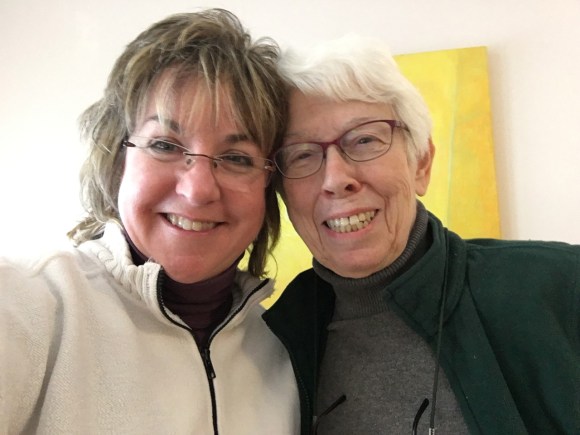
Jen and Judith
Frank reading one of the first copies of LOOK UP!, Jen’s new book
By definition, an adventure is “an exciting or dangerous experience, an undertaking usually involving danger and unknown risks.” But I prefer the less foreboding interpretation: “an exciting or remarkable experience.”
With that in mind, I will tell you that one of my recent exploits involved many of the things one might expect to find on an adventure: exotic foods, beautiful scenery, interesting conversation, and a joyful sense of having been someplace new and exciting with good companions.
The place? Western Massachusetts. The adventure? A get-together with my friends Judith and Frank Bruder for dim sum…and then some!
When they heard I’d never had dim sum, they were quick to insist it be included on the iterinary, so off to Oriental Flavor in Amherst we went!
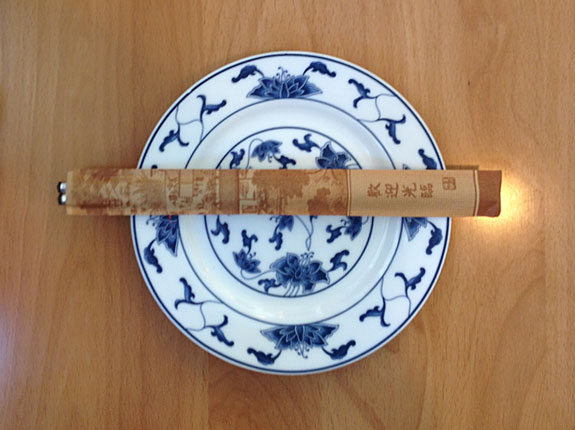
Plate after steaming plate arrived at our table — crystal shrimp dumplings, crispy shrimp balls, pork shu mai, steamed tofu crepes — while we enjoyed a lively conversation about languages, food styles, trying new things and chicken feet.
Thankfully, it was time for dessert! And we happily devoured two delicate egg tarts, and a pair of delicious omochi sticky rice balls filled with lotus paste and fried with seasame seeds.
A ride through beautiful late-spring farmlands on a phenomenal Kodachrome day found us at Flayvors of Cook Farm in Hadley for three scoops of farm fresh ice cream. Chocolate Almond Chip! Black Raspberry Chip! Hadley Grass! What’s Hadley Grass ice cream? A sweet, pale-green concoction made from local, profusely-growing asparagus.
Then it was back to Judith and Frank’s for continued conversations about good books and good writing, good food and good friends.
In her book You Learn by Living: Eleven Keys for a More Fulfilling Life, Eleanor Roosevelt wrote: “And the purpose of life, after all, is to live it, to taste experience to the utmost, to reach out eagerly and without fear for newer and richer experience. You can do that only if you have curiosity, an unquenchable spirit of adventure.”
It was with both curiosity and a spirit of adventure that we ended our day by attempting our first-ever group selfie—here, for your enjoyment!
(To read more about our day, please see Judith’s post “To Touch the Heart.”)
The blogosphere is a pretty amazing place. Consider this: on a regular basis, I open up WordPress, put down in words and pictures a conversation that is on my mind, and hit PUBLISH. Those very steps connect me instantaneously to all of you—my “Followers” and the greater blogging community.
Like that! I hit PUBLISH, and someone in Slovakia is reading about my trip to Cape Cod, and someone in Mongolia is taking a walk with me in the woods of Connecticut!
Like that! We are communicating—you and I and people from at least 100 other countries! Reading, commenting, sharing in the thoughts and ideas we exchange here.
Like that! I am sitting in an Italian pastry shop in Northampton, Massachusetts feasting on decadent, sugary treats with a fellow blogger I feel like I’ve known forever.
Judith and I meet and immediately pick up our conversation where we left off yesterday, although we haven’t seen or spoken with each other since last July. We do this easily, because our blogs are part of our conversation — almost daily.
An assortment of pastries sits on the table, alongside an assortment of topics: technology, writing, books, spirituality, photography, food. It’s no surprise — but a great surprise, at the same time — that she and I find common threads in our thoughts, our interests, and what we want to talk about today. By their very nature, blogs attract like-minded souls, and our tête-à-tête bears witness to that fact.
We immediately come to the agreement that the word “conversation” best fits this synergy that happens between bloggers, and joyfully continue with ours — animated and face-to-face.
We were driving along a road in Western Massachusetts on Sunday when she handed me a word.
“The first time you do something is so special,” she told me me, “the Japanese have a separate word for it…hajimete.”
Hajimete: for the first time.
I love that this word was part of Sunday’s conversation, because Sunday’s conversation was the first time she and I have ever spoken to each other, face to face.
She is the wise and worldly Judith Bruder, author of two wonderful blogs: A View from the Woods and Touch2Touch. We have been sharing words with each other since December 2010, as readers and writers, thinkers and travelers. But Sunday was our first opportunity to meet and continue the conversation in person.
And that we did, from the first open-the-door moment into a sunny, summer afternoon for lunch, a walk in the park, and a Sunday drive past inspiring views.
As the sentences and sidebars unfolded before us in real time, it felt as if we had been doing this forever — sharing our stories, finding similar paths, learning new things from each other. There was a sweet and marked familiarity to the day.
That is the beauty of word-sharing — whether it’s these blog posts or emails, letters or poems, prose or lyrics. Word-sharing does not require physical presence because it comes from the heart. What you share — what we share — connects our spirits wherever and in whatever form we happen to be.
That Judith and I found the opportunity to be live and in-person was a true gift — and a connection I hope will continue here and there.
[ Click here to read more about our visit on Judith’s blog Touch2Touch. ]
• • •
Photo courtesy of Judith’s husband, Frank Bruder, with whom additional, delightful words were shared.
We are “talking” about enlightenment this morning. It is barely 10:00 a.m., and our talk evolves as pieces of thought shared in a comment field of my friend Judith Bruder’s blog.
“Are we, every one of us, capable of extraordinary beauty, and wisdom, and kindness—if only we realized it?” she asks. “Is that, perhaps, what enlightenment ultimately is—realization of the oneness and infiniteness of everything, including ourselves?”
“I believe we are,” I say, “but there are so many distractions between here and “realized.” I suspect enlightenment needs great expanses of quiet, reflection and disconnection in order to take root and flourish.”
Another friend, this morning, is talking about Thoreau and our important and necessary connection with nature as a source of joy.
But a cicada interrupts my thoughts as I read her words, and I glance up and notice how the morning sun dapples the grass outside the window. I suspect I have not looked up from this whirring machine since the yard was shadowed in last night’s dreams.
This is not the disconnection to which I was referring.
Twenty minutes later, I am in the woods, walking a path I have not explored since summer set upon us with its mid-July ferocity.
When I left the house, I imagined immediate connection here—to pick up where we left off in June, with quiet observation and reflection.
But there are bugs. Lots of bugs.
I have visited with the metaphor of these bugs before—as pesky as my thoughts, as persistent as my worries, as distracting as life’s picayune interruptions.
With the incessant buzzing about my head, how I am ever to find that cherished space and quiet I was seeking?
“Fine,” I say out loud, in surrender to the swarm of gnats. And pay attention, instead, to the rhythm of my swatting—two hands at first in a ballet above my head, then alternating them, left and right.
I walk this way for close to an hour—hands like a windmill through a pine forest into a warm sunny meadow and up to the clearing where the woodpecker sings. At the footbridge, I watch two dragonflies dance, then walk carefully up the rocky slope and down to where the stream crosses the path.
I walk fast, in that way we do when we have a goal to obtain. Oblivious, eye on the prize. All the while swatting with noble attempts to ignore and tune out the…damn…bugs?
Where are the bugs?
Suddenly, they are gone.
I stop and breathe deeply to slow my pace. My arms rest at my sides, and I can feel a hint of coolness about my body. The path is quiet—except for a faint call of a Warbler off in the distance.
Just then, a wide band of sunlight pushes its way though the treecover and lights up the forest around me, until it sparkles and I weep.
“I think perhaps rooting and flourishing happens in cherishing the significant flash,” my friend responds on her blog. “In short — once my long blindness lifts, SEEING simply follows.”
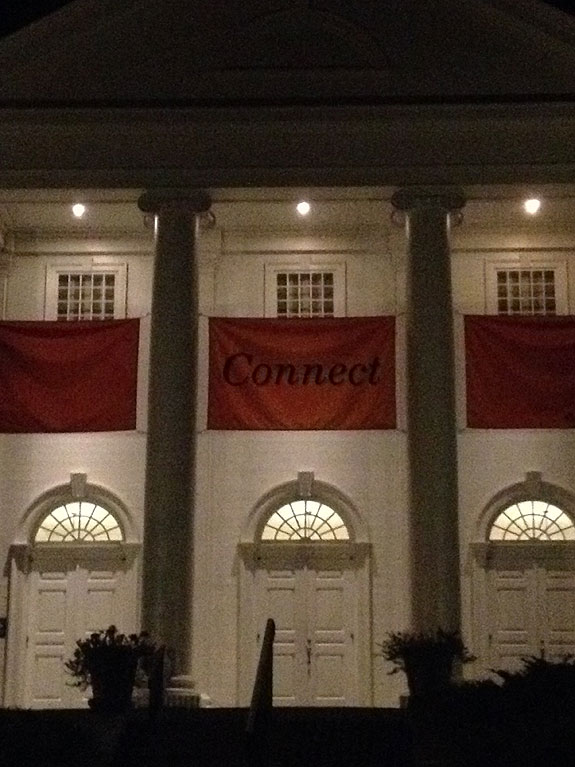
My friend Judith Bruder and I met on the internet many years ago, back in the early days of blogging, when WordPress was coming of age, and Julie was cooking Julia. I had just started my blog, Random Acts of Writing, and Judith was posting at Touch 2 Touch/A View from the Woods with the E.M. Forster quote as her tagline: “Only Connect!” We liked each other’s posts, commented now and then, remarked on shared interests in writing, food, and France.
But it was her frequent photoblogs about Look Park in nearby Northampton, Massachusetts that sparked my curiosity one summer, and we agreed to meet in person. One visit begot another. There were long conversations at her dining room table. Visits to local museums and restaurants. Cooking lessons. Celebrations. Consolations. We weathered milestones, heartbreaks, and the entirety of the pandemic.
It was during the pandemic that Judith came up with the brilliant idea to start a podcast. As she explained it:
“I knew that for me, the physical danger was less than another danger, the death of the spark which is the beating heart of the life force. That’s what had kept me young and vital until 85, my age when the world stopped. I had to find something that could keep the me that really counted, my spirit, my life force, alive.”
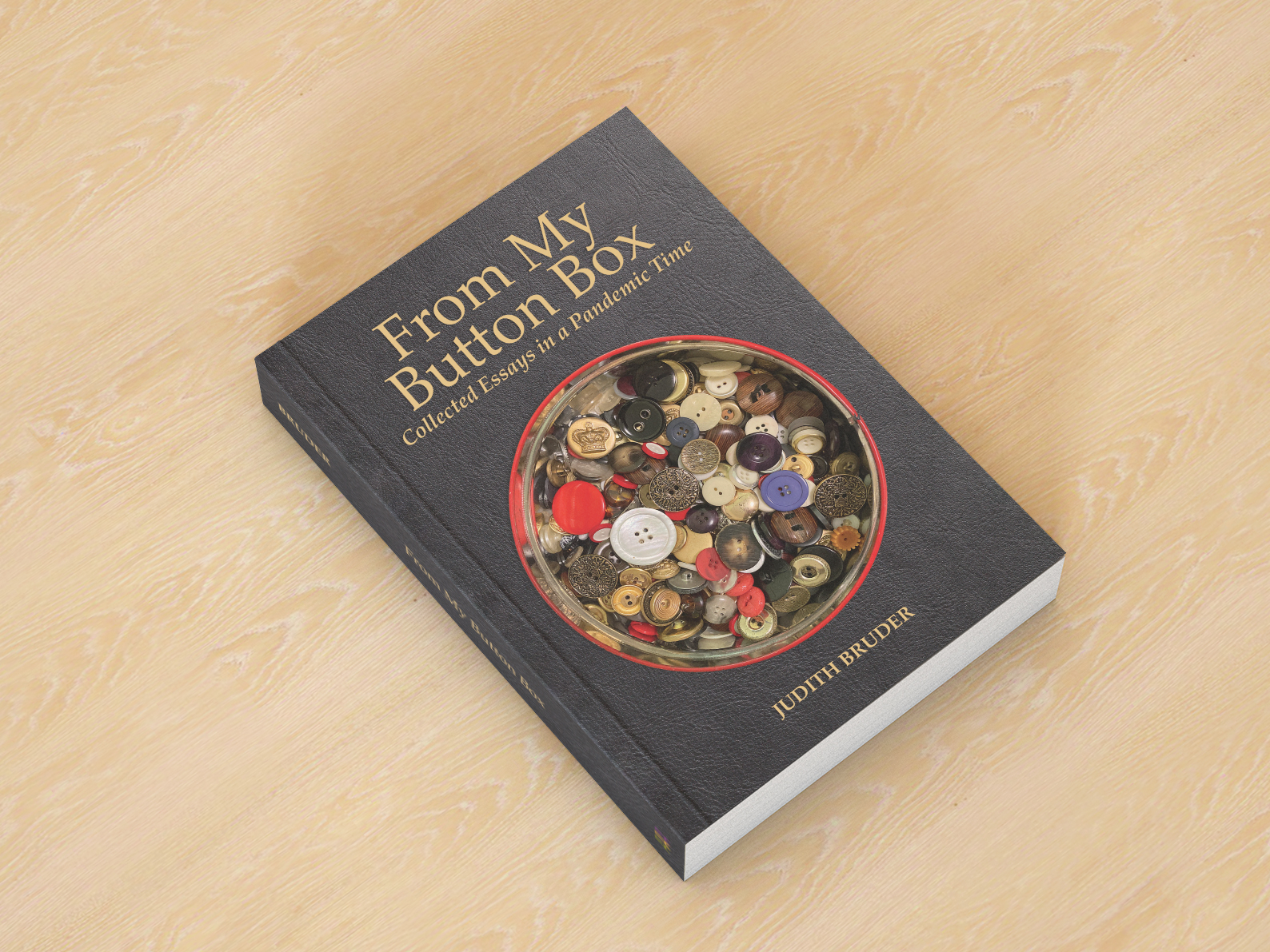
Her podcasts, called From My Button Box, kept her, me, and her varied listeners engaged and thriving through the roller coaster months of 2020.
In 2023, I had the privilege of helping my friend turn those podcasts into her third published book, From My Button Box: Collected Essays in a Pandemic Time. Published by Three Chairs Publishing, it’s a collection of her favorite podcasts, presented in a unique hybrid format: read the essays or listen to the original podcasts using individual QR codes throughout the book.
It’s a collection I’ve turned to often in the past week since my dear friend passed away on August 26, 2026. Reading her wise words and hearing her voice brings me as much comfort in my grief today, as it has over the past 15 years of our friendship.
Judith was a writer, a lecturer, and a scholar; a graduate of Wellesley College who had been a campus minister at Fordham University in Manhattan. At home she was a wife then widow, mother, grandmother, and proud great grandmother. She considered herself a freelance philosopher and a modern-day anchoress. She was a wise and steadfast friend to many, and those of us who knew her were truly blessed.
She will be missed and remembered.
Please stayed tuned for a series of blog reposts from Judith and my early blog connections, reposting here in Random Acts of Writing in the coming week.
We all have those moments…a health crisis, a family situation, or an unexpected turn of events that sends us swiftly to the sidelines. And we wait there until we’re ready to get back in the game, until we feel steady and strong enough to step into the routine again.
As many of you know, I had knee replacement surgery last fall. And while my recovery is moving along nicely, one of the unexpected side effects has been a lack of creative output and projects.
When I get frustrated by that, I am reminded of my friend Judith’s advice last summer — that the recovery is the project. That sometimes, those life moments mean that everything else, including our creative pursuits, might need to take a back seat to the larger task at hand.
But, as photographer Joshua Kissi noted: “sometimes the creativity is in the rest.” And it turns out Creative Rest is a thing!
In her book Sacred Rest: Recover Your Life, Renew Your Energy, Restore Your Sanity, Saundra Dalton-Smith identifies seven types of rest: physical, mental, emotional, social, sensory, spiritual, and creative.
“Creative Rest,” she explains, “is allowing white space in your life and giving room for your creativity to show up. Creative Rest lets you focus on your basic need for wonder.” It “involves giving your mind a deliberate break to allow your creativity to regenerate.”
While Dalton-Smith’s ideas for Creative Rest do not include knee surgery, she does suggest things like enjoying coffee in a new location, spending time in a museum, or people-watching in a park — places where you can let “your mind wander off-leash for a while.”
Creative Rest is a place of wondering, wandering, and waiting.
Which reminds me of a poem I wrote several years ago while waiting for a friend to arrive at the train station. Called “Places of Waiting” (see below), it talks about the fertility of waiting, the possibility contained in nothingness, and the expansive nature of these life pauses.
Summer is filled with opportunities for pauses, like a moment in the garden or a walk along the beach. Remember to allow time for waiting — and rest — in between all the busy-ness.
Happy Summer!
Love, Jen
Places of Waiting
I love these places of waiting this quiet axis of the world a point around which things spin he on his way there and she on hers there they, together, embrace and part or run, race, return and I, here, silent silent and of no consequence to their what-comes-next nor to my own, really I am here-and-now, a great pause a smudge of time a nothingness into which pours everything peace, poetry, god
EXPLORATIONS
One of my favorite things about putting together Creatively Speaking is the wandering exploration of topics and things to share with you, like…
Joshua Kissi, who insists on “telling stories by any medium necessary.” Kissi is a Ghanaian-American creative entrepreneur specializing in photography and filmmaking, based in New York City. To see his work, visit www.joshuakissi.com.
Questlove is a culinary entrepreneur, a New York Times best-selling author, and a musician, who you might know from the Tonight Show with Jimmy Fallon. He’s the author of the book Creative Quest — “a must-read guide for all creatives” — which I just borrowed from my local library. For more, visit questlove.com.
Digging deeper into the concept of creative resets, I discovered Sacred Rest, the Saundra Dalton-Smith book I mentioned above. She is a physician, a work-life integration researcher, and the founder of Restorasis, a professional development agency dedicated to restoring well-being in the workplace. In addition to the book, you can sign up for a free Sacred Rest Challenge with daily prompts and suggestions for finding rest.
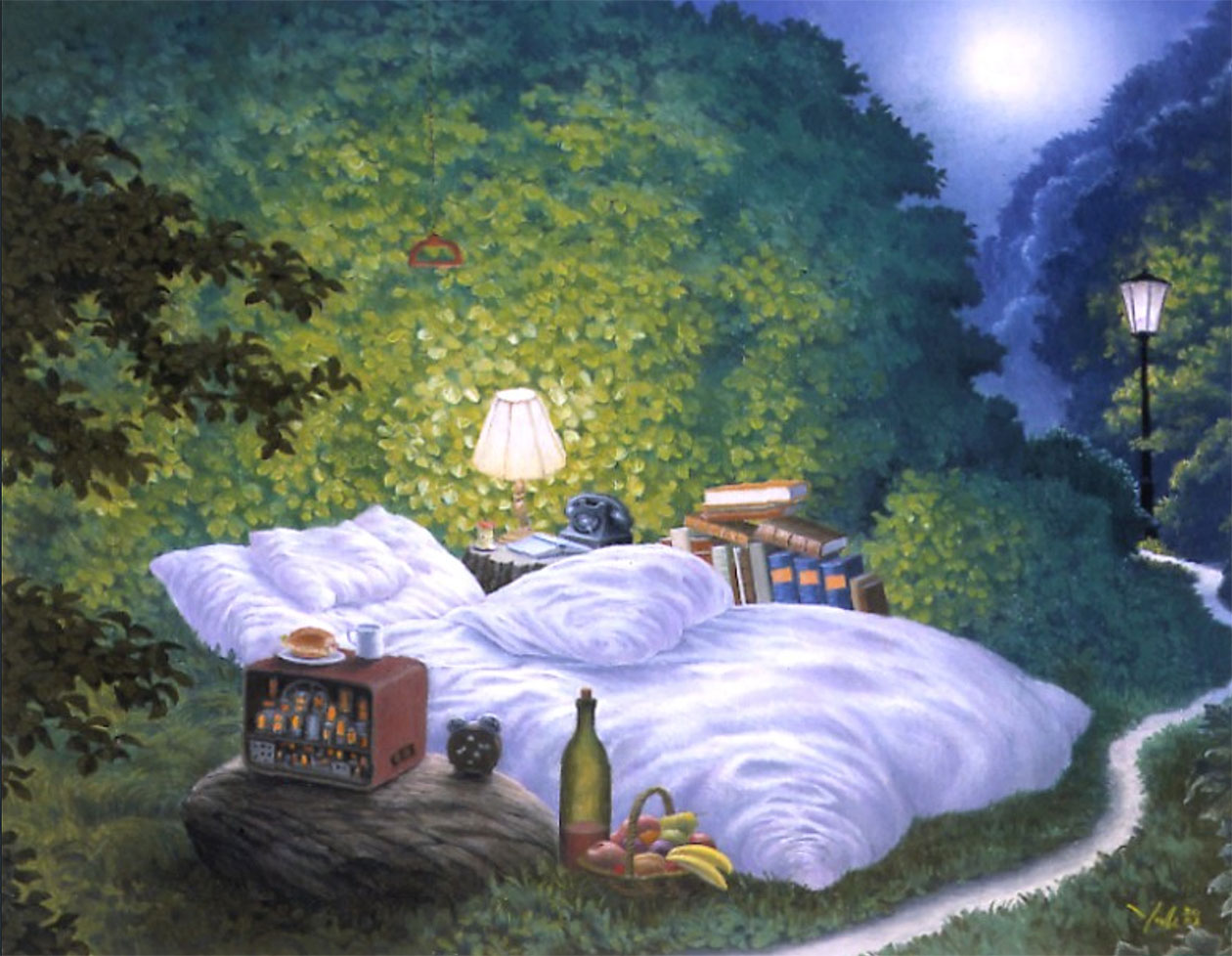
I love the painting at the beginning of this issue of Creative Speaking: The Moonlight Bed, by Jacek Yerka. Yerka is a surrealist painter from Poland. His work, which you can see on his website yerkaland.com, is other-worldly.
When I was in grade school, I used to tell a silly story that went something like…
Once upon a time, there was a little universe. And in that universe, there was a little solar system. And in that solar system, there was a little planet. And on that planet, there was a little continent. And on that continent…
The story — which I could see in my mind — got closer and closer, periscoping in on a little house and maybe a little family or a little girl. I don’t remember the ending, if there even was one.
I found myself thinking about that as I was careening up I-95 for what creativity guru Julie Cameron might call an Artist Date.
“An artist date is a block of time, perhaps two hours weekly, especially set aside and committed to nurturing your creative consciousness, your inner artist. In its most primary form, the artist date is an excursion, a play date that you preplan and defend against all interlopers. You do not take anyone on this artist date but you and your inner artist, a.k.a. your creative child. That means no lovers, friends, spouses, children – no taggers-on of any stripe.”1
It was my first solo adventure since my knee replacement surgery four months ago, and I suspect I was breaking Artist Date rules. First of all, I was rushing to get there. It felt more like an errand run or a have-to-do than a creative outing.
Second, there were all sorts of interlopers — the client with erupting mental health issues, the pedophile president, the elementary schoolgirls bombed in Iran, the words of John Lennon — going round and round in my head.
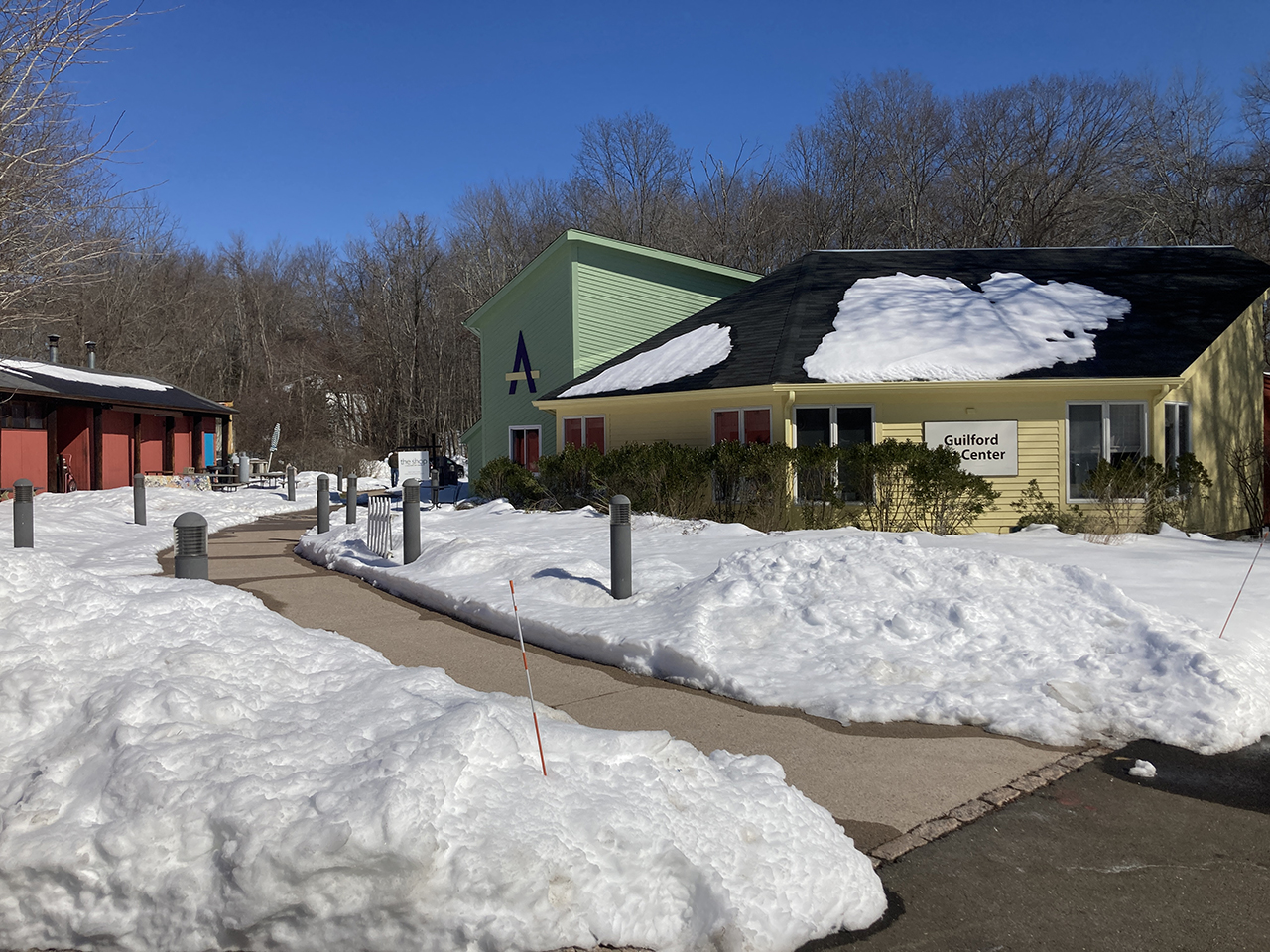
Nonetheless, I kept driving, thinking about the little universe and all of its big problems on my way to the Guilford Art Center, which was hosting an exhibit called, ironically, CIRCULAR THINKING.
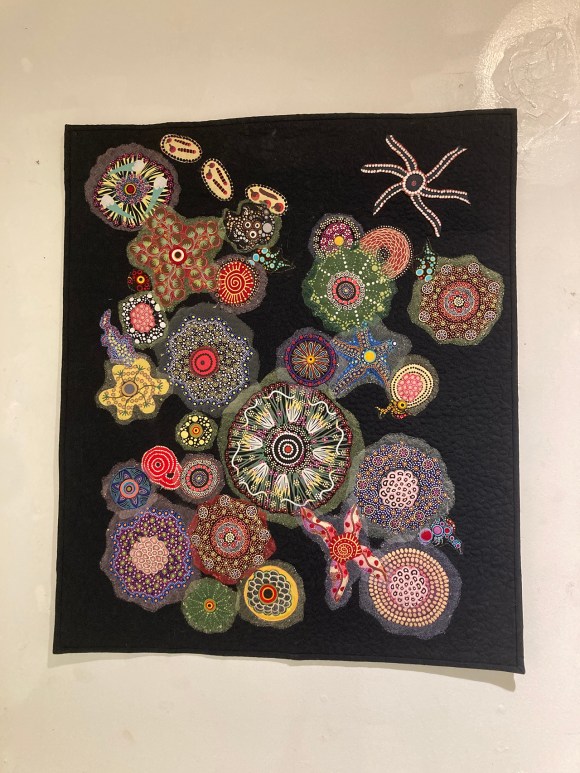
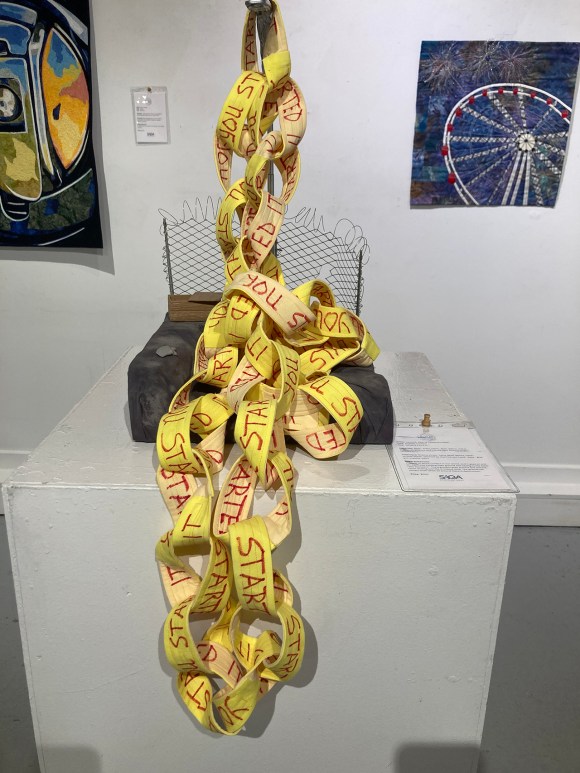
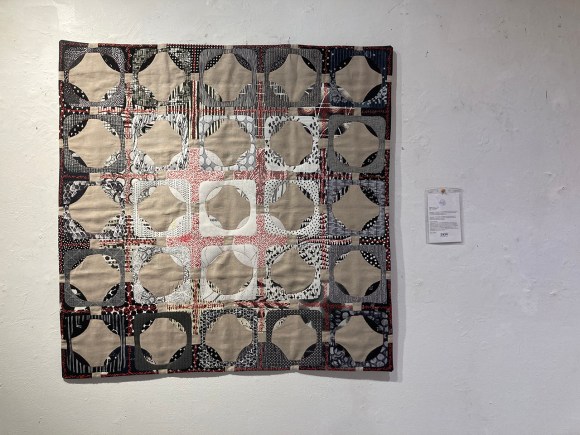
CIRCULAR THINKING, featuring fiber art created by the Studio Art Quilt Associates, was “designed to explore the varieties of meanings, images, and experiences evoked by the circle…a shape, a symbol, a concept, or a metaphor.”2 The exhibit had been on view since the beginning of the month, and I was happy to slip into the colorful space on its last day.
So much color that I thought, for a moment, I might escape our little world and lose my interlopers all-together.
But there was a shadow of RFK across Hope Barton’s quilt Why We Need Vaccines; Lynne Allen and Cassandra Allen mentioned Endless Conflict, and Martha Wolf asked me to read between the lines of A Newspaper to see the loss of our black and white reality.
Why We Need Vaccines, Hope Barton
Endless Conflict, Lynne Allen and Cassandra Allen
A Newspaper, Martha Wolf
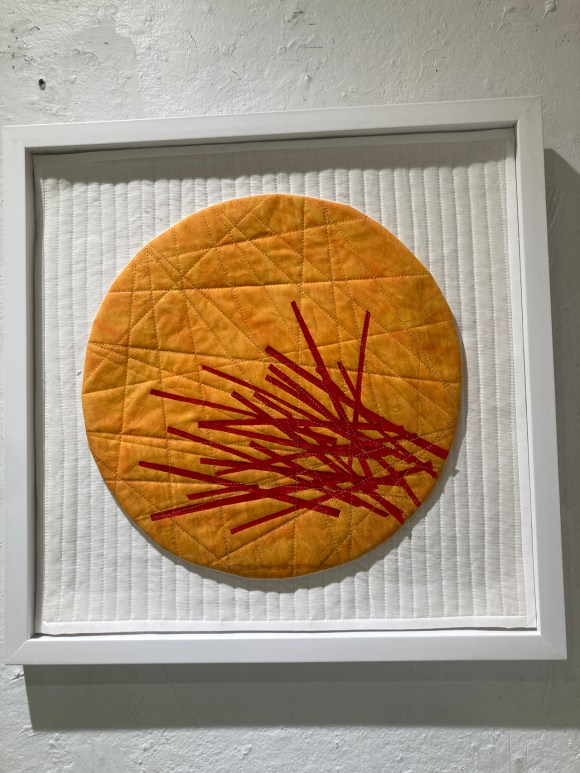
I was buzzing. Hurried. Preoccupied. Definitely not of a “date” mindset. But then a bright bold sun called out and Catherine Lavoie’s piece called Shattered explained…
“Red slashes represent that moment when you finally admit your life is shattered and you need to make changes. The golden background fabric represents the glow of Hope that you can do this.”
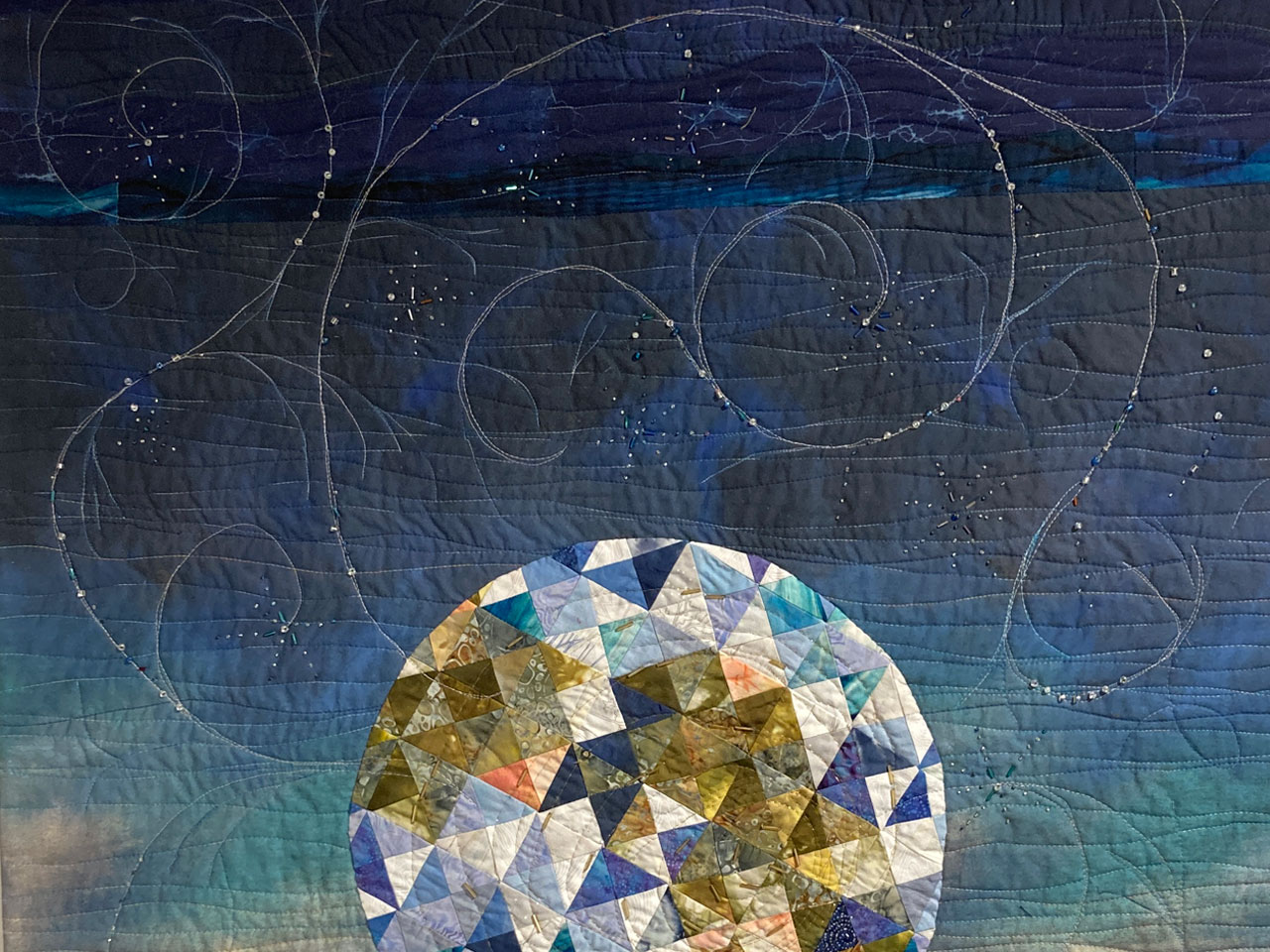
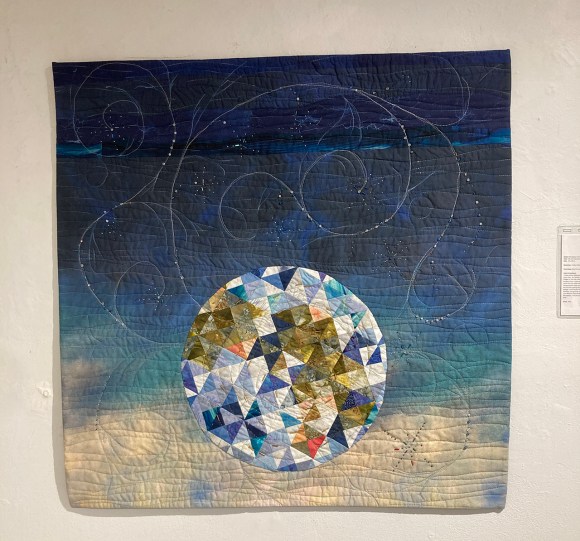
Then Rita Hannafin’s sparkling quilt reminded me that We Are Stardust, “part of the swirling, timeless energy that continues life.”
And slowly, slowly, slowly, I started to come back to myself. Settle in. A little.
Shattered, Catherine Lavoie
We Are Stardust, Rita Hannafin
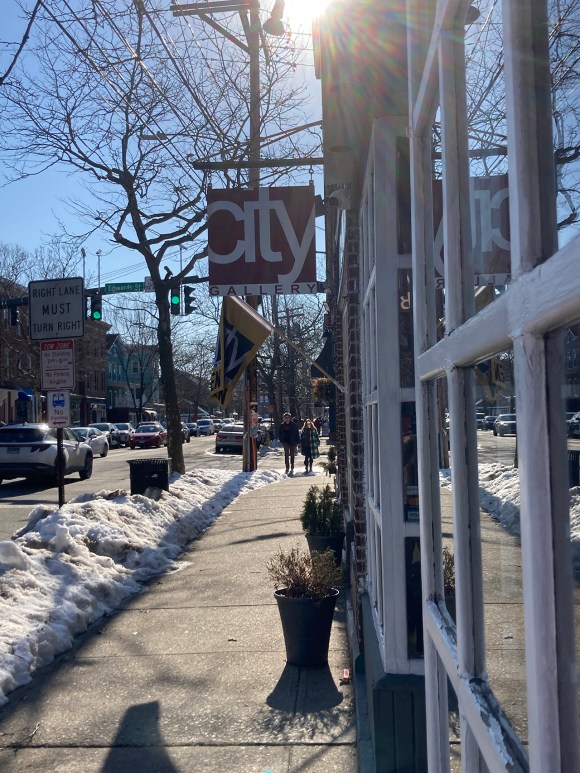
I wandered through the rest of the gorgeous exhibit, browsed the amazing collection of gifts in The Shop — oh my! — then headed on to my next stop, City Gallery in New Haven.
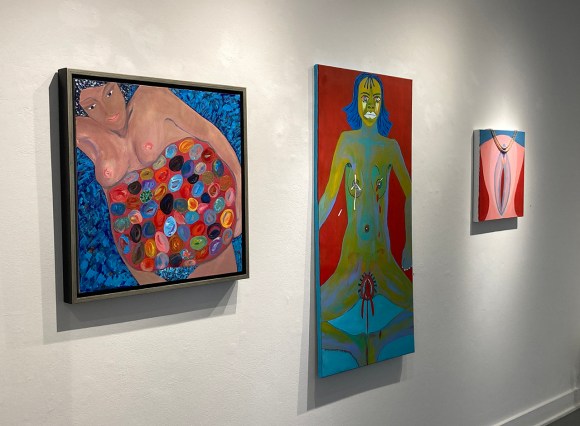
City Gallery was hosting painter Beatriz Olson and her solo exhibit UNMUTED: THE RETURN OF COLOR, “a body of work that traces her journey back to voice, embodiment, and the full spectrum of color that once lay quiet beneath the demands of culture, profession, and expectation.”3
Beatriz is an expressive artist, whose work “involves holistic approaches to healing the body mind and soul distress by using color, form and lack thereof to process emotions.”
Serendipitously, she was gallery sitting for the afternoon, so not only did I get a personal tour of the exhibit, I had the chance to talk with Beatriz about her work and the stories behind the paintings, including The Great Mother and Courage.
The Great Mother, Uncomfortable Truths, Ubabashed – Beatriz Olson
Courage, Beatriz Olson
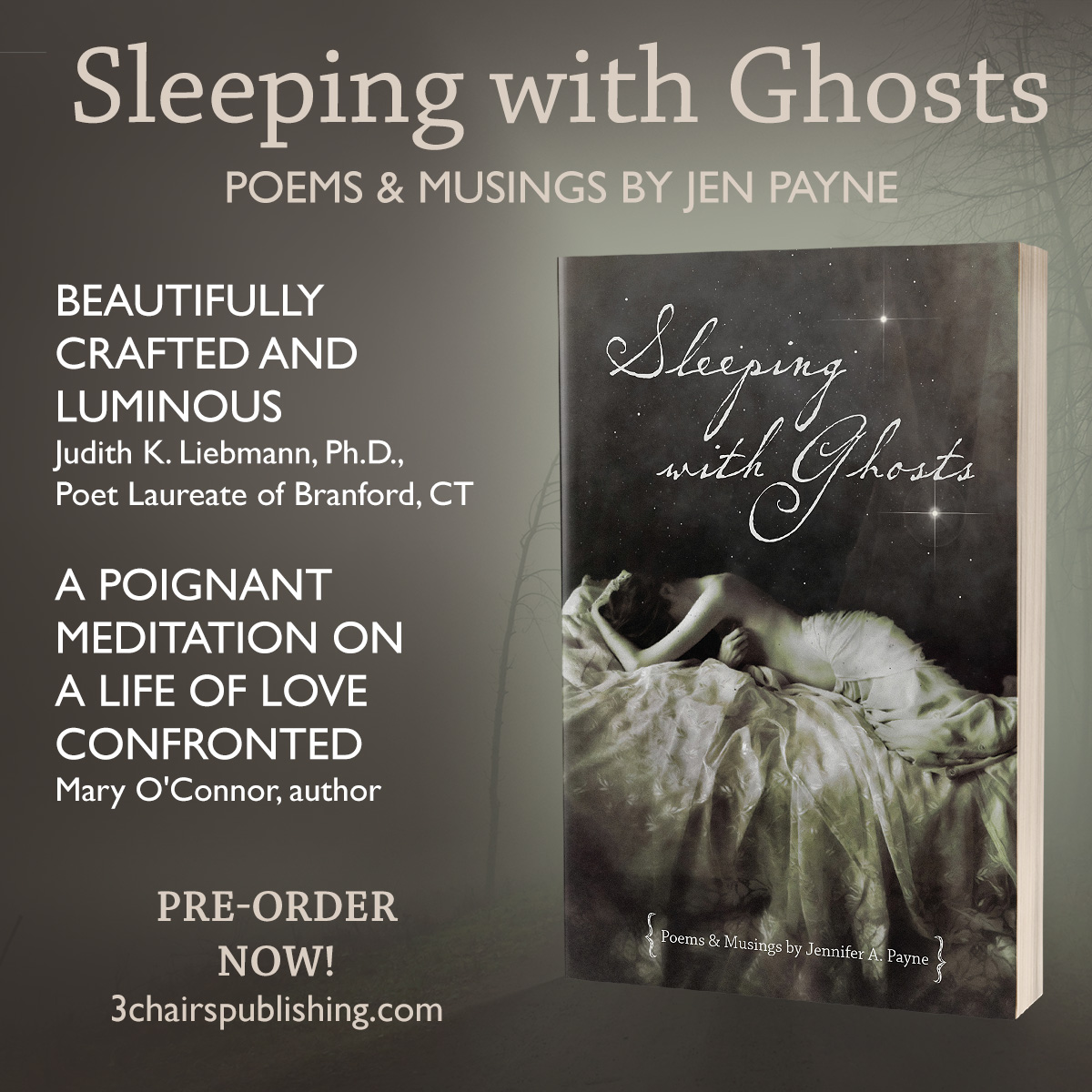
(We also talked about knees — she’s a doctor and her husband is an Orthopedic Surgeon — and books. As a matter of fact, we’re exchanging books — a copy of my Sleeping with Ghosts for a copy of her Mind Body Secrets that I can’t wait to read!)
Women’s Voyage to Freedom
Perhaps my favorite piece in her show was Women’s Voyage to Freedom, hanging prominently on the back wall of the gallery. Its bold colors and gold accents tell the story of women coming into their own in this world — moving from what we’re taught, to what we learn, to how we emerge, flourish, and create our own stories.
Noticing the little Universe in the upper corners of the painting, it felt as if the Artist Date had come full circle. And, in a way, so had I — returning to the curious and mobile spirit who is more than ready to get back to living a creative life!
Detail, Women’s Voyage to Freedom
[1] Cameron, Julia. The Artist’s Way: A Spiritual Path to Higher Creativity. United States: Penguin Publishing Group, 2002.
At 6:15 this morning I had the thought I should drive to Pennsylvania. Sit at my father’s graveside for a while. Talk about all of the things that have changed in the 30 years since we buried him there, the all of us still in shock about the accident, the sudden death, the things we’d left unsaid.
Thirty years is a long time — almost half my life now — there would be a lot to say.
I hadn’t thought of a cemetery visit, made a plan. The grief is so subtle now, with no demands for place and time. It comes as it will come, whether I am sitting there among rows of stones, or sitting in the woods communing with the spirit of everything.
So that was my choice — the spirit of everything in the woods early this morning, and I was happy for the solitude, the Sunday morning quiet.
While I hoped for a sign — he often appears as Hawk — or a voice on the wind, what I found was gratitude.
A deep and unyielding gratitude for how very well he raised me, how strong he taught me to be; for his laugh and the stick-with-it, positive way he approached life; for his encouragement to dream big and love big.
My favorite story about my Dad was the time he took me sledding when I was about four-and-a-half. He set me up on the sled at the top of a rather large hill and reminded me to steer left when I got to the tree. But I got my left and right mixed up and hit the tree straight on — requiring a race to the emergency room and ten stitches. A few weeks later, he brought me back to that hill and told me to open the glove compartment. Inside was the bloody rag he’d held to my forehead — it was a no-pain-no-gain moment. Then he made get on the sled and go back down the hill because…“When you fall off the horse, you get right back on.”
These days we call that tenacity, perseverance, courage, strength, resilience — all of the things that got 29-year-old me standing graveside to this version of me now. I like to think he’d be really proud.
Last week, in one of those wonderful moments of happenstance, I met a local woman who — we discovered while discussing her photography work — was raised in the same town as my mom and dad. We got to talking about what it was like growing up there, how you really are made up of where you come from, and how the language of the place filters into conversations like ours and defines things without elaboration.
I wasn’t born in Bethlehem, Pennsylvania — but my entire family was — my mom’s family and all of Dad’s, uncles and aunts, cousins. My parents, decades after moving to Connecticut, still called it Home, and for me, sometimes, it feels that way, too. As a child, we spent holidays and summers in Bethlehem, attended family weddings and funerals. Still, today, I can drive around the city without getting lost, find my way back to my grandparents’ houses, the cemeteries, the church where I was baptized and my parents were married.
So I knew, immediately, the location of the photographs in this local woman’s portfolio. The view from the Southside that Walker Evans immortalized (above), the Kraken-like spires of the steel mill rising from the shore of the Lehigh River, the stories-high windows through which I used to watch molten steel flicker and pour as we drove through town.
Like my client, I have always been fascinated by the steel mill. It holds its place in my mind as the beating heart of the city, with its pulsing engines and machines. It was the center through which everything moved: the trains that woke me up at night, my grandfathers working night shifts, my grandmothers keeping house in the shadows of industry, the smell of iron ore on their skin.
If you have been there or lived there, you know that smell. You know the feel of Steel City, its rough-around-the-edges energy and patchwork culture of blue collar workers, religious sects, and immigrants. You know the hills of Southside, the porch-lit Moravian Stars, and you can see the famous steel stacks along the skyline. You see them, even now, as ghosts keeping watch over the casinos and concert venues, the museum dedicated to the long-gone industry that made its city famous.
The woman I met, Linda Cummings, is an artist-photographer with an incredible catalog of work. You can see her collection of Bethlehem, PA images on her website. They’re part of a larger collection of work called Slippages that will be featured in her new book of the same name.
Hindsight is 20/20 except when what you’d been seeing then, back then, was larger than life, grander than anything you could imagine and so enormously out of proportion that… now, hindsight is microscopic requiring broken circles of glass — that you try not to bite down on too hard or else you might bleed even more than you already have — to see what was right in front of your eyes all along how minuscule you had to make yourself to fit into that space that small mindedness that box with clearly defined edges (and no imagination) but these are things you don’t see through rose colored glasses their purpose only to color inside the lines with one conforming color the vision of what you were programmed to think you wanted that small sweet girl and her dolls playing make believe building castles out of miss-matched pieces instead of telescopes with which to see the much bigger picture.
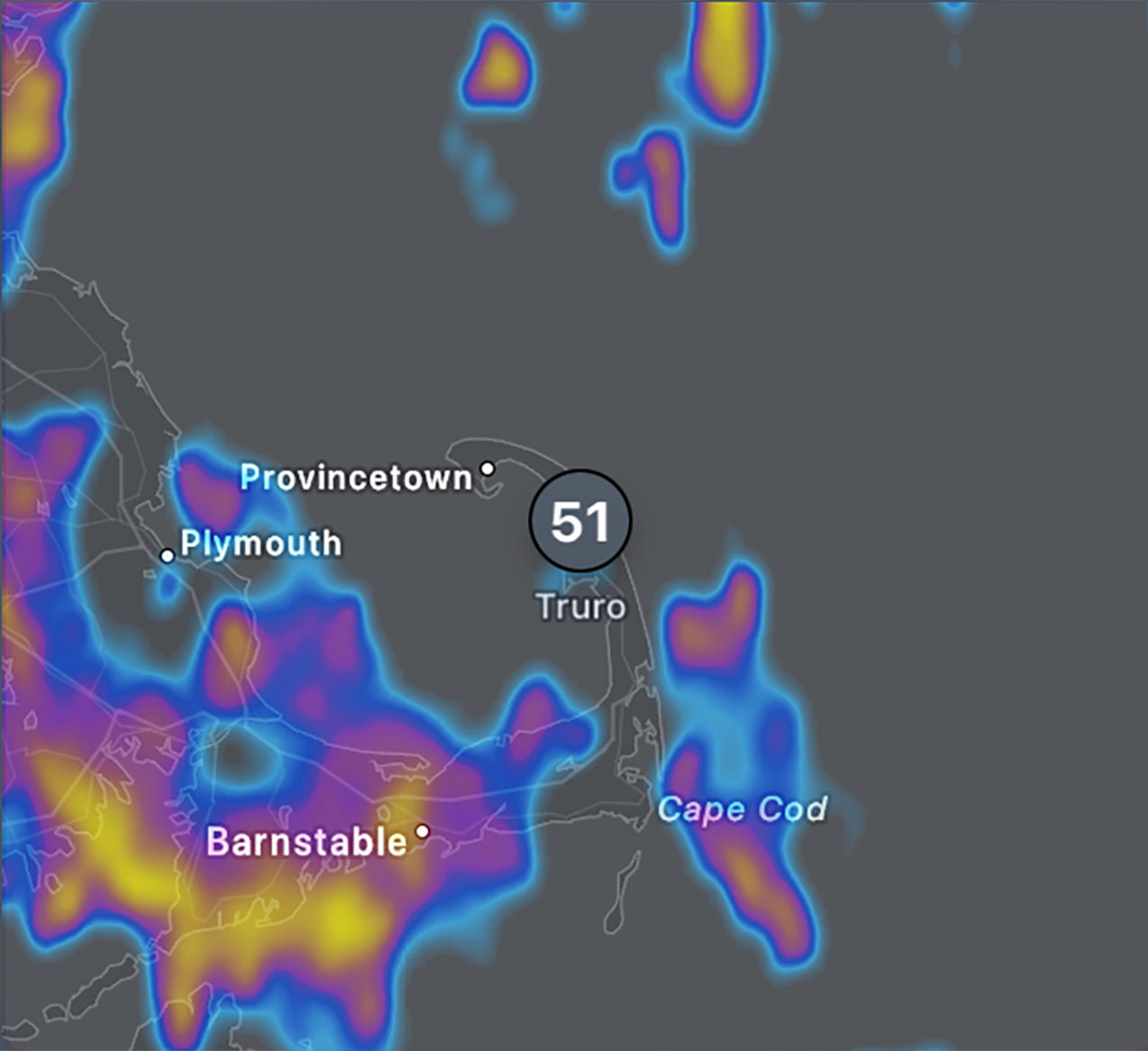
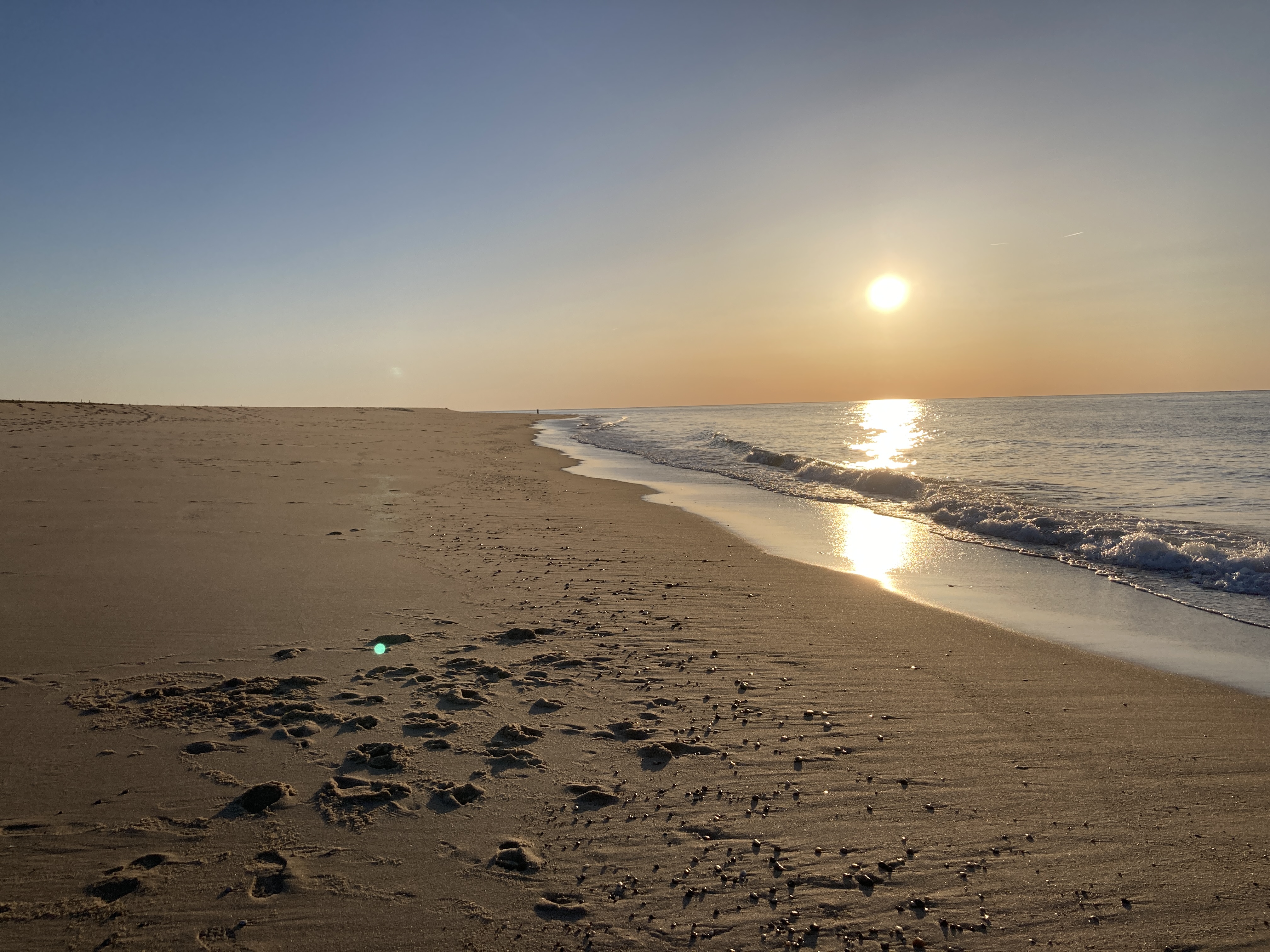
Radar shows the storm purple and red and gold but all I see for miles are shades of Cape Cod gray pale where the sky should be a graphite-thin horizon line its boats like ghosts and a graduated green-gray ocean punctuated by the occasional wild white cap making its way to shore even the trees are gray this morning their late spring effort almost forgot inside this passing storm whose endings promise blue.
Bring me here, darling, the day I die. Let’s hope the seals bob curiously at our folly and the black cap gulls make us laugh along with them.
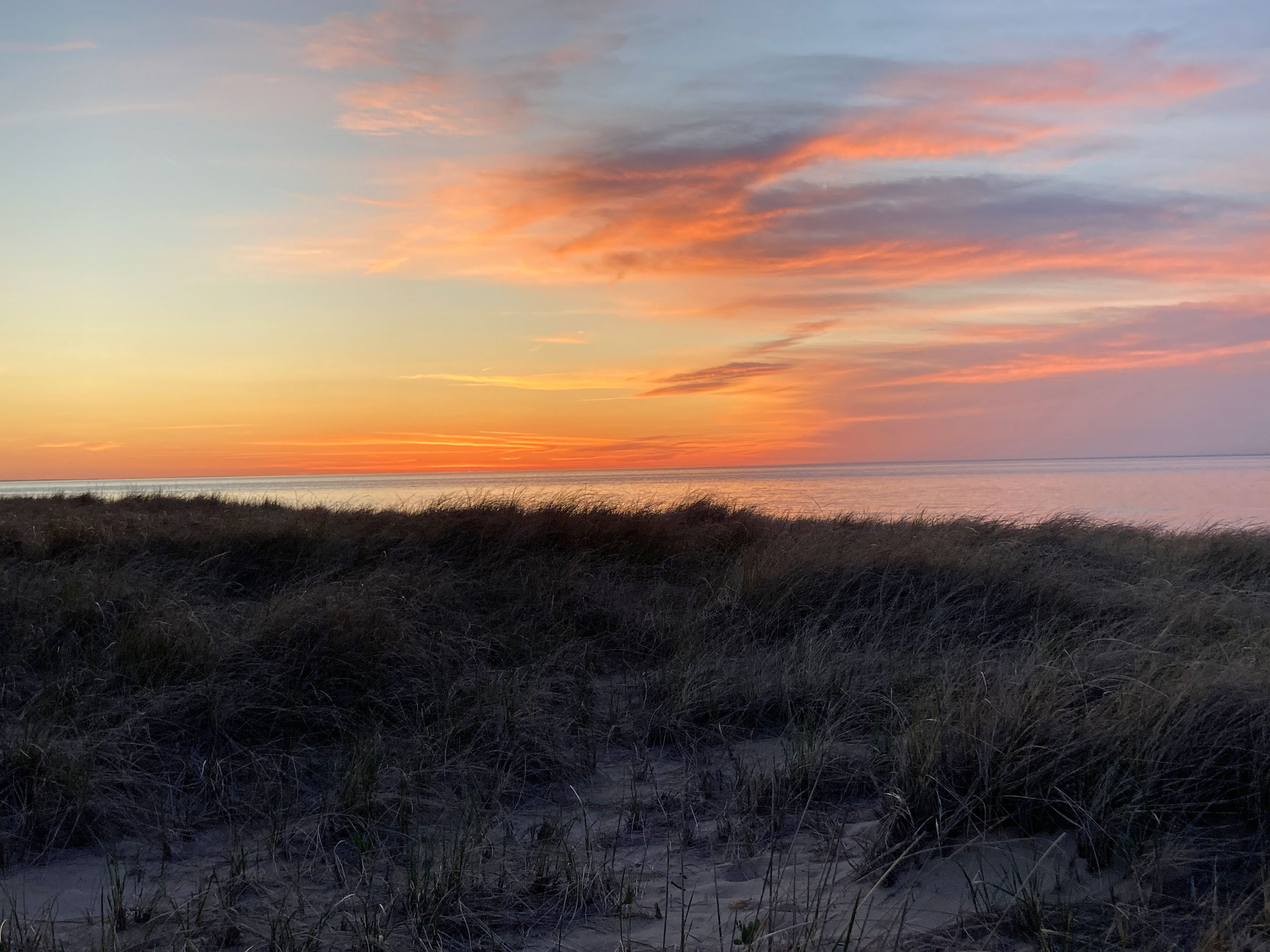
Let’s manifest giant waves — the kind little boys scream into — and a full moon that plays hide and seek with the setting sun behind billowed clouds and tall green grasses.
We can celebrate whale spouts and whale tails and the fine thin lines of birds come back — that life goes on and a moment of joy can last forever, here, a laugh, a dance, and love worn smooth with time.
We’ll hope for a cold spring day you and me alone on the dunes and that one final breathtaking breeze to push me forward into oblivion.
Her Algorithm has teeth fangs, really like the kind you see in nightmares, and its fur is black and sharp like a worn carpet tread in worry and fear, with small fibers that pierce the skin and stick like burrs.
Her Algorithm has firm, strong legs and claws that dig in and hold fast to a path she didn’t even realize she was walking down, until she’s so far deep and running at such a clip all she can see is the hot steamy breath of her Algorithm, the gates of hell like a flaming blur.
and there’s nothing a cute purring kitten or craft project can do but watch from the sidebar and wait their turn until the Algorithm catches sight of something more interesting and follows its scent down a rabbit hole of obscure poetry, trendy dance moves, and weird fashion from a 1970s JCPenney catalog that turns her Algorithm a shaggy, avocado green.
Heart-shaped rocks underfoot all around on the grassy path and sand dune from here to the shore and at the water’s edge
(dare I say even in the palm of the Garçon at the pâtisserie whose smile needed no translation)
Hearts!
There was a time I would have come home with enough heart-shaped rocks to border a banister, fill a bowl and basket, lined them up to show the Garçon in the morning with coffee and croissants
but I am content now to find moon stones instead translucent round and easy love in the stars, the sky, the universe enough
In a persistent effort to weave a web the spider imperceptible casts her silver filaments from the uppermost spire of a wintered beach plum one thin budded branch from which a hundred casts arc and fall arc and fall her small labors shimmering in afternoon light prayers of possibility glittering
There is a slice of ocean outside my window and in it the world from a view just above a confluence of birdsong and whalesong the mechanics of the day juxtaposed to sweet, sweet silence.
There’s this photo in which he stares at the camera and I remember we’d already begun by then; made plans, talked for hours, fallen in love, even by the look on his face; I remember that day, our chairs pushed together, sharing our lunches, scribbling notes to each other like school kids; but we were hardly that, hardly so fresh to all of it; I wish my camera had focused more, had adjusted its exposure to show the shadows, the rough edges and hidden details, to find the nuances in the full picture I see so clearly, now.
This is Reverend Scott on the valve in the belly of Poseidon. Quint in the jaws of his worst nightmare. Jack and Rose at the Titanic’s stern. Eowyn and the Nazgûl. Harry and Voldemort. Bruce Willis on the asteroid careening through space.
This is the battle scene. The climactic moment. The death scene.
This is before the denouement. Before the resolution. Before the credits roll.
This is the moment that needs you. That demands faith. That requires courage. And sacrifices.
So hang on tight, baby, because it’s going to be a bumpy ride…
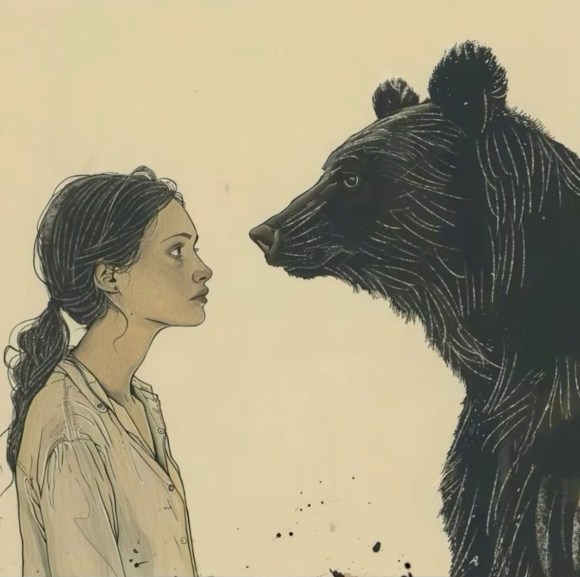
Grizzly Bear and Goldilocks (that’s not my name, she says) are discussing the merits of cinnamon applesauce and whether or not I would eat her, instead, barbequed with ranch dressing but before I can answer in my gruffy harumphing voice we’re off to gather sticks for our make-believe fire pit and the s’mores we’ll eat later because right now she’s making breakfast pancakes with maple syrup? bacon and strawberries I love bacon! which we eat while she laughs that the syrupmakes my fur sticky so she cleans it off my hands thank you then we pretend-read a book before going to bed and I snore as loud as I can until she wakes me up ten seconds later to sit by the fire (just one more round, she asks) so I can’t possibly leave and why would I ever want to? there are s’mores, after all, and a backyard afternoon that is just right.
I have seen her one hundred times since she died in crowds and corners when I least expect and last night in a dream again looking fabulous and forgiving all my tears waited until I was done so we could step into the space of time allotted that glorious dreamspace where everything is as it was and we do as we used to do for hours unending until I wake no longer feeling quite as alone.
If these walls could talk these shelves and set-aside spaces you might think I love her and I do one hundred times I do and have for so long I no longer remember first glance, first conversation first spark of friendship but this and this and this tell our story — part of it most of it the sum of it — easy to turn pages in this space and remember the miles we traveled, the endless stories, the memories gathered in pockets to take home for safe keeping.
The morning thick with sound spring sound a humid hovering of birdsong and flowersong buds on trees whispering and soft soil separated by anxious green almost ready for the ministry of bees and butterflies soon to be tending and tittering a symphony of what is this moment and what will be at any moment soon.
Sleep has been merciful these past three months, arriving early from exhaustion staying late in fellowship with the dreams that wax nostalgic for simpler nightmares and harmless ghosts.
But this morning, I’m awake at 3, my familiar and I like old friends sharing space beneath the spring moon, waning in its sixth phase, while one lone peeper keeps time as sharp as the second hand on a clock.
We have not been together in this way — the moon and morning and me — since the monsters took over, since their cacophony of destruction, the sinister palpitation of days, and all of us wondering what or who will be next.
This morning is a gift of quiet comfort, the marsh frog a beacon which seems to say Here! Here! Here! over and over and over, it reminds that even in the age of monsters, once can find solace in the soft, dark edges, calm in the promise of cycles and phases, of spring and worlds ever spinning.
sit up straight the napkin goes on your lap elbows off the table tines down tines up left hand, right hand, tip the spoon away don’t slurp don’t shovel don’t talk with your mouth full
To the Starlings who have moved into the Privet Hedge on Short Beach Road,
Welcome.
Please stay as long as you like.
Help yourself to the bugs and slugs in the front garden. Enjoy the spread of sweet clover and violets in the lawn, but watch for the mower who arrives every two weeks on Friday.
There’s always shade under the boxwoods, if you need, and rain water in small pools along the mossy brick path.
In the back, you’ll find a bird feeder loosely tended, but often full of seeds, and an endless dance of bees among the honeysuckle by the old dogwood.
We have resident squirrels, a family of five jays, and a chipmunk who resides just south of the bird bath which we keep filled all summer long.
The pond out back offers the companion of frogs and turtles, crows and owls, a flock of your brothers and sisters, and at least one hawk for balance.
Pay no mind to the cat. She never goes outside, but does love her spot on the screen porch. Feel free to watch her watching you, that could go on for hours!
Now mind you, I do have one request.
What I ask only in return is this: please do not cross the wide wild way, west of the hedge. It’s fast and merciless. If you, out of instinct, fly that way ever, please stay high and alert.
It occurred to me this morning, while I held tight to old dreams, that someone, somewhere was also waking to this day, but opening eyes to a present they recognized: the familiar sun though curtains and the routine of Sunday laid out in front of them with no need to pretend otherwise; the photos on the shelf of old friends smiling, the bucket list taped to the refrigerator door, the piggy bank promise of new adventures somewhere and someday still shimmer in the early light of their morning, there; should I tell them? remind them to hold fast live in the moment for god’s sake everything is fleeting, tomorrow might already be a memory.
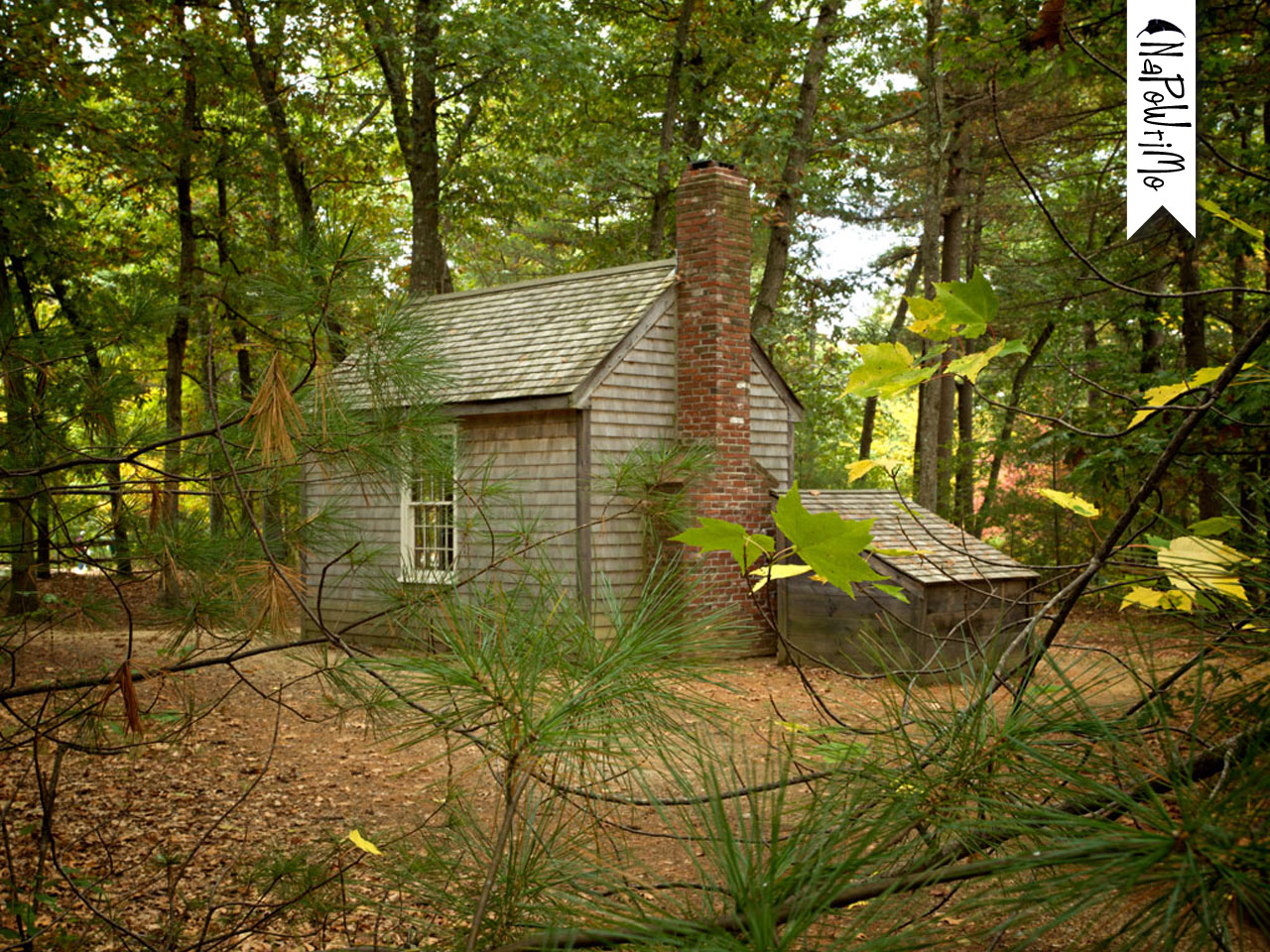
Thoreau, she tells me, was tended to by women. Meals and laundry — a side of the story I’d missed, hadn’t even thought to think about; his cabin in the woods? his solitude and simplicity? my dream! my escape! my alternate ending! and who considers practicalities when we’re having a transcendental crisis? I am disheartened and disappointed and then…delighted! The solitude of the woods? The simplicity of sojourn? And a community of women to soothe and support? Life Goals times one hundred!
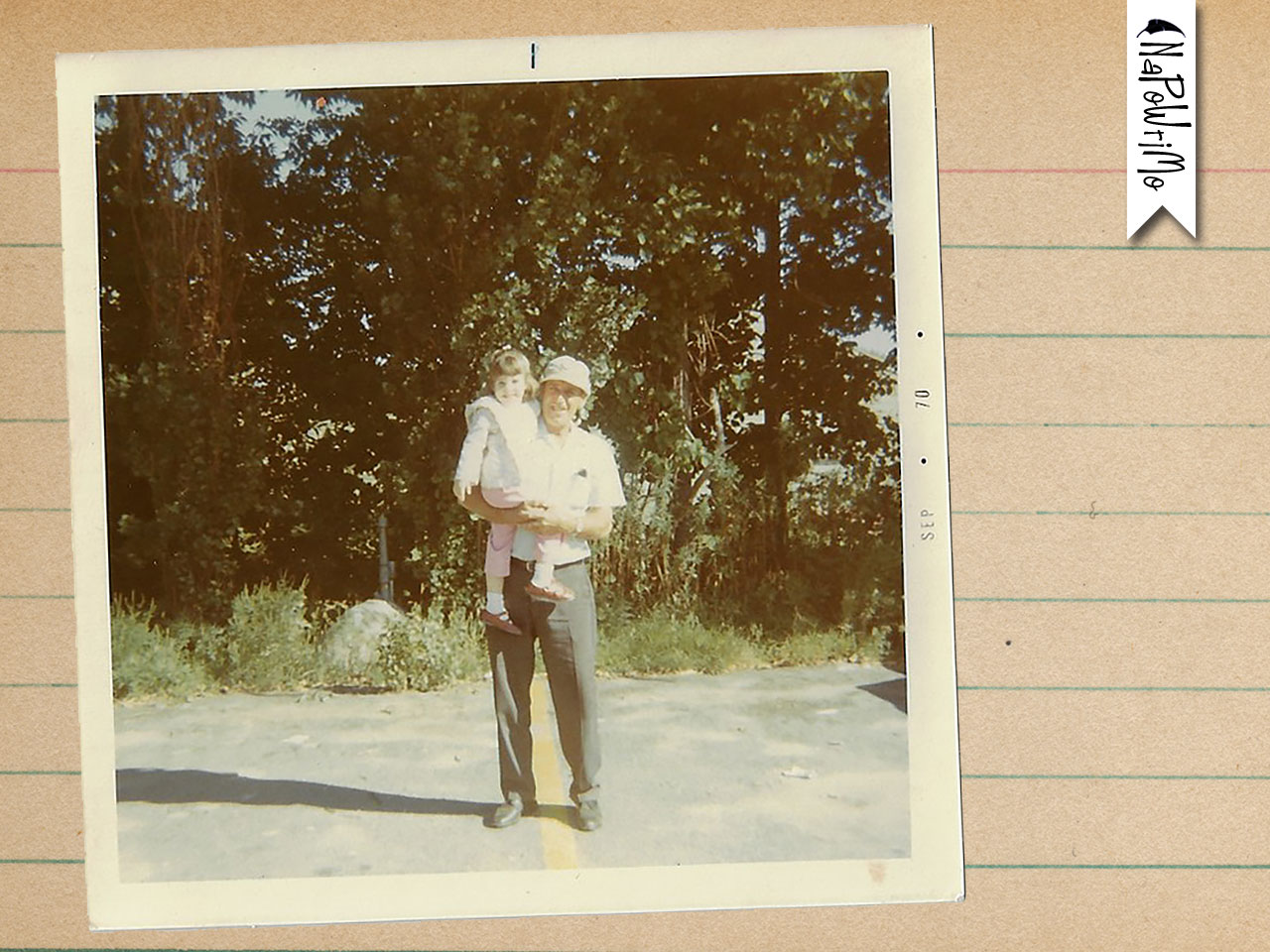
It’s the robin’s trill that most often calls him to mind deep from the arbor of spring azalea and its cotton candy blooms, the privet hedge shoulder high then two stories up in an instant of memory, a wooden screen door slam bees and clover and Pappy lifting me to the sky whiskey on a breeze, the rough chafe of whiskers, “chirp chirp” he says as a kiss against my cheek then sets me on the ground to tangle in the blossoms one more time before we leave for home.
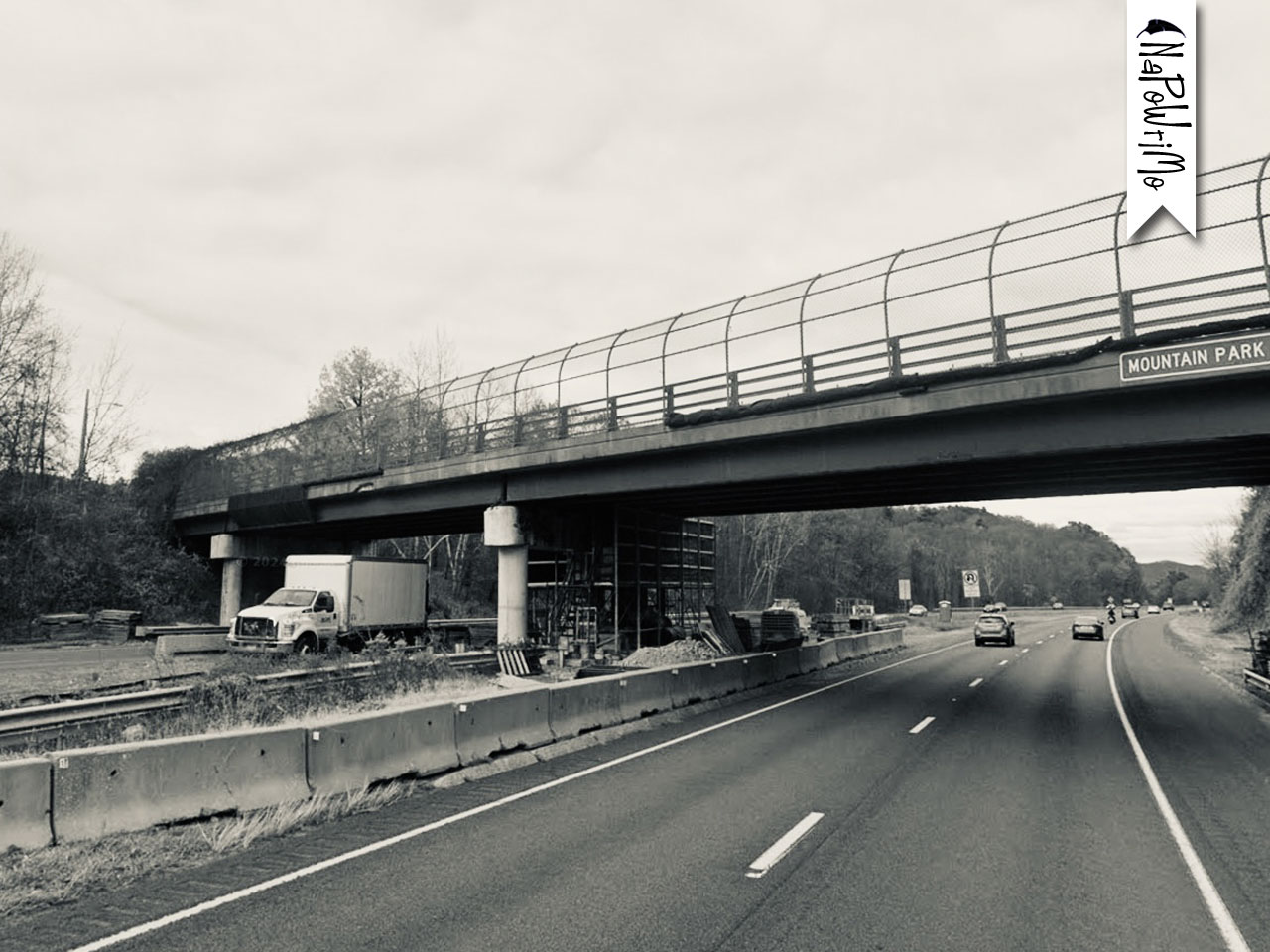
There’s a ghost standing on Mountain Park Road I spy her from the highway as I scream past at seventy She might have waved but had no need to I saw her knew her remembered all of the layers of time, there on the overpass at Mountain Park Road and I wondered briefly if she knew me here now this apparition this shadow of who she used to be in a blur of recognition a moment frozen in time the all of us in overlap here, there, then, now on Mountain Park Road
This morning I stayed in bed squeezed my eyes shut and begged for more more sleep more dreams more anything than what waits: that 21st century disappointment and the cold blank stare of what comes next
It was already hard enough to live with the stark comparison of hopes and dreams versus real world, the daily effort of just keep swimming just keep swimming
Now there is just this THIS every day THIS good lord THIS
Once, I told a therapist that I was considering a long slow drift in ice floe silence, and she sat aghast asked if she should be concerned so I dialed it back and laughed like I was joking
Concerned is such a funny word — To Whom It May Concern we have concerns but it is of little concern
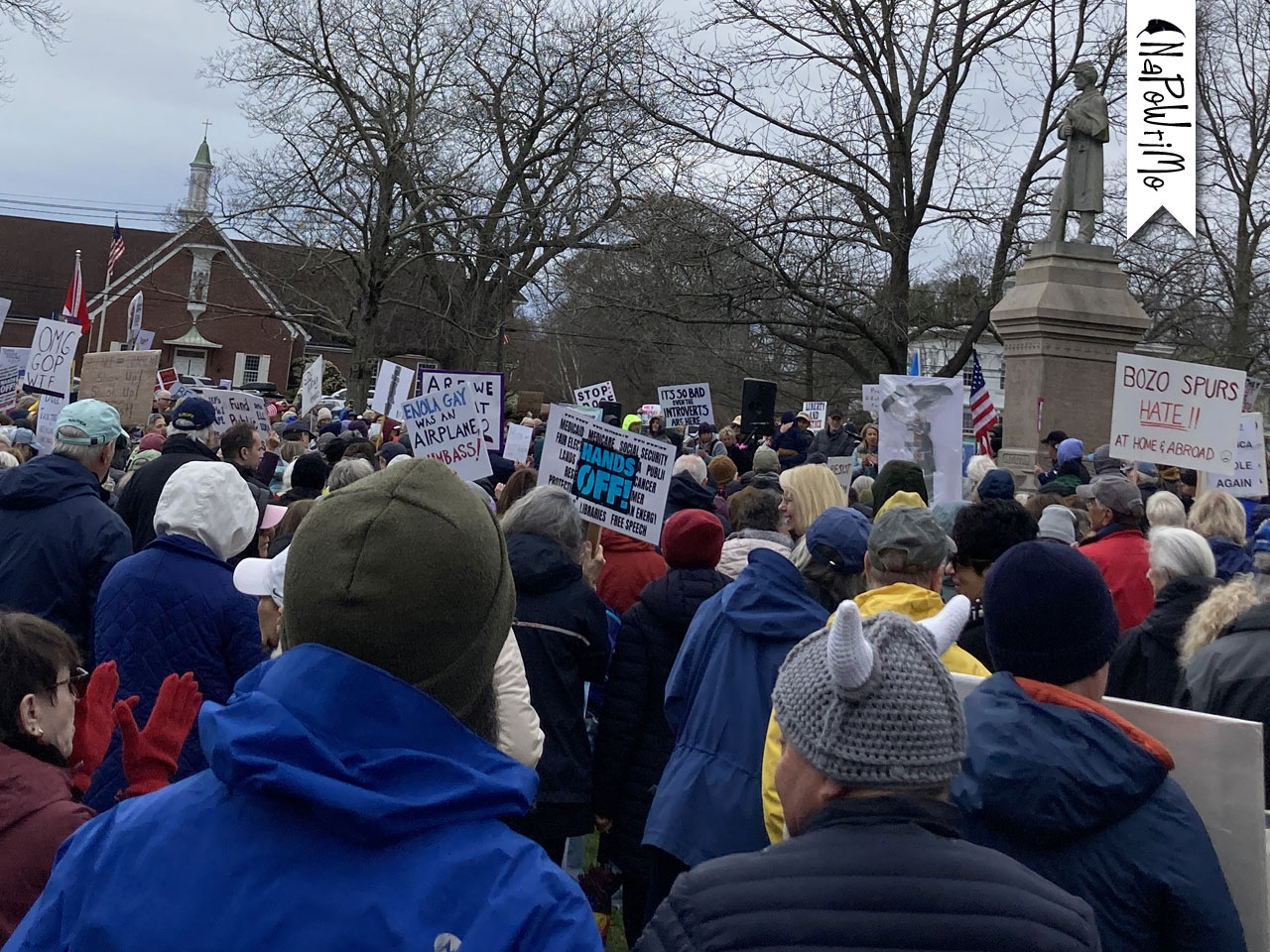
Yesterday, at a protest, I danced with strangers and felt free in a way I haven’t since my best friend died seven years ago and I thought: she is better for it dead before THIS all of this with no concerns no need for persistence or resistance or a clever exit strategy disguised in a poem.
All along the highway a brutal massacre agony and destruction jagged edges claw the sky not even the grace of a clean cut no time to spare for the scream of chain saws the equal labor-to-labor dignity of tree felling the man-versus-nature earth shaking victory (the silent apologies) we are now machine-efficient cost-effective and ruthless with stands of trees laid bare twisted to their breaking point ripped and torn delimbed, stripped, shredded sun burning shaded places raw spaces for the taking
Somewhere in the ebb (of the work day) and flow (of the springtime woods) a page turned and laid itself gently across the path like a vignette filter on this enchanting afternoon and there beneath my feet…
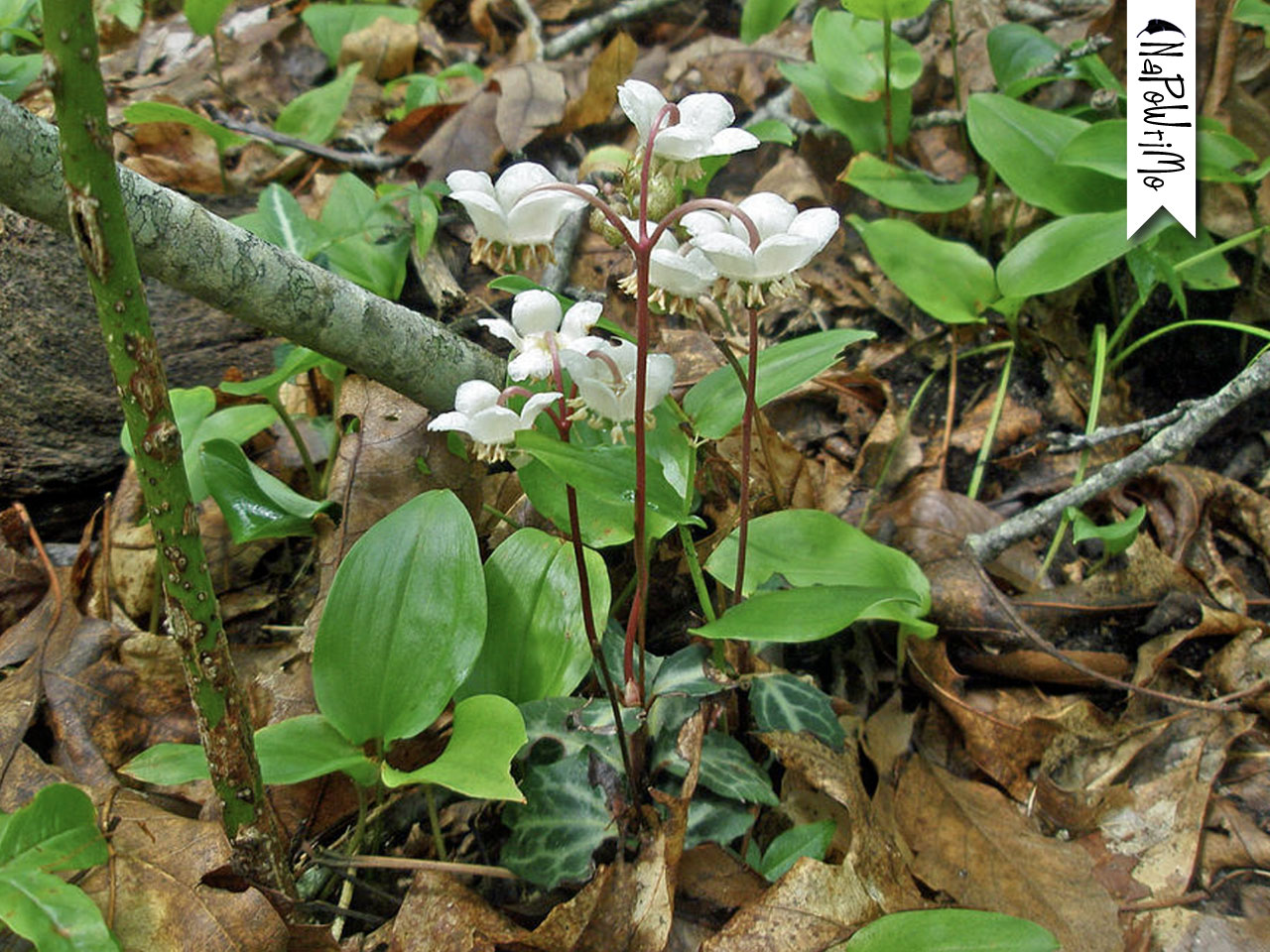
A single spotted wintergreen rises up from the ground…Spotted wintergreens are the flowers that grow from longing.
The sun has warmed the alcove of cedar, so I sit for a while to consider the flowers, the swan, the osprey, the character who calls to me from across the pond who? who?
He turns and stops, his head tilted towards the ground. He stands there for several seconds, staring at the spotted wintergreen…
Am I dreaming? Then he carefully pushes his hands into the soil next to it and a cardinal flower punches through the surface…Cardinal flowers grow from frustration.
Perhaps dreaming or remembering? Surely there is magic about, even the Owl agrees watching now from above, as I sigh and adjust and…
Kneel beside the cardinal flower and touch the Earth, a purple cone flower rises to greet me.…the perfect flower for apologies.
We add to our conversation, wildflowers taking over the dirt…and so much spotted wintergreen, longing everywhere…
We see each other. I think we always have.
How long did I sleep? I don’t recall. Time stood still there by the pond beneath the trees that whispered and sang and soothed us — the Owl and I — for a moment or hours or maybe perhaps a lifetime.
A new flower punctuates the end of our conversation – a single iris to say he loves me.
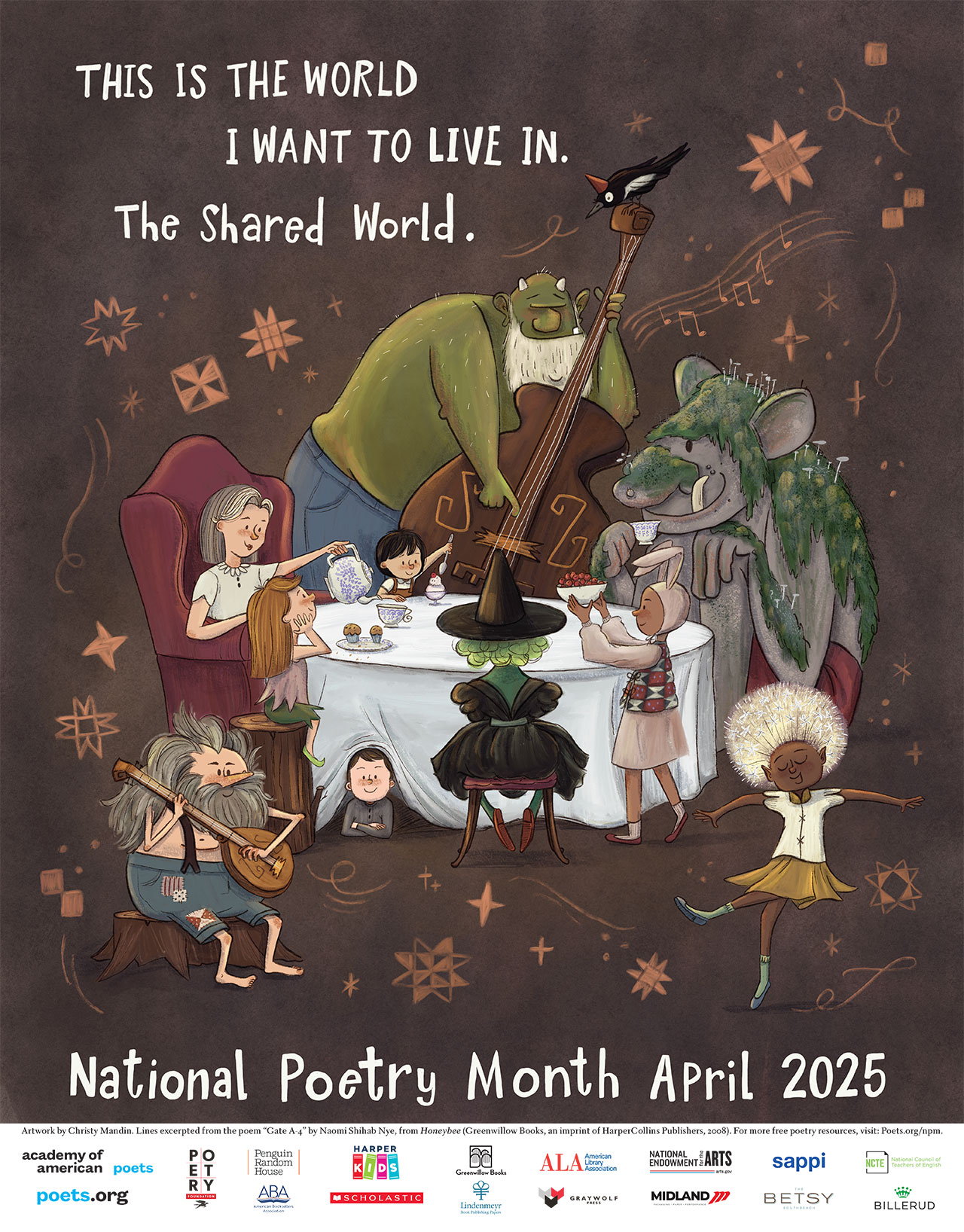
“Launched by the Academy of American Poets in April 1996, National Poetry Month is a special occasion that celebrates poets’ integral role in our culture and that poetry matters. Over the years, it has become the largest literary celebration in the world, with tens of millions of readers, students, K–12 teachers, librarians, booksellers, literary events curators, publishers, families, and — of course — poets, marking poetry’s important place in our lives.”
My favorite way to celebrate is to join with the thousands of poets participating in NaPoWriMo — NATIONAL POETRY WRITING MONTH —in which we write a poem a day for the month of April.
While NaPoWriMo is celebrating 22 years this year, I’m happy to say this will be my 11th year attempting to write 30 poems in 30 days! Here we go!
twice today we passed each other and twice today that friction of energy and chemistry and memory tugged at the the solid yellow line like the force between silver magnets so we each turned bullet-time freeze frame slow motion twice today a sideswipe glance the closest we’ve been in years
These days, I wake up with a thin veil of hope. Before the All of it sets in. Again. Then I breathe and stretch. Light incense. Beseech saints and gods. And settle into the morning routine of cat feeding and coffee making — this is the Grounding.
When I am fortified enough, I glance at the headlines and subject lines. Read Jessica Craven’s latest Chop Wood, Carry Water to talk me off the ledge. Remind myself about Chaos Theory, and This Too Shall Pass. Recite the Serenity Prayer: serenity, courage, wisdom. Breathe.
I relay inspiring quotes about Resistance and Creativity and Hope on social media. Call and email my Senators and Representatives. Take small actions of Revolution before I settle into my day, which, for now, is same and sane and familiar.
Familiar enough that at some point, I shake off the Big World things and muck about in my own for a while. The usual: the house repairs, the bills, the client rubbing me the wrong way, that one thing that one person said that irritated the piss out of me, my mother’s caregiving, the impending knee surgery, on and on…
And on…while the world fucking burns outside my window. Literally. Figuratively. Absolutely.
Every time I find myself marinating about my Small World things, I hear Julia Roberts/Liz Gilbert in the opening monologue of the movie Eat, Pray, Love:
“l have a friend, Deborah, a psychologist, who was asked if she could offer psychological counseling to Cambodian refugees — boat people, who had recently arrived in the city. Deborah was daunted by the task. These Cambodians had suffered genocide, starvation, relatives murdered before their eyes, years in refugee camps, harrowing boat trips to the West. How could she relate to their suffering? How could she help these people? So guess what all these people wanted to talk about with my friend Deborah, the psychologist. lt was all, “l met this guy in the refugee camp. I thought he really loved me, but when we got separated, he took up with my cousin. Now he says he loves me, and keeps calling me. They’re married now. What should l do?” This is how we are.”
This is how we are, in part, because we are susceptible to what is called “Crisis Fatigue” — that feeling of overwhelm, lack of control, or the urgency of the next crisis.
And goodness knows, we’re like a Russian doll of crises these days! Everywhere you look, it’s crisis stacked upon crisis upon crisis.
So where is the fulcrum? How do we find a balance between staying informed and hiding under covers? Between revolutioning and resting?
Remember, this is a marathon, not a sprint. You need to make time to drink water, slow down a little, pace yourself.
In her article “When tragedy becomes banal: Why news consumers experience crisis fatigue,” Rebecca Rozelle-Stone , Professor of Philosophy, University of North Dakota asks, “How might we recover a capacity for meaningful attention and responses amid incessant, disjointed and overwhelming news?” and suggests, beyond reining in digital device usage, that we consider:
“Limiting the daily intake of news can help people become more attentive to particular issues of concern without feeling overwhelmed. Cultural theorist Yves Citton, in his book The Ecology of Attention, urges readers to “extract” themselves “from the hold of the alertness media regime.” According to him, the current media creates a state of “permanent alertness” through “crisis discourses, images of catastrophes, political scandals, and violent news items.” At the same time, reading long-form articles and essays can actually be a practice that helps with cultivating attentiveness.”
She also recommends a focus on “more solutions-based stories that capture the possibility of change. Avenues for action can be offered to readers to counteract paralysis in the face of tragedy. Amanda Ripley, a former Time magazine journalist, notes that “stories that offer hope, agency, and dignity feel like breaking news right now, because we are so overwhelmed with the opposite.”
So do that.
But remember…it’s OK to take a day off — from work, from social media, from headlines, from the Resistance.
It’s OK to eat ice cream or take a nap or laugh out loud. It’s OK to make plans, to look forward to things.
Do the things that keep you sane and keep you grounded. Revolution requires Resilience.
In Eat, Pray, Love, the medicine man Ketut suggests to Julia Roberts/Liz Gilbert:
Keep grounded so it’s like you have four legs. That way, you can stay in this world. Also, no looking at world through your head. Look through your heart instead. That way, you will know God.
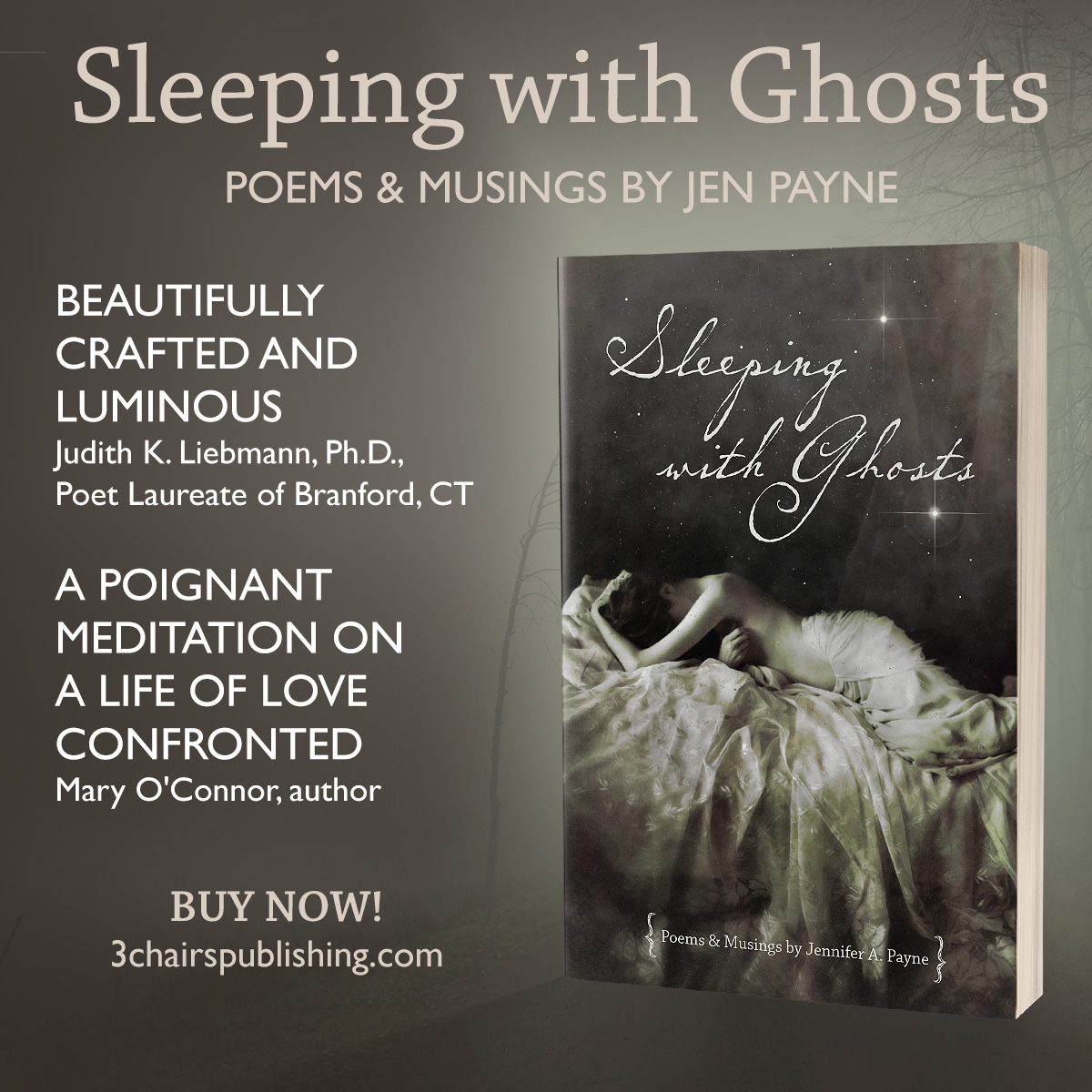
As part of its ongoing Fireside Chats program, the Blackstone Memorial Library welcomes Branford author Jen Payne for a poetry reading on Saturday, March 8, 1:00 – 3:00 p.m.
In honor of International Women’s Day, Jen will be reading from her new book, Sleeping with Ghosts, focusing on some of the women she’s written about — mentors and muses and friends. After the reading, Jen will be joined by Laura Noe for a conversation about how our relationships with women influence and inspire us. Laura, a local author as well, holds a master’s degree in Women’s and Gender Studies, and is currently teaching the Psychology of Women at SCSU. Attendees are welcome to bring a short (100 words or so) introduction about one important woman in your life to share with the group.
Copies of Sleeping with Ghosts will be available for sale during the event. Refreshments will be served.
This event is free and open to the public. No registration is required. The Blackstone Memorial Library is located at 758 Main Street, Branford. For more information, visit http://www.blackstonelibrary.org.
Jen Payne is a poet, author, photographer, and artist. She is inspired by those life moments that move us most — love and loss, joy and disappointment, milestones and turning points. Her writing serves as witness to these in the form of poetry, creative non-fiction, flash fiction and essay. When she is not exploring our connections with one another, she enjoys contemplating our relationships with nature, creativity, spirituality and our inner lives. Ultimately, she believes it is the alchemy of those things that helps us find balance in this frenetic, spinning world.
Her work has appeared in numerous publications including Sunspot Literary Journal, The Perch, and the 2024 Connecticut Literary Anthology. She has written five books: Look Up!, Evidence of Flossing, Waiting Out the Storm, Water Under the Bridge, and Sleeping with Ghosts, all of which are available to borrow from the Blackstone Library. They can also be purchased online at 3chairspublishing.com.
FEBRUARY 13 Valentine’s Book Signing & Spontaneous Poetry Reading Thursday, February 13, 4:00 p.m. – 6:00 p.m. at Guilford Art Center (411 Church Street, Guilford)
The Shop at Guilford Art Center is hosting a Valentine’s Day Shopping Event, all day on Thursday, February 13. Come see the treasury of beautiful objects made by hand with lots of love…it’s the perfect place to find gifts for the loves in your life. As a special treat, I’ll be signing copies of my book Sleeping with Ghosts, handing out homemade cookies, and doing spontaneous poetry readings from 4:00 p.m. – 6:00 p.m. Please stop by!
FEBRUARY 15 Center Cemetery Book Launch with Jane Bouley Saturday, February 15, 12:30 – 3:30 p.m. at the Blackstone Memorial Library (758 Main Street, Branford)
Join local author and Branford Town Historian Jane Bouley for an Open House and Book Launch highlighting her most recent work Center Cemetery: Church Yard Section. The two-volume work includes the record and photographs of 470 gravestones in the oldest section of Branford Center Cemetery on Montowese Street. Jane will show photographs, describe the book, and answer questions. Refreshments will be served.
This is the third book that Words by Jen has helped Jane publish, and I am honored to have been invited to be part of this event to answer questions about book publishing. Please stop by to say hello!
MARCH 8 Fireside Chat & Poetry Reading with Jen Payne Honoring International Women’s Day Saturday, March 8, 1:00 – 3:00 p.m. at the Blackstone Memorial Library (758 Main Street, Branford)
Please join me for a special poetry reading to honor International Women’s Day. I’ll be reading from my new book, Sleeping with Ghosts, focusing on some of the astounding women I’ve known — mentors and muses and dear friends. Together, we’ll talk about how our relationships with women influence and inspire us. If you’d like, please bring a short (100 words or so) introduction about one important woman in your life to share with the group.
APRIL 27 Book Signing & Spontaneous Poetry Reading at Breakwater Books Sunday, April 27, 1:00 – 3:00 p.m. at Breakwater Books (81 Whitfield Street, Guilford)
I’ll see you on the CT Book Trail at Breakwater Books in Guilford, where I’ll be signing copies of my book Sleeping with Ghosts, handing out some sweet treats, and doing spontaneous poetry readings from 1:00 – 3:00 p.m. Plus, get your CT Book Trail Passport stamped for a chance to win over $4,000 in prizes as part of the 2-day CT Book Trail Passport Challenge!
Time alone during a retreat on the shore of Cape Cod, MA.
If the world were a sound, it would be flipping through all of the channels on a radio really fast. Announcers and DJs, commercials and music genres overlapping in the same way our 21st-century tasks seem to layer upon themselves.
We’re always busy, there’s always something else to be managed, and the To Do list is never-ending — one crossed-off item seemingly births two or three more. Work, family, and home responsibilities line up like a song queue on a commercial-free weekend — endless.
If you’re a creative type, like I am, though, you need to turn down the volume sometimes. All of that noise — all of those weighty expectations —stifle our ideas and muffle our creative voice.
And while a Vacation can be helpful sometimes, that’s a different genre of time off, usually involving a barrage of activities, schedules, attractions, must-dos, and must-sees. What’s more beneficial to your creative spirit is a Retreat.
What’s the difference?
I like to think of Retreat as all about the R words, like: Relax, Rest, Regroup, Restore, Reflect, Reset, Roam, Read, Recharge, Replenish. Get the idea?
It’s time without any expectations or To Do lists, and time “off the grid,” if you can stand it.
According to an article by executive coach Rebecca Zucker in the Harvard Business Review, taking time off has reverberating positive effects on your sleep, memory, concentration, mood, and stress level.
Time off, she explains, “can allow you to tune out much of this external noise and tune back into your true self. You can start to separate the striver part of you, let go of your ego, and reacquaint yourself with the essence of who you really are…feel a sense of peace…and do things that bring you joy.”
How’s that for motivation?
For the last 12 years, I’ve taken a week-long Retreat on the shores of Cape Cod. I spend my time reading books, walking by the water, and taking long afternoon naps. I eat simple meals, spend time in nature, write some poetry, and remember how to breathe deeply again. I try to make it a quiet experience — time for rest and reflection, not a tourist jaunt or food tour.
Of course, not everyone has the time or resources to take off by themselves for a whole week. Sometimes I don’t either. Sometimes, an overnight at a hotel with a good book and a picnic basket of food is time enough. A Sunday drive down the highway with the radio on and the windows open can clear my head as much as a long walk by the ocean. And always, a morning hike in the quiet woods reminds me that somewhere beneath all the layers of noise, my creative voice is waiting for her opportunity to sing!
What’s your ideal Retreat? Can you think of two or three ways — grand and small — that you can tune back into your creative spirit?
For the poet is a light and winged and holy thing, and there is no invention in him until he has been inspired and is out of his senses, and the mind is no longer in him… — Plato
Ghosts, Muses, Inspiration, Universe, God. Call it what you will — there is another layer of this world that we live in, and if you can quiet your mind, sometimes, you can hear it and be inspired by it!
As I was finishing up the manuscript for Sleeping with Ghosts, my editor and I both agreed something was missing. While I loved the final poem “Missing Banksy,” its alluded message about impermanence wasn’t quite strong enough to hold up the end of the book. But what would? I had no idea!
When I get stuck like that and can’t find answers — about my writing or about life in general — I like to walk in the woods. It’s where I can settle my mind, slow down the busy-ness, and sometimes…sometimes…hear ghosts.
On this particular walk, I started out at the trailhead by asking the Universe to help me find a final poem, a final message for the book. Often, I can entice Inspiration with a request like that, and this time, it responded in the voice of my Dad.
It’s not the first time my Dad’s ghost has spoken to me. He told me to PAY ATTENTION on I-95 once and saved me from a pretty awful accident; he often shows up unexpectedly as a hawk with a call of I AM HERE; and he responded to my poem query with a series of questions that became the poem “The Final Ghost.”
But connecting with our ghosts can be challenging! There is so much noise in the world today — we’re busier than ever, more distracted by things, more seduced by technologies. There are so many things demanding our attention, how can we possibly hear Ghosts, listen to Muses, or tune into our Inspiration?
One of my all-time favorite movies is Contact with Jodi Foster. The scene I think about often is when she is in the portal pod that’s been reconfigured with an anchored chair and seat belt — things to keep her rooted in place as she travels across space through wormholes. But as she starts her journey, the chair and seat belt cause more harm than good. She may be OK to Go, but they keep her too firmly in place. It’s only when she releases what holds her down that she projects openly forward.
In the same way, listening to your Ghosts requires that you release what’s holding you back.
For Jodi Foster’s character Ellie Arroway, what was holding her back was physically obvious. For me, I know that my biggest obstacle is technology and how it eats up my time and siphons my attention span.
So, what gets in the way of listening to your Ghosts?
Just this weekend, I talked with a woman who told me in a whispered voice how she stopped listening to her Ghosts because it seemed a little scary. And I have a friend who is a phenomenal painter, but she often ignores her Inspiration because it feels too powerful, almost possibly un-godlike.
But the idea of listening to Ghosts or Inspiration or Muses reaches far back into human history.
Did you know that “the word inspiration ultimately derives from the Greek for ‘God-breathed’ or ‘divinely breathed into.’ In Greek myth, inspiration is a gift of the muses, the nine daughters of Zeus and Mnemosyne (Memory).”
Similarly, “the Oxford English Dictionary defines inspiration as “a breathing in or infusion of some idea, purpose, etc. into the mind; the suggestion, awakening, or creation of some feeling or impulse, especially of an exalted kind.”
In his article “How to Find Inspiration, the Psychology and Philosophy of Inspiration,” writer and philosopher Neel Burton offers seven 7 simple strategies to encourage inspiration:
1. Wake up when your body tells you to. 2. Complete your dreams. 3. Eliminate distractions, especially the tedious ones. 4. Don’t try to rush or force things. 5. Be curious. 6. Break the routine. 7. Make a start.
Because I know too much you look like her, so instead of blaring my horn I stop and smile and let you pull out into the crowded lot in front of me
You’re sweet and apologetic in gestures, so I smile even more and nod because I know too much, and I owe you — or her — a thousand kindnesses in place of apologies that have long since gathered dust in the corner of both our stories
Because I know too much about your suspicions and my jealousies, your patience and mine, I think this gesture now in this parking lot with this stranger might be atonement, might be appreciation — or love — a precious light in the shadows of our shared secret
I am a part of all that I have met; Yet all experience is an arch wherethro’ Gleams that untravell’d world whose margin fades For ever and forever when I move. How dull it is to pause, to make an end, To rust unburnish’d, not to shine in use! As tho’ to breathe were life! Life piled on life Were all too little, and of one to me Little remains: but every hour is saved From that eternal silence, something more, A bringer of new things…
We all have ghosts — those lingering memories that resurface when a song comes on, when a certain scent fills the air, or when we wander in our dreams. Those are the kinds of ghosts that appear in Sleeping with Ghosts — the memories of moments and people who have wandered into my own life, the lovers and soulmates and muses to whom the book is dedicated.
As I was gathering the poems for this book, I kept hearing the phrase “I am a part of all that I have met.” It’s a line from Alfred, Lord Tennyson’s poem “Ulysses,” in which the protagonist reflects on his life and sees the fabric that is woven between him and his experiences. That is the essence of Sleeping with Ghosts, we are all connected — by memory, by story, by experience. To emphasize that, readers will find common phrases, themes, and symbols repeated throughout the chapters and stories in the book — a weaving of love, hope, and loss. (Humor, too.)
In total, there are 14 chapters in the book, including seven primary ghosts about whom I’ve written most frequently. These are the stories that captured my attention (and my heart) and left a shadow of memory long enough for me to step into now and then, to revisit and repurpose them into poems. The seven ghosts include a first love, the last love, secret encounters, and those defining moments that come from living life with an open heart.
There are two chapters dedicated to my muses — the people who have inspired my life in a variety of ways, including life-long friends and cherished mentors — and a chapter that narrates the Ephemera of life’s encounters.
My favorite section of the book is called Dreamwork. It’s a collection of 12 poems presented like an inquiry or analysis with dated entries that note the particular ghosts as they reappear in dream form. These dream-ghosts are the wistful spirits of What If or Might Have Been, Ulysses’ “untravell’d world whose margin fades.” I truly believe that dreams offer all of us an opportunity to reconnect with our memories, heal old wounds, and reinterpret moments in new and helpful ways.
I hope this book, as a whole, offers readers a chance to see things in new ways. That in the shadowy corners of their own memories, they might conjure up the “something more, A bringer of new things…” for themselves.
Remember, we all have ghosts. Give them a direct line to your Muse, and you never know what will happen!
The physical therapist shows me exercises, but I tell her I am Stretched Too Thin ENOUGH ALREADY! So she digs into the mechanics of my Bracing for the Worst and attempts to allay the places where I am Holding on for Dear Life — god bless their white-knuckle grip and control efforts — INCOMING! My shoulders, for example, find comfort near my ears these days perhaps to hear which of the Invading Forces will surge today, while my back has decided it — and it alone — will hold me upright and steady so as not to fall headfirst into the Thick of It All; apparently my glutes are sitting this one out, and lord knows my knees won’t hold us up — they’ve just about given up or out, having carried the burden of this ALL OF THIS for way too long; even the feet are fed up FUCK YOU! says my big toe, the Last Line of Defense; the only Saving Grace these days is way up at the top where words and ideas and creative Escape Routes are lighting up the sky!
My mother, who is easily insulted, often remembers the time a therapist called her a storyteller. Mom recounts the comment as one might an injustice, and she twists and elongates the word “storyteller” to make it sound as painful as it felt for her.
What’s the old saying? The truth hurts.
That’s the funny thing about my mother’s story — she IS a storyteller. Long before neurodivergent was a word, my mother was making her way through life with the only tools she had, and one of those was storytelling. Often and on repeat. It’s how she relates to the world and people around her.
I have a friend whose mother was also a storyteller. She had a degree in drama, was in numerous theatrical productions, taught children how to act and perform, and went on to start a successful annual storytelling festival. She also found connection in telling stories.
The act of storytelling is as diverse as these two examples and includes four primary forms: oral, visual, written, and digital. Within each of those forms, there are a myriad of vehicles: books and magazines, visual arts, stage, radio, film, television, video, internet.
Consider all of the ways storytelling comes into your own life! It’s part of the fabric of who we are. Think about it! What would we be without our fairytales, folktales, fables, religions, and mythologies? We are built on story!
And quite literally. This is what social scientist Brené Brown, says about storytelling in her book Rising Strong: How the Ability to Reset Transforms the Way We Live, Love, Parent, and Lead.
“We are wired for story. In a culture of scarcity and perfectionism, there’s a surprisingly simple reason we want to own, integrate, and share our stories….We do this because we feel the most alive when we’re connecting with others and being brave with our stories — it’s in our biology. The idea of storytelling has become ubiquitous. It’s a platform for everything from creative movements to marketing strategies. But the idea that we’re “wired for story” is more than a catchy phrase. Neuroeconomist Paul Zack has found that hearing a story — a narrative with a beginning, middle, and end — causes our brains to release cortisol and oxytocin. These chemicals trigger the uniquely human ability to connect, empathize, and make meaning. Story is literally in our DNA.”
Like my mother, I’m also a storyteller. I frequently use analogy and story not only to talk about my own experiences, but to say, “I understand yours, too. Let’s talk about it.” It was Brené Brown who gave me the courage to tell those stories on paper, and who inspired several of my books, including my new collection of poems, Sleeping with Ghosts.
That book, Rising Strong, still sits on my coffee table — dogeared and well-worn — as a reminder to be brave, to show up, and to keep telling my stories. The book ends with her “Manifesto of the Brave and Brokenhearted,” which I’ll share with you here as inspiration for you to tell your own stories because what you have to say — no matter how you say it — is important!
Photo by Kool Shooters/Pexels.Brown, Brené. Rising Strong: How the Ability to Reset Transforms the Way We Live, Love, Parent, and Lead. United States: Random House Publishing Group, 2017.
DO GOOD HERE (Or that time I bought a mini trampolinebut forgot I am a spatially-challengedshort person living in a hobbit house)
My new trampoline takes up about 20% of my little living room, but I love it! It’s a healthy way to add some more movement into my life. It’s also playful and really fun!
And these days, who doesn’t need a little fun, right? Everything seems a bit dark-and-twisty, no matter what side of the aisle we sit on.
Which is not to belittle the seriousness of world affairs. They’re huge and seemingly insurmountable.
Unless you are bouncing on a trampoline and listening to Prince sing about the other apocalypse that was going to happen back in 1999. Then the world seems…just as crazy as it’s always been.
I can no more alter the course of the grand scheme of human things than I can move a river, but I can Do Good Here.
All around us, here, there are small tasks that need doing. Small ways we can improve the world in which we live. Small adjustments we can make within ourselves to collectively improve the human condition.
The popular saying “Be the change you wish to see in the world” actually originated from this quote by social activist Mahatma Gandhi:
“We but mirror the world. All the tendencies present in the outer world are to be found in the world of our body. If we could change ourselves, the tendencies in the world would also change. As a man changes his own nature, so does the attitude of the world change towards him. This is the divine mystery supreme. A wonderful thing it is and the source of our happiness. We need not wait to see what others do.”
We need not wait to see what others do. We can just start the doing.
So, look inside your heart and ask: what do I need to change within me?
Look around your community and ask: how can I help to make change?
Then DO GOOD HERE.
Volunteer at a local organization. Donate to a local charity. Support local businesses.
Speak with kindness. Smile. Laugh. Be constructive (not critical).
Be creative! Use your creativity to be a voice for the change you want to see in the world.
Then, buy a trampoline and bounce your freakin’ heart out. Because joy is contagious and it might just be the best first step!
Wishing you and yours a joyful holiday season, and a new year filled with GOOD.
the underside of bittersweet in the last days of fall
red is American holly if the jays have been temperate,
winterberry and spicebush, the staghorn sumac
it’s the pointed leaf of a maple red maple, aptly named
and the flash in the splash of the painted turtle diving
red is the tap tap tap of the woodpeckers, there
and the robins who may have stayed too long
red is burning bush invading the woods,
it’s native wintergreen and partridge berry
red is abundance and wild, decoration enough
CHRISTMAS DECORATIONS IN NATURE PRESERVES
Think about the following before decorating a public tree:
While plastic ornaments are cheap and easy to obtain, they produce their own set of issues when left outside. Any ornaments that fall off the tree can easily end up in a waterbody and will never degrade in any environmentally friendly manner. The sun will make them brittle, and they can break apart into smaller and smaller pieces. Animals can eat the plastic and even pass it along to their offspring. This can be fatal for them both.
Ornaments made of glass or other breakable materials can shatter and find their way into the landscape. Again, this presents issues for wildlife. It also makes cleanup efforts more difficult and dangerous. No one wants to step on or pick up pieces of thin, broken glass.
All the ornaments, tinsel, garland, and tree skirts you use can quickly end up on the ground where they’re no longer fun and sparkly holiday ornaments. Now they’re in the watershed where they can cause greater problems for our water system. It’s best to leave these on your tree at home.
If it’s not cleaned up promptly, what was once a whimsical holiday embellishment is now a garish eyesore in a matter of a few weeks. If you’ve ever walked past one of these neglected scenes after the holidays, you know how they look. Shiny tinsel is now faded by the sun and left half draped on the ground. The ornaments have mostly fallen off, leaving one or two sad remnants clinging to the tree. It’s an embarrassing scene, one that belies the natural beauty of the area.
In the movie, the woman is sad and she curls into the man for comfort and he wraps his arms around her and pulls her close and I remembered — briefly — when you used to do that for me — comfort me — now all you do is enrage me — you and your weak minded hypocritical ignorant politics — and instead of curling into you I want to tear off your skin, and bludgeon you with a stick, and run over you with my car at a very high speed, and I find myself wishing that instead of loving you I’d suffocated you one night with a pillow and…oh was that out loud?
She arrives with a flounce, a bell-ringer at the door in a purposeful manner, and before I even see the graven image hung around her neck I know what I am dealing with, it’s in her posture — the parochial way she holds herself as she quietly tsks tsks tsks at books on the shelf, the way she nods when she finds a kindred spirit points to one up high on a shelf “He’s Good,” she says out loud and I know it’s a capital G, like her god. I feel like I should sit up straight and uncross my legs proper but my own talismans give me away before I can adjust myself; I want to tell her we are all made with love but she averts her eyes and walks right past, the crucifix seemingly larger with each breath.