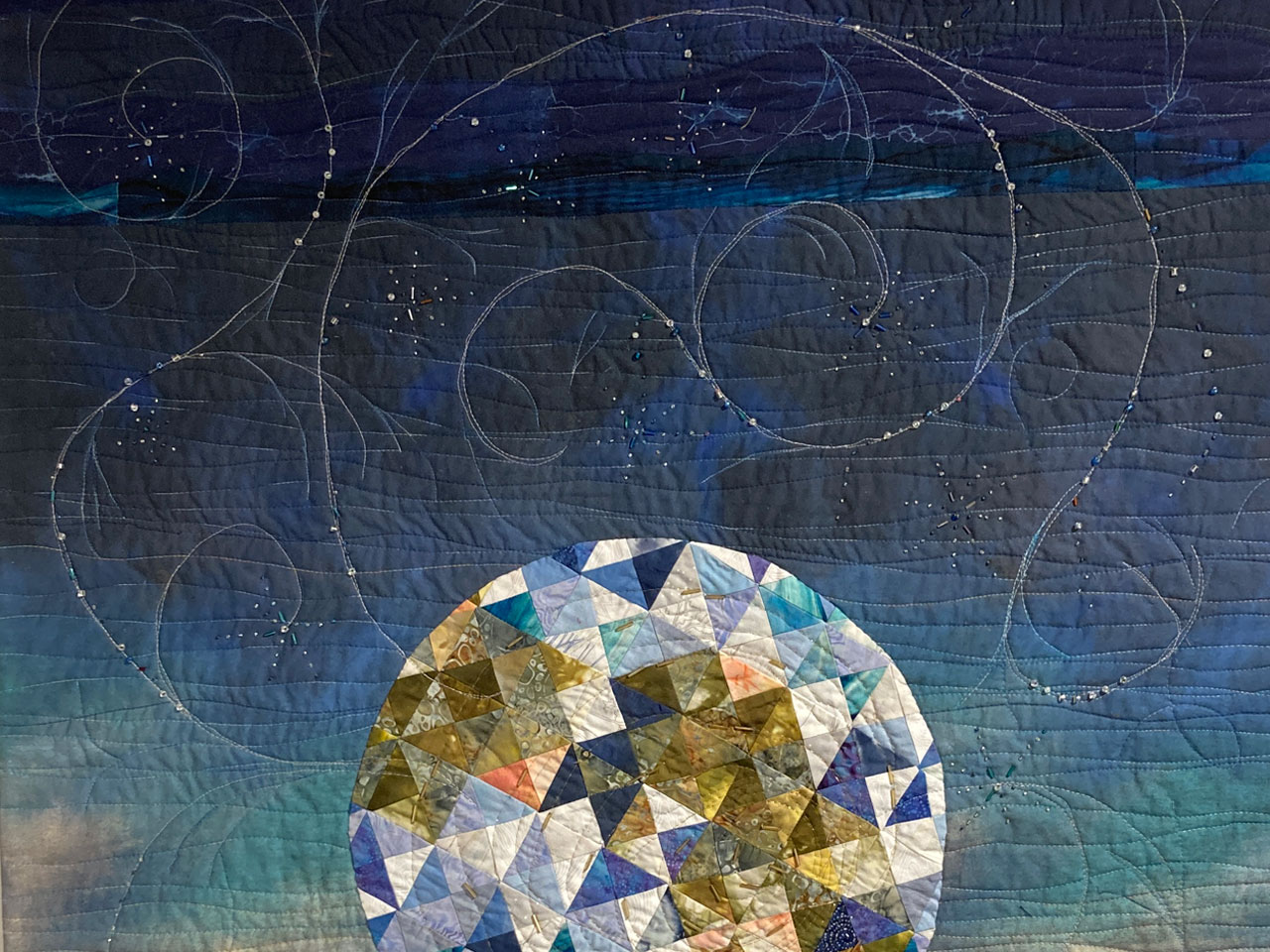
This morning, on a friend’s Facebook page, I read a heartfelt plea for a newsfeed devoid of a Donald Trump’s face. And while I, too, would love an opt-out button for that, it makes me wonder: is that her Algorithm? is she clicking on posts that generate more of that same face? That happens to me, a lot.
Our Algorithms, if you think about it, are mirrors of our thoughts — are they not? How we think, what we’re thinking about, often what we thought about yesterday or the day before. The omnipresent Big Brother feeds us more of the same until we are beyond sated, until we’re over-stimulated and over-whelmed, jacked up on fake dopamine, or banging on Read More Read More Read More like a sugared-up teenager at a carnival whack-a-mole.
And while I know (I know) it’s important that we keep informed about current events, that we pay attention to what’s happening in our world — I’m also concerned that we’re collectively helping to create what’s happening by focusing on what’s happening.
It’s called Manifesting. You can read about the positive effects of manifesting in popular books like The Secret (Rhonda Byrne) and Law of Attraction (Esther Hicks and Jerry Hicks).
And before you say hocus-pocus. Remember that prayer is also a form of manifesting.
“According to many spiritual teachings…consciousness creates our reality. What we desire is what we receive. If we are uncertain, we receive the energy of uncertainty. If we respond to crises with worry and negative, thinking, we increase the likelihood of a painful outcome.” — Yehuda Berg, The Power of Kabbalah
Yes, we are living in scary times. Yes, we need to pay attention to what’s going on. But in our attempts to pay attention to what we don’t want, are we losing sight of the things we DO want?
How can we ever hope to create a safe, peaceful, equitable world if our thoughts (and hearts) are always focused on threats, war, and inequalities?
We can all talk about what we don’t want — easily and profusely. Think about it, how many conversations have you had in the past six months about Donald Trump and his insane antics? About the circus that is our government, the atrocities happening to our immigrants, in Gaza, in Ukraine? About what’s happening to America, democracy, and our way of life?
Now, how many times have you talked about what makes a great leader? about the people on the ground doing good work on behalf of those who are suffering? about what you want the world to look like in the future? how many times have you laughed, planted something, created, danced?
All week long, activist and author Jessica Craven’s Chop Wood, Carry Water emails focus on what’s going on, the scary things happening in our government, and actions steps to take. But once a week, she posts Extra! Extra!, a glorious accounting of all of the good things that have happened lately.
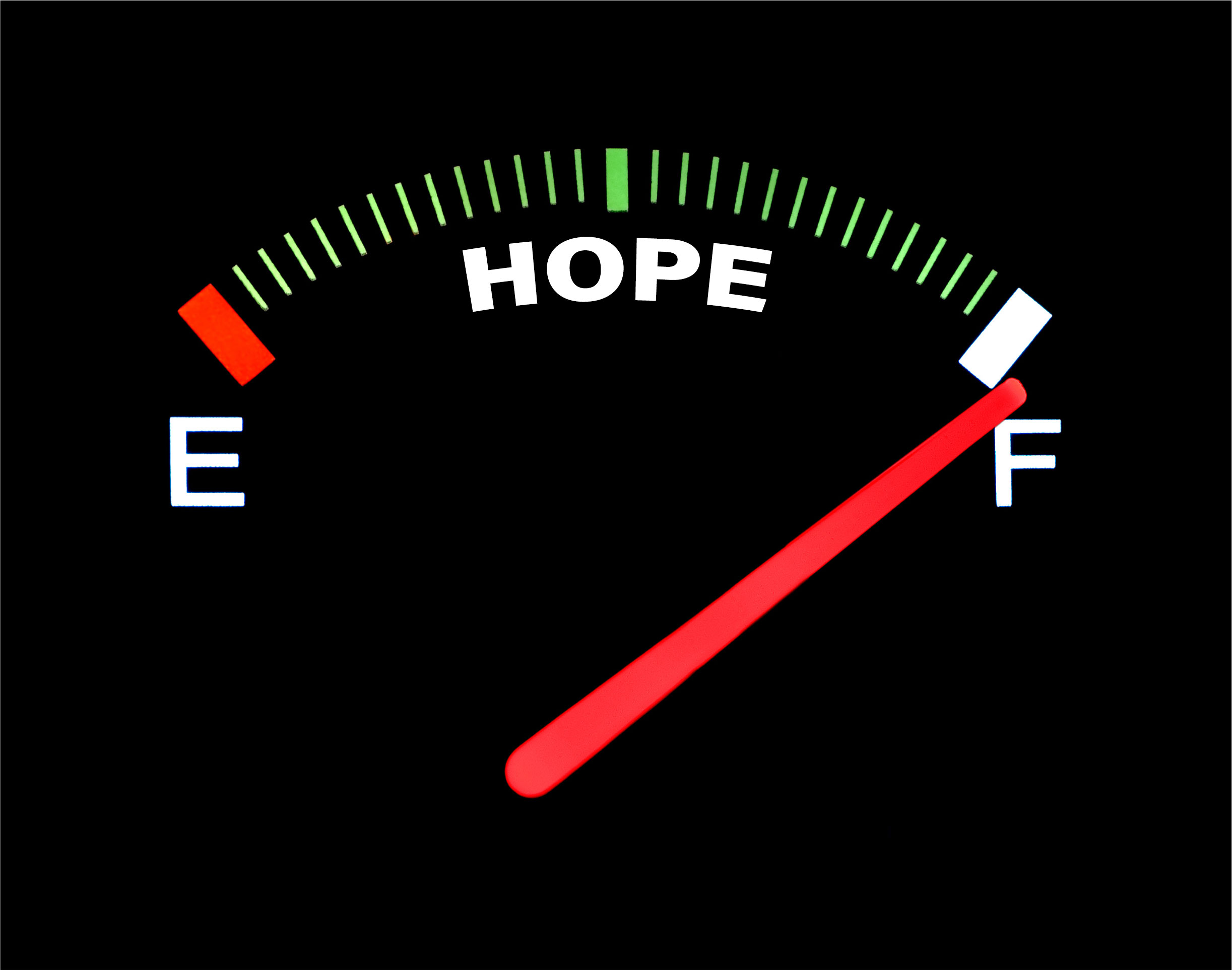
I’ll be honest, by the time Extra! Extra! arrives on Sundays, I am usually stacking another shipment of canned beans in my basement and making sure my stun gun is fully charged. So to read all of the positive things that are happening, all of the forward steps we’re taking, all of the good news despite my Algorithm? My Hope tank fills right back up!
We all need a full Hope tank. So, here are 10 Ways to Fill Yours…
1. Go outside and breathe. 2. Listen to your favorite music and dance (or sing) (or both). 3. Go for a walk in the woods. 4. Have a playdate with a friend. 5. Get creative: make art, write something, bake, garden. 6. Watch a favorite movie. 7. Go to the library and find a book to read. 8. Take a day off social media/media/technology/work. 9. Keep a Gratitude Journal. 10. Change your Algorithm by reading good news; start here.
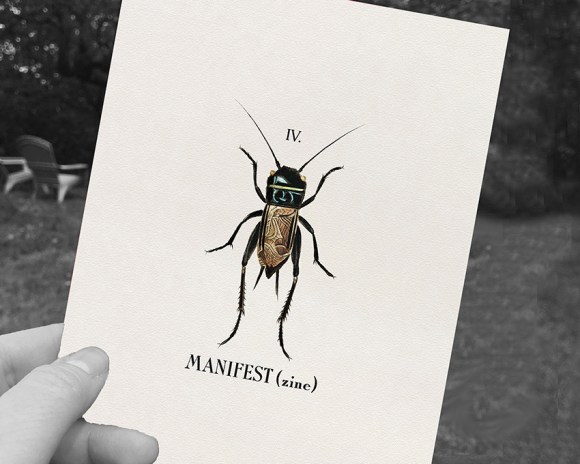
Let’s all MANIFEST the kind of world we want to be living in together!
These days, I wake up with a thin veil of hope. Before the All of it sets in. Again. Then I breathe and stretch. Light incense. Beseech saints and gods. And settle into the morning routine of cat feeding and coffee making — this is the Grounding.
When I am fortified enough, I glance at the headlines and subject lines. Read Jessica Craven’s latest Chop Wood, Carry Water to talk me off the ledge. Remind myself about Chaos Theory, and This Too Shall Pass. Recite the Serenity Prayer: serenity, courage, wisdom. Breathe.
I relay inspiring quotes about Resistance and Creativity and Hope on social media. Call and email my Senators and Representatives. Take small actions of Revolution before I settle into my day, which, for now, is same and sane and familiar.
Familiar enough that at some point, I shake off the Big World things and muck about in my own for a while. The usual: the house repairs, the bills, the client rubbing me the wrong way, that one thing that one person said that irritated the piss out of me, my mother’s caregiving, the impending knee surgery, on and on…
And on…while the world fucking burns outside my window. Literally. Figuratively. Absolutely.
Every time I find myself marinating about my Small World things, I hear Julia Roberts/Liz Gilbert in the opening monologue of the movie Eat, Pray, Love:
“l have a friend, Deborah, a psychologist, who was asked if she could offer psychological counseling to Cambodian refugees — boat people, who had recently arrived in the city. Deborah was daunted by the task. These Cambodians had suffered genocide, starvation, relatives murdered before their eyes, years in refugee camps, harrowing boat trips to the West. How could she relate to their suffering? How could she help these people? So guess what all these people wanted to talk about with my friend Deborah, the psychologist. lt was all, “l met this guy in the refugee camp. I thought he really loved me, but when we got separated, he took up with my cousin. Now he says he loves me, and keeps calling me. They’re married now. What should l do?” This is how we are.”
This is how we are, in part, because we are susceptible to what is called “Crisis Fatigue” — that feeling of overwhelm, lack of control, or the urgency of the next crisis.
And goodness knows, we’re like a Russian doll of crises these days! Everywhere you look, it’s crisis stacked upon crisis upon crisis.
So where is the fulcrum? How do we find a balance between staying informed and hiding under covers? Between revolutioning and resting?
Remember, this is a marathon, not a sprint. You need to make time to drink water, slow down a little, pace yourself.
In her article “When tragedy becomes banal: Why news consumers experience crisis fatigue,” Rebecca Rozelle-Stone , Professor of Philosophy, University of North Dakota asks, “How might we recover a capacity for meaningful attention and responses amid incessant, disjointed and overwhelming news?” and suggests, beyond reining in digital device usage, that we consider:
“Limiting the daily intake of news can help people become more attentive to particular issues of concern without feeling overwhelmed. Cultural theorist Yves Citton, in his book The Ecology of Attention, urges readers to “extract” themselves “from the hold of the alertness media regime.” According to him, the current media creates a state of “permanent alertness” through “crisis discourses, images of catastrophes, political scandals, and violent news items.” At the same time, reading long-form articles and essays can actually be a practice that helps with cultivating attentiveness.”
She also recommends a focus on “more solutions-based stories that capture the possibility of change. Avenues for action can be offered to readers to counteract paralysis in the face of tragedy. Amanda Ripley, a former Time magazine journalist, notes that “stories that offer hope, agency, and dignity feel like breaking news right now, because we are so overwhelmed with the opposite.”
So do that.
But remember…it’s OK to take a day off — from work, from social media, from headlines, from the Resistance.
It’s OK to eat ice cream or take a nap or laugh out loud. It’s OK to make plans, to look forward to things.
Do the things that keep you sane and keep you grounded. Revolution requires Resilience.
In Eat, Pray, Love, the medicine man Ketut suggests to Julia Roberts/Liz Gilbert:
Keep grounded so it’s like you have four legs. That way, you can stay in this world. Also, no looking at world through your head. Look through your heart instead. That way, you will know God.
Today, I talk with Kaecey McCormick at Some Thoughts: Everything Creativity, who writes: “I’m thrilled to bring author Jen Payne to the blog today in an interview to discuss life, writing, and her new book, Sleeping with Ghosts. Earlier this month, I hosted a Community Poetry & Prose Night with the theme “The Ghosts We Carry,” and Jen’s book is a wonderful example of how we can be “haunted” by so much and how these “ghosts” show up in our writing.
Kaecey: Jen, welcome! I’m thrilled to chat about your new book, SleepingwithGhosts. The way you blend genres in this collection is fascinating. Sleeping with Ghosts is described as a ‘time-traveling memoir’ into the heart and mind of a poet. What inspired you to choose this format, and what challenges did you face in crafting such a unique narrative?
Jen: Hi Kaecey. Thanks for being part of the Sleeping with Ghosts blog tour!
Like you, I’m not only a writer and poet, I’m also a blogger. I’ve been writing and creating at Random Acts of Writing (randomactsofwriting.net) since 2010. That name, it turns out, was spot-on! My creative work shifts from poetry and flash nonfiction, to essay and photo essay.
As readers will find in Sleeping with Ghosts, I also write a lot of memoir pieces.
The poems in the book have been written over the past 10-15 years, but they cover a time span of 40! From that perspective, time traveling becomes a natural consequence! (It helps that I’m also a closet Trekkie and a bit of a sci-fi nerd.)
I find I have an acute memory for what I call “defining moments” — those places in time when something shifts or changes, times that you bookmark to remember. I am easily able to slip back into those moments and recall the feelings, the conversations, my surroundings. And then I write!
As happened in my previous books of poetry, Evidence of Flossing and Waiting Out the Storm, the poems in Sleeping with Ghosts gathered themselves quite naturally. As soon as I set the intention to create this book, the poems and chapters, and their organization was very clear. The biggest challenge, I suppose, was making sure that the ghosts each got their own say, and that their stories were told to completion.
Kaecey: I can imagine that covering a time span of 40 years meant some “ghostly” challenges! You did a wonderful job making sure each voice was heard. Much of your writing in this collection reflects on past relationships or experiences. I’m wondering, was there a defining memory or experience that sparked the creation of Sleeping with Ghosts? How did it start and how did the concept evolve from that initial inspiration?
Jen: Indirectly, yes.
I’ve been a writer all my life: journalist, copy editor, freelance writer, marketing wordsmith. I started my own graphic design and marketing business, Words by Jen, when I was 27, and spent a great deal of time writing for other people.
But the year I turned 40, I reconnected with someone I had been deeply, crazy in love with. We hadn’t spoken in 15 years, and our reconnection felt monumental and…karmic.
When it didn’t work out (again), everything broke wide open for me. I had to find a way to write from that place, from that broken-hearted, emotional, vulnerable place. That’s really when I began writing the good stuff!
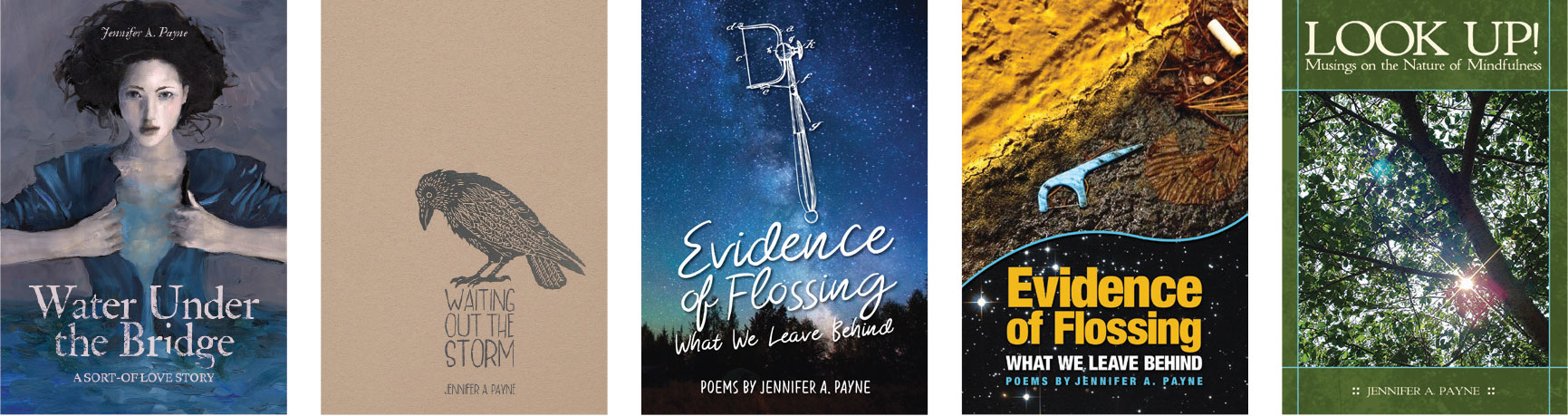
(Actually, you can read about the whole experience in my book Water Under the Bridge: A Sort-of Love Story.)
Kaecey: It’s amazing how those difficult experiences can spark our creativity. And speaking of difficult, your work often explores themes of memory, creativity, and loss. How do you navigate writing about such personal experiences while still making them resonate universally? What advice do you have for poets and other writers who are tackling big themes like grief?
Jen: I think I write about my own experiences because I have to — it’s how I process things, how I connect with the world. Not to be cliche, but writing is my love language.
I’m a bit of an introvert, so writing and storytelling are my way of sharing, of having a conversation, of participating.
I’m not sure I intentionally try to make my work resonate universally, so much as the stories are universal. We all experience these moments —right? The broken heart, the unrequited love, the death of a friend, the relationship we need to leave.
But not everyone has the courage to talk about their experiences. It’s hard work talking about disappointment, broken hearts, loss, and grief.
What inspired me most to write from the heart, to be brave about it, was Brené Brown’s book Rising Strong. In it, she writes, “When we deny our stories, they define us. When we own our stories, we get to write the ending.”
So my advice to writers tackling the big life themes would be a) read Brené’sbook, and then b) be brave and write!
Kaecey: Love that. I’m a Brené Brown fan! So yes! And I appreciate what you just said about our stories as universal human experiences. You’ve also written about our connection to the natural world, and in previous interviews, you mentioned the “alchemy” of emotions, nature, and creativity. I’m hoping you can elaborate on how this idea informs your writing, whether that’s in the language and imagery itself or as part of your process, particularly in this new book, Sleeping with Ghosts?
Jen: There is a certain kind of magic that happens when we can step out of our day-to-day and let new information come in. For me, that very often happens when I walk in the woods or on the beach. For others, the magic happens in meditation or after physical activity.
We’re all so busy these days. And when we’re not busy with actual work — job, house, family, life — we’re regularly seduced by technology and our scrolling, binging culture. Creativity requires us to get away from all of that. How can we hear our Muses when everything else is demanding our attention?
I think it’s important for writers and artists to find those things that let them reconnect with their creative voice. One poet I know recently went on a week-long silent mediation, and when I marveled at that to his wife, she said “That’s him. I prefer moving meditation, like tai chi or yoga.”
For me, being in nature is a critical component of my writing. Whether it’s a regular walk at my favorite nature preserve or a week-long writing retreat by the water — I need that time away to process through the stories and the things I want to say.
And yes, very often there is an overlap of my connection with nature and the imagery and language in my writing, including Sleeping with Ghosts. Of course!
My book Waiting Out the Storm was a very personal tribute to a dear friend who died suddenly. I found the most comfort being in nature, and witnessing how life and death and rebirth play out all around us. Nature was my solace.
That’s what I mean by alchemy — we are part of a much larger universe than our day-to-day. If we can be open to that, give ourselves time and space to come back to our awareness of that, it can infuse our writing and our sense of self in pretty amazing ways!
Kaecey: Beautifully put, Jen. And so helpful for other writers to read about that part of the process. Speaking of process, I feel like, as writers, we’re often surprised by something in our work or in the process itself. Maybe you start a poem about the lipstick case you lost and end up writing about the death of your cat. Maybe you want to write about the sunlight and you end up writing about your toddler’s whining. (Or maybe that’s just me!) In looking back at your journey with Sleeping with Ghosts, what has been the most surprising or rewarding aspect of creating this collection and sharing it with others?
Jen: This is a great question. Our writing can come as a surprise sometimes, can’t it?

One of the most surprising things about Sleeping with Ghosts for me has been how these poems assume their own personality, and almost innately tell the story of each particular ghost…despite the fact that they were written at different times over the past 15 years.
The ghost in I Am a Rock/I Am an Island is unrequited loved no matter when I write about it — in the moment or 10 years later. The ghost in Seeing Red is angry all the time — then and even now.
The other surprising thing — and probably my favorite part about writing this book — is that the ghosts found ways to speak to me. They often showed up to remind me about a moment or a conversation that should be included. Sometimes they needed a final say — and they would chime in while I was on a walk or they’d show up in a dream. “Sleeping in Truro” was one ghost’s final say-so, and “Dear Jenny” was a ghost who appeared just months before the book went to press. When I asked the ghosts to give me a final poem for the book, they sent my Dad who asked, “Did you love?”
I did, I have…and now I get to share that with my readers!
Kaecey: “Did you love?” What a beautiful question and how wonderful to be able to answer in the way that you did! Jen, thank you so much for being here with me today. It’s be a joy to talk to you about writing, life, and your inspiration!
Jen: Kaecey, thank you for these thoughtful questions and the chance to dig a little deeper into the inspiration and ghosts in Sleeping with Ghosts! I appreciate it!
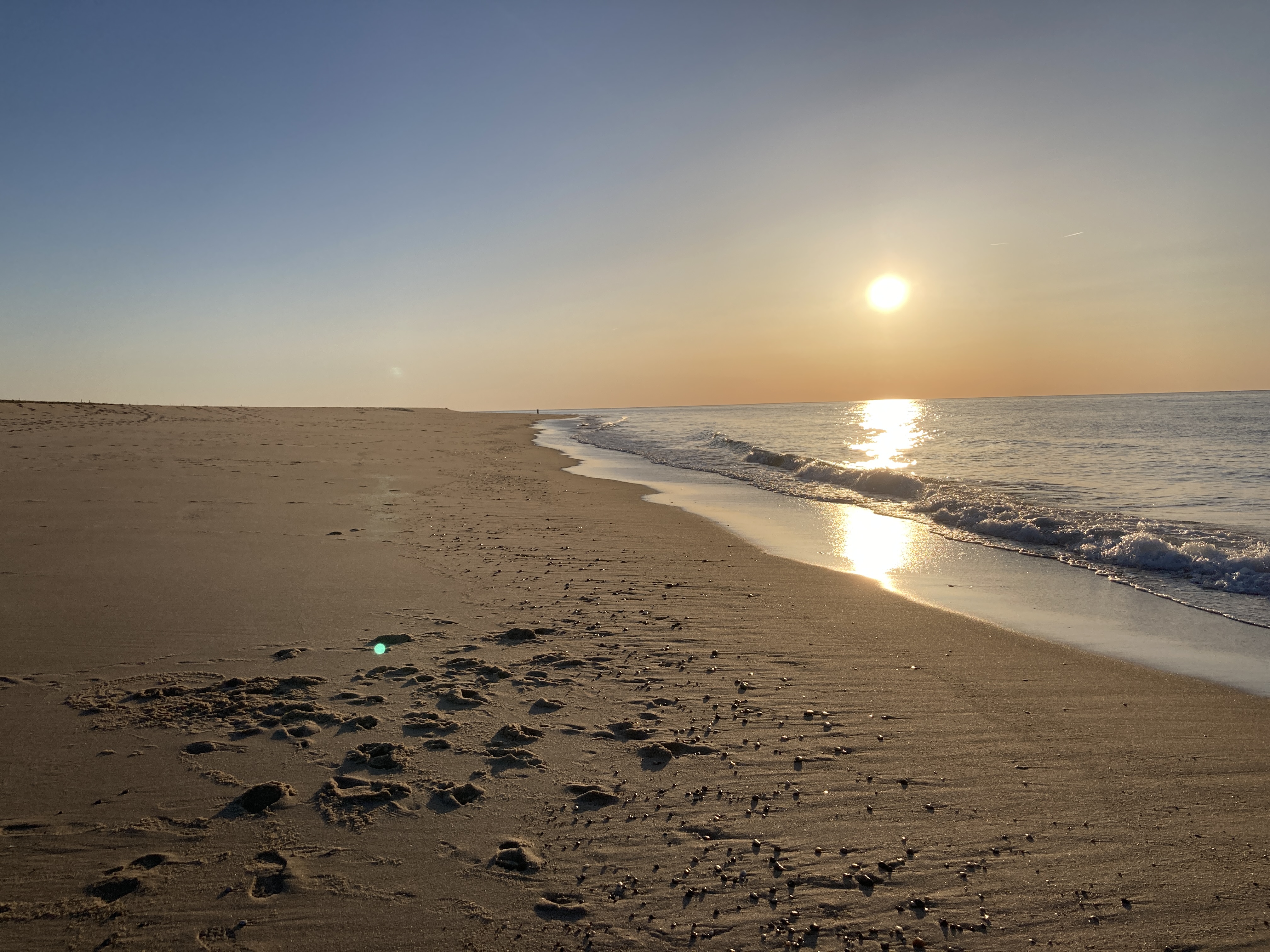
Time alone during a retreat on the shore of Cape Cod, MA.
If the world were a sound, it would be flipping through all of the channels on a radio really fast. Announcers and DJs, commercials and music genres overlapping in the same way our 21st-century tasks seem to layer upon themselves.
We’re always busy, there’s always something else to be managed, and the To Do list is never-ending — one crossed-off item seemingly births two or three more. Work, family, and home responsibilities line up like a song queue on a commercial-free weekend — endless.
If you’re a creative type, like I am, though, you need to turn down the volume sometimes. All of that noise — all of those weighty expectations —stifle our ideas and muffle our creative voice.
And while a Vacation can be helpful sometimes, that’s a different genre of time off, usually involving a barrage of activities, schedules, attractions, must-dos, and must-sees. What’s more beneficial to your creative spirit is a Retreat.
What’s the difference?
I like to think of Retreat as all about the R words, like: Relax, Rest, Regroup, Restore, Reflect, Reset, Roam, Read, Recharge, Replenish. Get the idea?
It’s time without any expectations or To Do lists, and time “off the grid,” if you can stand it.
According to an article by executive coach Rebecca Zucker in the Harvard Business Review, taking time off has reverberating positive effects on your sleep, memory, concentration, mood, and stress level.
Time off, she explains, “can allow you to tune out much of this external noise and tune back into your true self. You can start to separate the striver part of you, let go of your ego, and reacquaint yourself with the essence of who you really are…feel a sense of peace…and do things that bring you joy.”
How’s that for motivation?
For the last 12 years, I’ve taken a week-long Retreat on the shores of Cape Cod. I spend my time reading books, walking by the water, and taking long afternoon naps. I eat simple meals, spend time in nature, write some poetry, and remember how to breathe deeply again. I try to make it a quiet experience — time for rest and reflection, not a tourist jaunt or food tour.
Of course, not everyone has the time or resources to take off by themselves for a whole week. Sometimes I don’t either. Sometimes, an overnight at a hotel with a good book and a picnic basket of food is time enough. A Sunday drive down the highway with the radio on and the windows open can clear my head as much as a long walk by the ocean. And always, a morning hike in the quiet woods reminds me that somewhere beneath all the layers of noise, my creative voice is waiting for her opportunity to sing!
What’s your ideal Retreat? Can you think of two or three ways — grand and small — that you can tune back into your creative spirit?
For the poet is a light and winged and holy thing, and there is no invention in him until he has been inspired and is out of his senses, and the mind is no longer in him… — Plato
Ghosts, Muses, Inspiration, Universe, God. Call it what you will — there is another layer of this world that we live in, and if you can quiet your mind, sometimes, you can hear it and be inspired by it!
As I was finishing up the manuscript for Sleeping with Ghosts, my editor and I both agreed something was missing. While I loved the final poem “Missing Banksy,” its alluded message about impermanence wasn’t quite strong enough to hold up the end of the book. But what would? I had no idea!
When I get stuck like that and can’t find answers — about my writing or about life in general — I like to walk in the woods. It’s where I can settle my mind, slow down the busy-ness, and sometimes…sometimes…hear ghosts.
On this particular walk, I started out at the trailhead by asking the Universe to help me find a final poem, a final message for the book. Often, I can entice Inspiration with a request like that, and this time, it responded in the voice of my Dad.
It’s not the first time my Dad’s ghost has spoken to me. He told me to PAY ATTENTION on I-95 once and saved me from a pretty awful accident; he often shows up unexpectedly as a hawk with a call of I AM HERE; and he responded to my poem query with a series of questions that became the poem “The Final Ghost.”
But connecting with our ghosts can be challenging! There is so much noise in the world today — we’re busier than ever, more distracted by things, more seduced by technologies. There are so many things demanding our attention, how can we possibly hear Ghosts, listen to Muses, or tune into our Inspiration?
One of my all-time favorite movies is Contact with Jodi Foster. The scene I think about often is when she is in the portal pod that’s been reconfigured with an anchored chair and seat belt — things to keep her rooted in place as she travels across space through wormholes. But as she starts her journey, the chair and seat belt cause more harm than good. She may be OK to Go, but they keep her too firmly in place. It’s only when she releases what holds her down that she projects openly forward.
In the same way, listening to your Ghosts requires that you release what’s holding you back.
For Jodi Foster’s character Ellie Arroway, what was holding her back was physically obvious. For me, I know that my biggest obstacle is technology and how it eats up my time and siphons my attention span.
So, what gets in the way of listening to your Ghosts?
Just this weekend, I talked with a woman who told me in a whispered voice how she stopped listening to her Ghosts because it seemed a little scary. And I have a friend who is a phenomenal painter, but she often ignores her Inspiration because it feels too powerful, almost possibly un-godlike.
But the idea of listening to Ghosts or Inspiration or Muses reaches far back into human history.
Did you know that “the word inspiration ultimately derives from the Greek for ‘God-breathed’ or ‘divinely breathed into.’ In Greek myth, inspiration is a gift of the muses, the nine daughters of Zeus and Mnemosyne (Memory).”
Similarly, “the Oxford English Dictionary defines inspiration as “a breathing in or infusion of some idea, purpose, etc. into the mind; the suggestion, awakening, or creation of some feeling or impulse, especially of an exalted kind.”
In his article “How to Find Inspiration, the Psychology and Philosophy of Inspiration,” writer and philosopher Neel Burton offers seven 7 simple strategies to encourage inspiration:
1. Wake up when your body tells you to. 2. Complete your dreams. 3. Eliminate distractions, especially the tedious ones. 4. Don’t try to rush or force things. 5. Be curious. 6. Break the routine. 7. Make a start.
I am a part of all that I have met; Yet all experience is an arch wherethro’ Gleams that untravell’d world whose margin fades For ever and forever when I move. How dull it is to pause, to make an end, To rust unburnish’d, not to shine in use! As tho’ to breathe were life! Life piled on life Were all too little, and of one to me Little remains: but every hour is saved From that eternal silence, something more, A bringer of new things…
We all have ghosts — those lingering memories that resurface when a song comes on, when a certain scent fills the air, or when we wander in our dreams. Those are the kinds of ghosts that appear in Sleeping with Ghosts — the memories of moments and people who have wandered into my own life, the lovers and soulmates and muses to whom the book is dedicated.
As I was gathering the poems for this book, I kept hearing the phrase “I am a part of all that I have met.” It’s a line from Alfred, Lord Tennyson’s poem “Ulysses,” in which the protagonist reflects on his life and sees the fabric that is woven between him and his experiences. That is the essence of Sleeping with Ghosts, we are all connected — by memory, by story, by experience. To emphasize that, readers will find common phrases, themes, and symbols repeated throughout the chapters and stories in the book — a weaving of love, hope, and loss. (Humor, too.)
In total, there are 14 chapters in the book, including seven primary ghosts about whom I’ve written most frequently. These are the stories that captured my attention (and my heart) and left a shadow of memory long enough for me to step into now and then, to revisit and repurpose them into poems. The seven ghosts include a first love, the last love, secret encounters, and those defining moments that come from living life with an open heart.
There are two chapters dedicated to my muses — the people who have inspired my life in a variety of ways, including life-long friends and cherished mentors — and a chapter that narrates the Ephemera of life’s encounters.
My favorite section of the book is called Dreamwork. It’s a collection of 12 poems presented like an inquiry or analysis with dated entries that note the particular ghosts as they reappear in dream form. These dream-ghosts are the wistful spirits of What If or Might Have Been, Ulysses’ “untravell’d world whose margin fades.” I truly believe that dreams offer all of us an opportunity to reconnect with our memories, heal old wounds, and reinterpret moments in new and helpful ways.
I hope this book, as a whole, offers readers a chance to see things in new ways. That in the shadowy corners of their own memories, they might conjure up the “something more, A bringer of new things…” for themselves.
Remember, we all have ghosts. Give them a direct line to your Muse, and you never know what will happen!
My mother, who is easily insulted, often remembers the time a therapist called her a storyteller. Mom recounts the comment as one might an injustice, and she twists and elongates the word “storyteller” to make it sound as painful as it felt for her.
What’s the old saying? The truth hurts.
That’s the funny thing about my mother’s story — she IS a storyteller. Long before neurodivergent was a word, my mother was making her way through life with the only tools she had, and one of those was storytelling. Often and on repeat. It’s how she relates to the world and people around her.
I have a friend whose mother was also a storyteller. She had a degree in drama, was in numerous theatrical productions, taught children how to act and perform, and went on to start a successful annual storytelling festival. She also found connection in telling stories.
The act of storytelling is as diverse as these two examples and includes four primary forms: oral, visual, written, and digital. Within each of those forms, there are a myriad of vehicles: books and magazines, visual arts, stage, radio, film, television, video, internet.
Consider all of the ways storytelling comes into your own life! It’s part of the fabric of who we are. Think about it! What would we be without our fairytales, folktales, fables, religions, and mythologies? We are built on story!
And quite literally. This is what social scientist Brené Brown, says about storytelling in her book Rising Strong: How the Ability to Reset Transforms the Way We Live, Love, Parent, and Lead.
“We are wired for story. In a culture of scarcity and perfectionism, there’s a surprisingly simple reason we want to own, integrate, and share our stories….We do this because we feel the most alive when we’re connecting with others and being brave with our stories — it’s in our biology. The idea of storytelling has become ubiquitous. It’s a platform for everything from creative movements to marketing strategies. But the idea that we’re “wired for story” is more than a catchy phrase. Neuroeconomist Paul Zack has found that hearing a story — a narrative with a beginning, middle, and end — causes our brains to release cortisol and oxytocin. These chemicals trigger the uniquely human ability to connect, empathize, and make meaning. Story is literally in our DNA.”
Like my mother, I’m also a storyteller. I frequently use analogy and story not only to talk about my own experiences, but to say, “I understand yours, too. Let’s talk about it.” It was Brené Brown who gave me the courage to tell those stories on paper, and who inspired several of my books, including my new collection of poems, Sleeping with Ghosts.
That book, Rising Strong, still sits on my coffee table — dogeared and well-worn — as a reminder to be brave, to show up, and to keep telling my stories. The book ends with her “Manifesto of the Brave and Brokenhearted,” which I’ll share with you here as inspiration for you to tell your own stories because what you have to say — no matter how you say it — is important!
Photo by Kool Shooters/Pexels.Brown, Brené. Rising Strong: How the Ability to Reset Transforms the Way We Live, Love, Parent, and Lead. United States: Random House Publishing Group, 2017.
People often comment about the visual nature of my creative work, and how my writing is usually accompanied by photography or artwork.
As a graphic designer, artist, and writer, I firmly believe that partnering visuals and words layers the intentions of my work and makes the communication more palpable.
Two of my previous books, Look Up! Musings on the Nature of Mindfulness and Evidence of Flossing: What We Leave Behind, were as much about the color photographs as they were about the essays and poems. As a matter of fact, the whole concept of the poems in Evidence of Flossing was inspired by a series of photographs I took showing discarded dental flossers in random places.
Odd, I know, but they spoke to the message — our disrespect of nature — in a necessary and immediate way. Sometimes writing takes a while to be absorbed, while images have a speedy hook!
LOOK: THIS IS WHAT I WANT TO TELL YOU! (Read More)
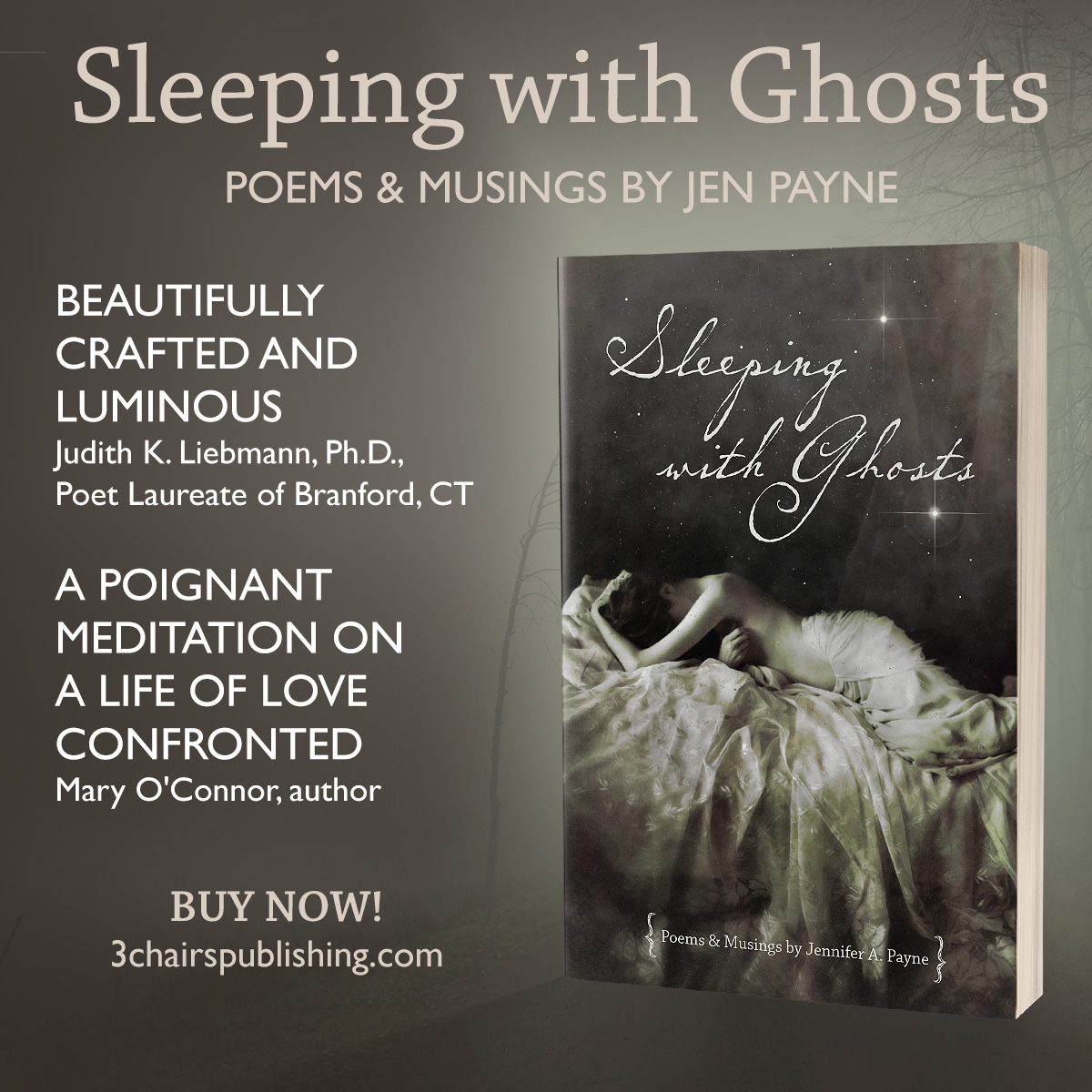
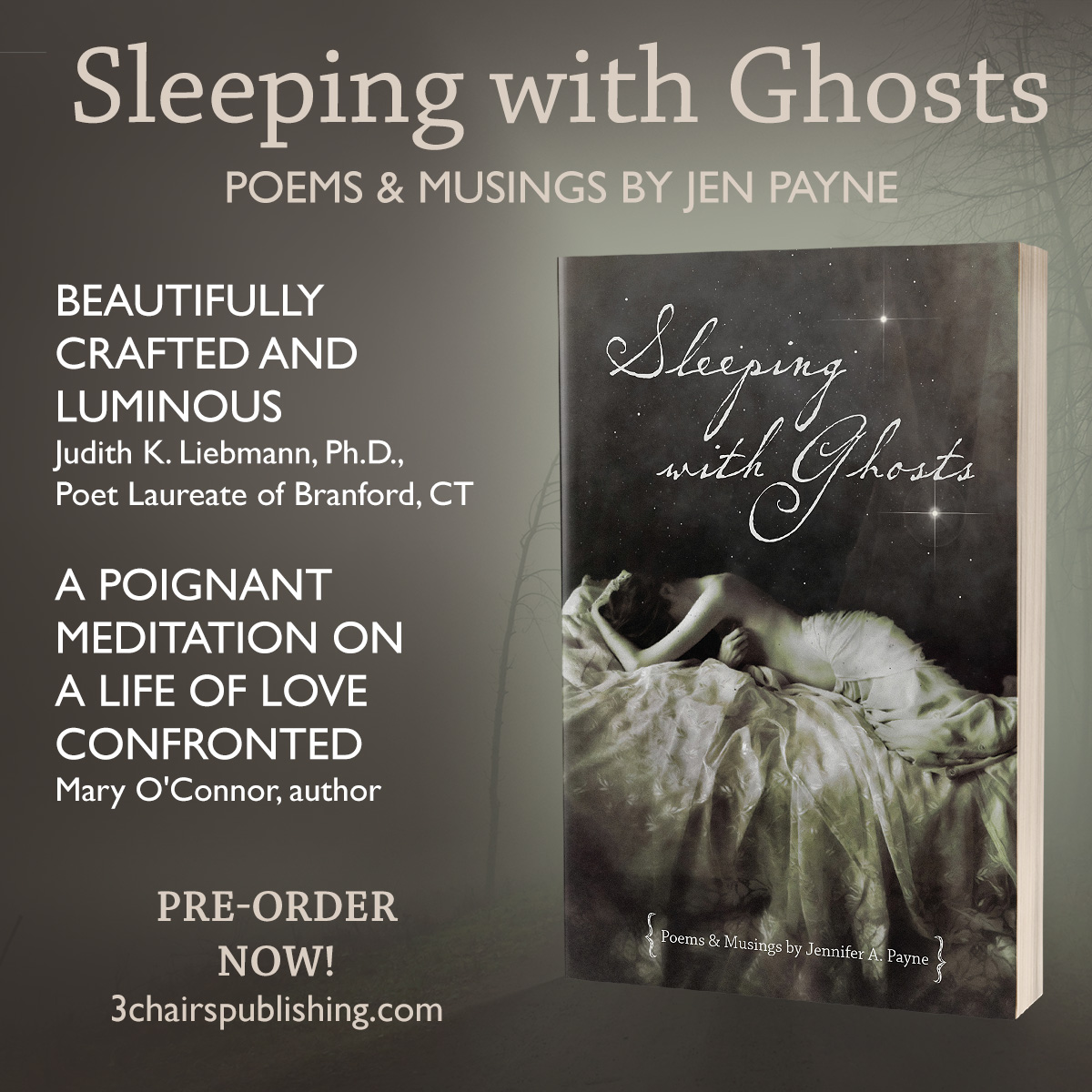
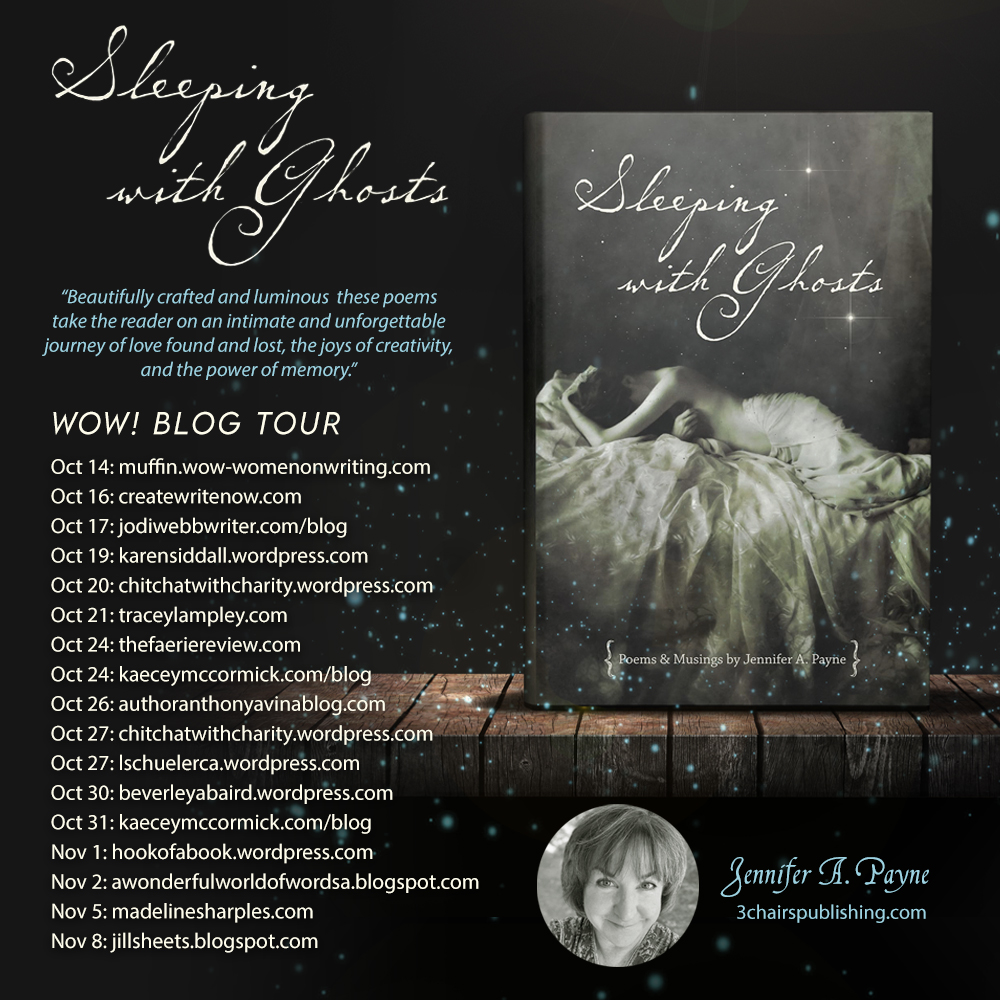
I love that the cover of my new book, Sleeping with Ghosts, does exactly that: it grabs your attention!
The cover photograph is by Polish artist Malgorzata Maj, who I connected with online back in 2015. (Yes, I’ve known the book’s title and have had that photo saved for nine years!)
Małgorzata is a contemporary painter and photographer known for her symbolic nighttime landscapes and ethereal portraits exploring the world of the Unknown. She graduated in 2004 (Olsztyn/Poland) with the title of Master in Arts. Influenced by 19th-century symbolism, her photographic works feature a bold painterly approach to the compositions she depicts. She has exhibited in galleries across the U.S. and Europe, and published her works on numerous book covers and magazines. Today she mostly focuses on traditional media such as oil painting and continues to explore themes and ideas less accessible for photographic medium.
In a bit of happenstance, on her website, Malgorzata says she “explores haunted places, past memories, and hidden feelings and symbols,” which really is the essence of Sleeping with Ghosts.
“Photography has this unique quality of something real and intangible,” she says, “…something that I find difficult to speak about. It is the language of ghosts.”
For the cover, I accented Malgorzata’s photograph with a cluster of stardust that appears in several places within the book. It’s from a series of images in a Lunar Calendar collection by Lana Elanor that includes stars, moons, and constellations.
Elanor is an independent artist from Ukraine who now lives in Tulum, Mexico. She is “a meditative person passionate about art, travel, and the study of the conscious and unconscious mind.”
About her work she says, “I’ve loved creating art for as long as I can remember myself. Only beauty itself is a catalyst for the awakening of this world, so I’m totally in love with the concept to make this place more beautiful than it was when we got here.”
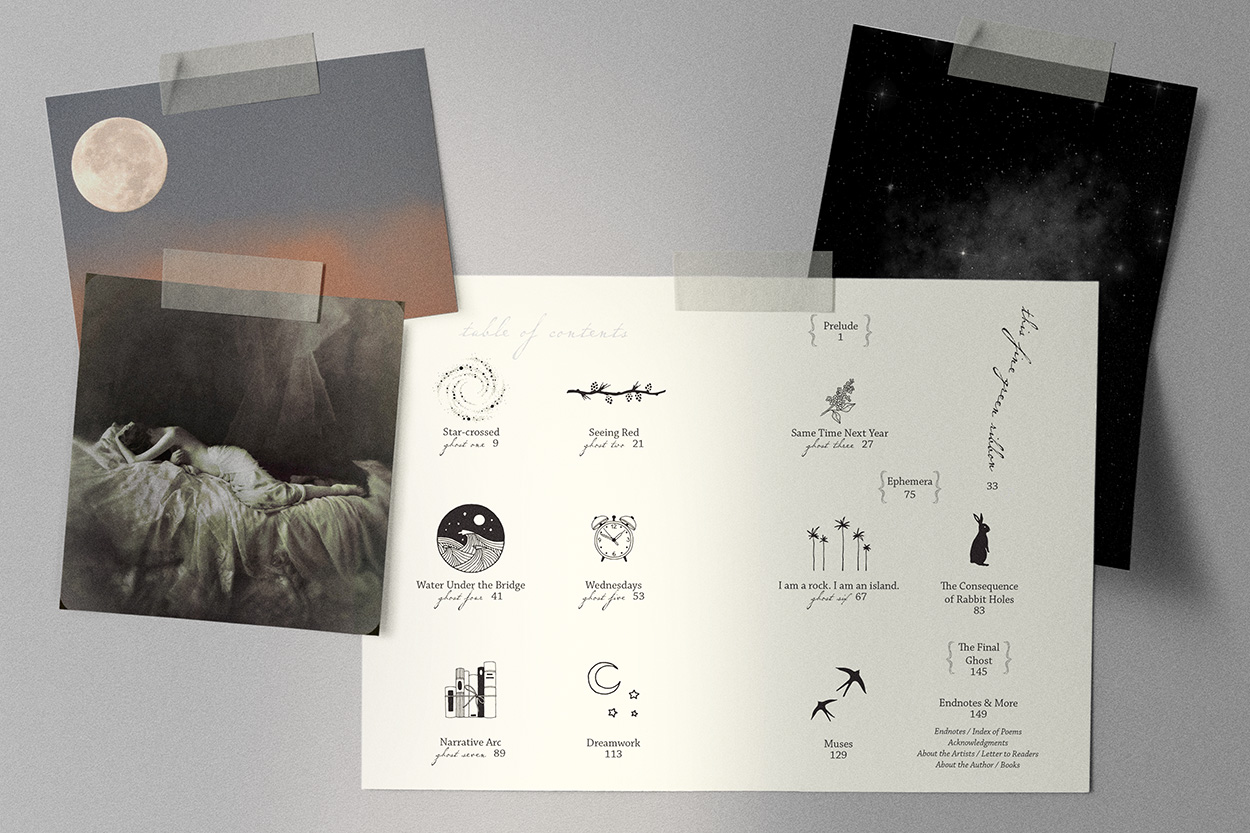
The illustrations that introduce each chapter, and entice the reader from the Table of Contents, are by Ukrainian artist Michael Rayback. I connected with Michael about his art in 2022, and we were both excited to include his work in my book. But Michael lives in Kyiv, and our last correspondence was several months after Russia invaded Ukraine.
I check his social media from time to time, to see if he is back online, but unfortunately, we have not reconnected. When I think of him, I remember this quote I saw on one of his sites:
“Art is self-expression, therefore all that you see here is a part of me. I know many languages of self-expression. I like drawing, I love photo art, cinema is one of the main parts of my life, I like cooking tasty and healthy food. I wake up at five in the morning to be alone and tune in for a new day, and the sun tells me that I’m doing everything right and inspires me to new creativity. I do yoga and meditate. All this helps me to explore myself, I learn something new every day, and every day I try to be a little better.”
Something we can all aspire to, right?
I do hope you appreciate the collaborative nature of Sleeping with Ghosts. Please visit these artists online and discover more of their work!
Did you know that Picasso created more than 50,000 works of art, but only about 100 of those are considered masterpieces? That’s less than 1% of his work!
I think about that little fact every April, when I attempt to write a poem a month for NaPoWriMo (National Poetry Writing Month). There aren’t a lot of masterpieces, for sure, but a few have been published. So there’s that.
Of course, lots of folks will point out the averages — ONE percent?!? And you’ll never be at a loss for angsty advice about being a writer. Ernest Hemingway said “There is nothing to writing. All you do is sit down at a typewriter and bleed.” Robert DeNiro considers a writer on a good day to be “isolated, neurotic, caffeine-addled, crippled by procrastination, consumed by feelings of panic, self-loathing, and soul-crushing inadequacy.”
Oh my. Does it have to be that painful?
I’ve been privy to lots of conversations about writing lately. I don’t have time, they say, or my work isn’t good enough, I can’t stop editing, what will people think?
I like what writing guru Natalie Goldberg advises: “Say what you want to say. Don’t worry if it’s correct, polite, appropriate. Just let it rip.”
That’s the approach I go by every April — just write. I suppose it’s the approach I take all year long. Just do it, like Nike says.
Author Neil Gaiman suggests, “This is how you do it: you sit down at the keyboard and you put one word after another until it’s done. It’s that easy, and that hard.”
Exactly, it’s that easy and that hard. I think it’s kind of like the lottery slogan: you can’t win if you don’t play. How are you ever going to write a masterpiece if you’re not writing all along?
“If one… is blessed with the gift, of the most perfect balloon,… one must make all accommodations to hold fast… else that perfect thing might slip from a grasp….”
Payne’s latest collection of poems, musings, and artwork is a bouquet of balloons—lovers, friends, and moments she could let slip away but that she keeps close through her writing about them. Grouped around seven (plus a final) ghost and a few intermediary themes, the poems are arranged and curated. Each section features a title page with artwork that spills over into the succeeding pages, creating both distinct moodscapes and an overarching synthesis. The poems are of a variety of lengths and styles. Few rhyme, some are one-hundred-word prose poems, and one about a necklace aptly curves down the page. Along with the whimsical illustrations, the song lyrics that several poems reference set an overall lively tone.
Although many poems are dedicated to someone specific, the people in the poems are unnamed. The subject matter of stars, ghosts, and dreams set the poems on an abstract plane, but they remain concrete by being located specifically in cities, bedrooms, houses, woods, and shared books. The poems give voice to letters never sent, connect people when in-person communication was lacking during the pandemic, and put words to elusive feelings hard to name in any clinical way.
In many of the ghost poems, lovers’ rendezvous are clandestine or fleeting. Likewise, the poems let readers into a delicate and secret balance between worlds. Like one poem about a dream lingering into wake-time, the collection is liminal, linking opposites: definite and indefinite, reality and fantasy, timeless and time-specific, and indescribable and descriptive. The final poem, dedicated to Payne’s father, crystallizes the collection’s intimate and loving atmosphere. She looks at her child self—hopeful, aspiring, tender—through her father’s eyes. So, too, the poems reflect back childlike wonder that enlivens and inspires.
Some of my all-time favorite books on writing are classics, like Bird by Bird: Some Instructions on Writing and Life by Anne Lamott, Poemcrazy by Susan Goldsmith Wooldridge, or Writing Down the Bones: Freeing the Writer Within by Natalie Goldberg. Those were the must-read books when I was coming of age as a writer.
I’ll be dating myself even further when I say that I much prefer Goldberg’s Wild Mind: Living the Writer’s Life to her popular Writing Down the Bones. I remember reading Wild Mind while sitting in an airport and feeling compelled — literally dragged to my feet — to go buy a notebook and pen so I could write right there.
That’s some powerful how-to magic.
That’s the kind of book you want in your TBR pile if you’re a writer in need of writerly guidance. Something that feels like magic!
One of my most dog-eared books is Brené Brown’s Rising Strong: How the Ability to Reset Transforms the Way We Live, Love, Parent, and Lead, which isn’t a how-to-write book at all. It’s a spellbinding get-out-of-your-comfort-zone-and-tell-your-story kind of book.
For a quick dose of that kind of brave magic, read any of The Moth compilations: Occasional Magic: True Stories About Defying the Impossible, A Point of Beauty: True Stories of Holding On and Letting Go, or All These Wonders: True Stories About Facing the Unknown. Talk about how to tell a story. Wow!
For those of you having a hard time finding inspiration? You gotta shake it up!
Do you know Keri Smith? She’s most well-known for her book Wreck This Journal. But she has a whole, delicious series of books that make you look at the world in curious new ways. Try The Wander Society or How to Be an Explorer of the World, and you’ll see what I mean.
For me, the key to writing is seeing the world with fresh eyes — which is what Smith’s books help you do. But there are other ways to do this.
Lots of writers write books about writing, right? Who better to know how to do it than a Stephen King (On Writing) or a Margaret Atwood (On Writers & Writing)?
But I find I am more inspired to write my own stories when I can get lost in one of theirs, like Atwood’s MaddAddam series, or Ransom Riggs’ Miss Peregrine’s Peculiar Children series.
Some of my favorite more recent get-lost books — the ones that help me shake up day-to-day — include The Book of Form and Emptiness, Ruth Ozeki, Cloud Cuckoo Land, Anthony Doerr, The Starless Sea, Erin Morgenstern, and The Watchmaker of Filigree Street series by Natasha Pulley.
Of course, you have to find your own favorite authors and genres, but don’t be afraid to mix it up! I spent one winter in a back-to-back foray of historical fiction books about World War II, while just this spring I devoured Tony DiTerlizzi’s young adult sci-fi series The Wondla Trilogy!
These might seem a little off-track from the topic of “How to Read Like a Writer,” but as Steve King himself says:
“If you want to be a writer, you must do two things above all others: read a lot and write a lot. There’s no way around these two things that I’m aware of, no shortcut… If you don’t have the time to read, you don’t have the time or the tools to write.”
Today, I talk with more Charity Howard at Chit Chat with Charity. You might remember her from the “Power of Writing Through Poetry, Memories” review she did of Sleeping with Ghosts. Today, we chat interview-style. Check it out!
JEN: Hi Charity.
Thank you for being part of the WOW! Women on Writing blog tour for my book Sleeping with Ghosts, and for taking the time to ask some good questions!
What is your favorite part of your book and why?
JEN: I love that Sleeping with Ghosts is not just a book of poetry or a memoir, but it’s also a visual experience. The stunning cover photo, by Polish artist Malgorzata Maj, captures the mood of the book so perfectly. The artwork by Michael Rayback and Lana Elanor illustrates the themes of the individual chapters and adds a bit of whimsy to the pages.
And while I love all of the poems, I think my favorite part is the Table of Contents and how it tells the story of the book at a glance. I like how it’s not just a block of text with page numbers, but a cipher for how to read the book. It feels like one of those maps you find at the beginning of adventure books or a legend that tells you how to travel forward.
What is your biggest inspiration for this poetry and musings book? Or perhaps the poem that stands out the most for you?
JEN: First and foremost, I am a storyteller. It’s how I relate to the world, how I communicate experience and understanding. I talk in story…remember the time?
Many of the poems and musings in this book are stories that live inside me already. But it’s not like I am thinking about, or “dwelling on” things, all the time. The stories just get primed to come to the surface sometimes.
It’s like when you hear an old song on the radio or smell a certain perfume in the air, and it reminds you of a memory? As a writer, I am able to follow those memories and pull out a poem or a short story.
A good example of this, and one of my favorite poems in the book, is called “Chester, 1 a.m.” I was driving down the highway when the Jethro Tull song Bourée came on the radio, and I was immediately transported back many, many years to this short, sweet memory…
CHESTER, 1:00 A.M. You will always be blue flannel, a plaid hard crush against skin, Bourée on a flute in the dark, and the taste of unseen spirits. Your sudden kiss, the punch-drunk dance against kitchen counter — what did you want from me in that brief romance? I still wonder.
That’s how inspiration works for me. My muse shows up in many forms with suggestions for which way to take my writing next. And I follow.
What is your advice for poets as they write their inspired work?
JEN: Listen to your Muses, not your Critics!
Your Critics are going to tell you how to write and what to write. They’ll tell you what’s good and bad, correct and incorrect. They’ll be rather black-and-white about things.
Your Muses, on the other hand, are creative and wild, and they love to color outside of the lines. Play with that and with them, and just follow your heart.
Be brave enough to tell your story the way you want to tell it!
What do you feel is the most important part of your writing process?
JEN: Making time for it. Period.
We’re all so busy with so many things that need to get done in a day. But that creative process, the process of expression, is so important to our well-being. As important as movement or rest or nourishment.
And just like those things, you have to make time for your creative work.
I am a notoriously early riser, and I will often spend the first few hours of my day writing. I love the quiet of the early morning before everything is awake and noisy again.
A 3 a.m. start works really well for me, but you have to find what works for you. Maybe it’s the other side of the clock midnight-writing, or an hour at a coffee shop with your laptop.
Remember, your creativity is a gift, and it’s important that you give it time to exist and prosper.
What would you say to describe your book to help entice readers to pick it up?
JEN: One of my readers — who is also a ghost in the book — once said my writing is “funny, sad, sexy, maddening.”
Sleeping with Ghosts is a time-traveling memoir that introduces readers to some charming characters — star-crossed teenagers, secret lovers, and long-term loves. It’s about romance, heartbreak, dreams, found love and lost love, memories. It’s also a book filled with story, inspiration, creativity, and pages and pages of beautiful muses without whom this book (and I) might not exist.
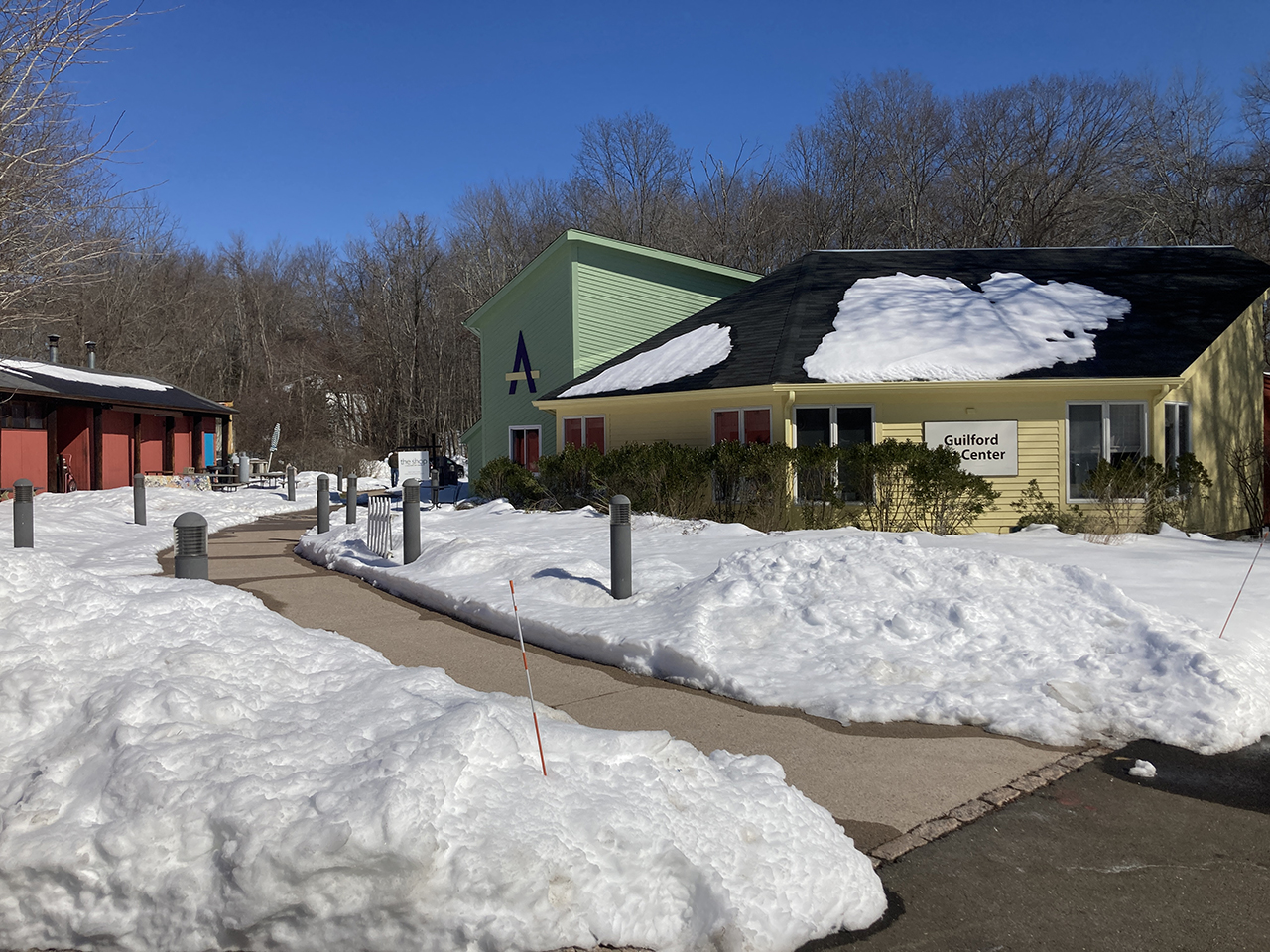
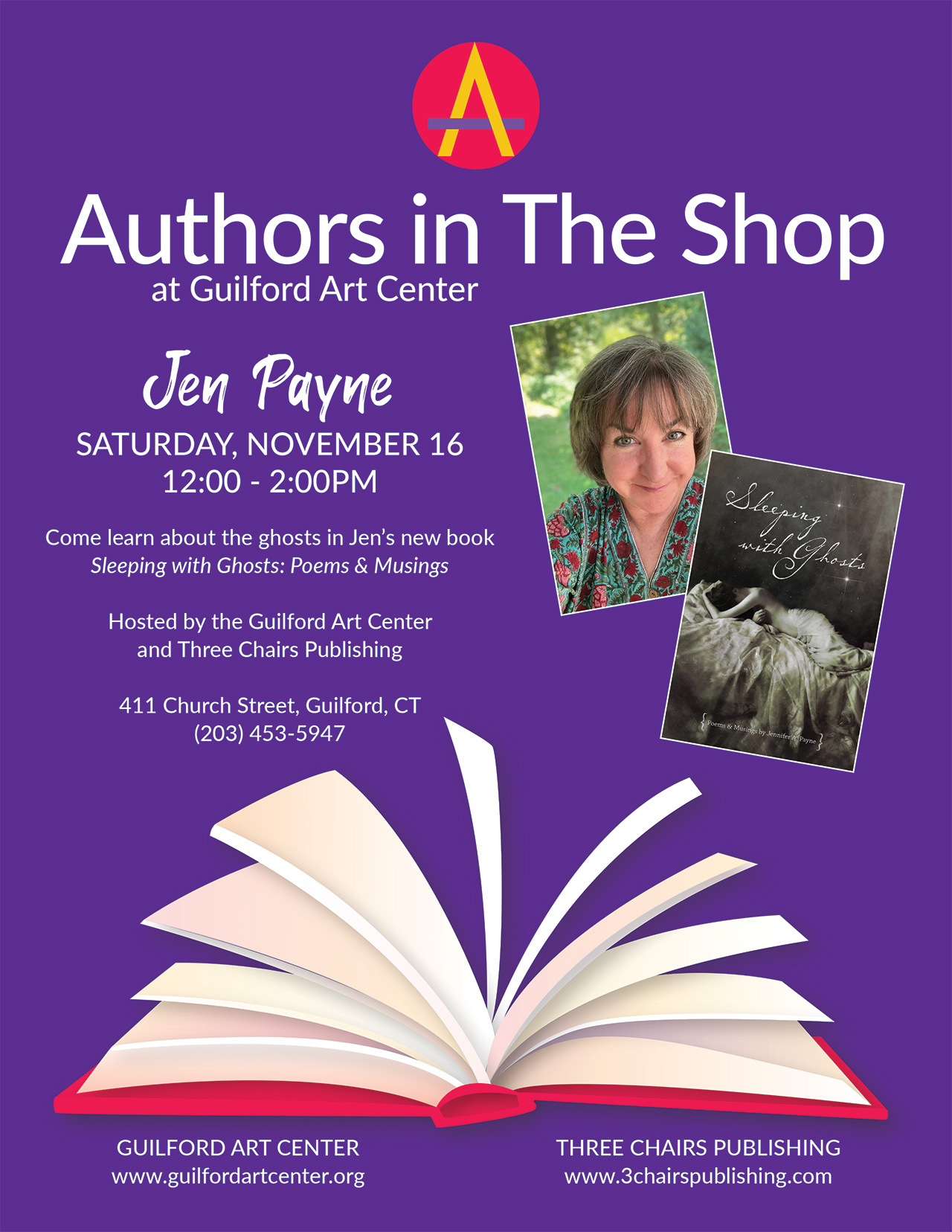
Guilford Art Center is excited to welcome local author Jen Payne to its AUTHORS IN THE SHOP series hosted by Three Chairs Publishing. For four Saturdays in November, authors will be in The Shop signing books and talking with Holiday Expo shoppers from 12:00 – 2:00 p.m.
Saturday, November 16 Learn about the ghosts in Jen Payne’s new book Sleeping with Ghosts: Poems & Musings, an intimate exploration of memory and meaning.
Known for her meditations and musings about our outside world, Connecticut writer Jen Payne takes readers inside this time…into the heart and mind of a poet, where memories wander, hearts break, and ghosts appear in dreams. Those ghosts — her lovers, soulmates, and muses — reveal themselves slowly, one at a time, in this wistfully reflective, time-traveling memoir.
AUTHORS IN THE SHOP is a great opportunity to spend some one-on-one time with local authors and to get a head start on your holiday shopping. (Signed books make awesome gifts!) Refreshments will be served. (Click here for more information.)
Out and about for Shoreline Arts Trail? Be sure to make time to explore Holiday Expo 2024! The Shop and Gallery at Guilford Art Center are filled with holiday gifts from local and American artists, makers and designers; craft categories include accessories, candles, cards, ceramics, clothing, fiber art, glass, homewares, jewelry, leather, Christmas ornaments, soaps, specialty foods, stationery…as well as signed books from our guest authors.
Authors in The Shop at Guilford Art Center and Holiday Expo are free and open to the public. Guilford Art Center is located at 411 Church Street, Guilford, off I-95, exit 58. The Shop is open 7 days a week, Monday-Saturday, 10:00 a.m. – 5:00 p.m., and Sunday 12:00 – 5:00 p.m. For more information, visit www.guilfordartcenter.org.
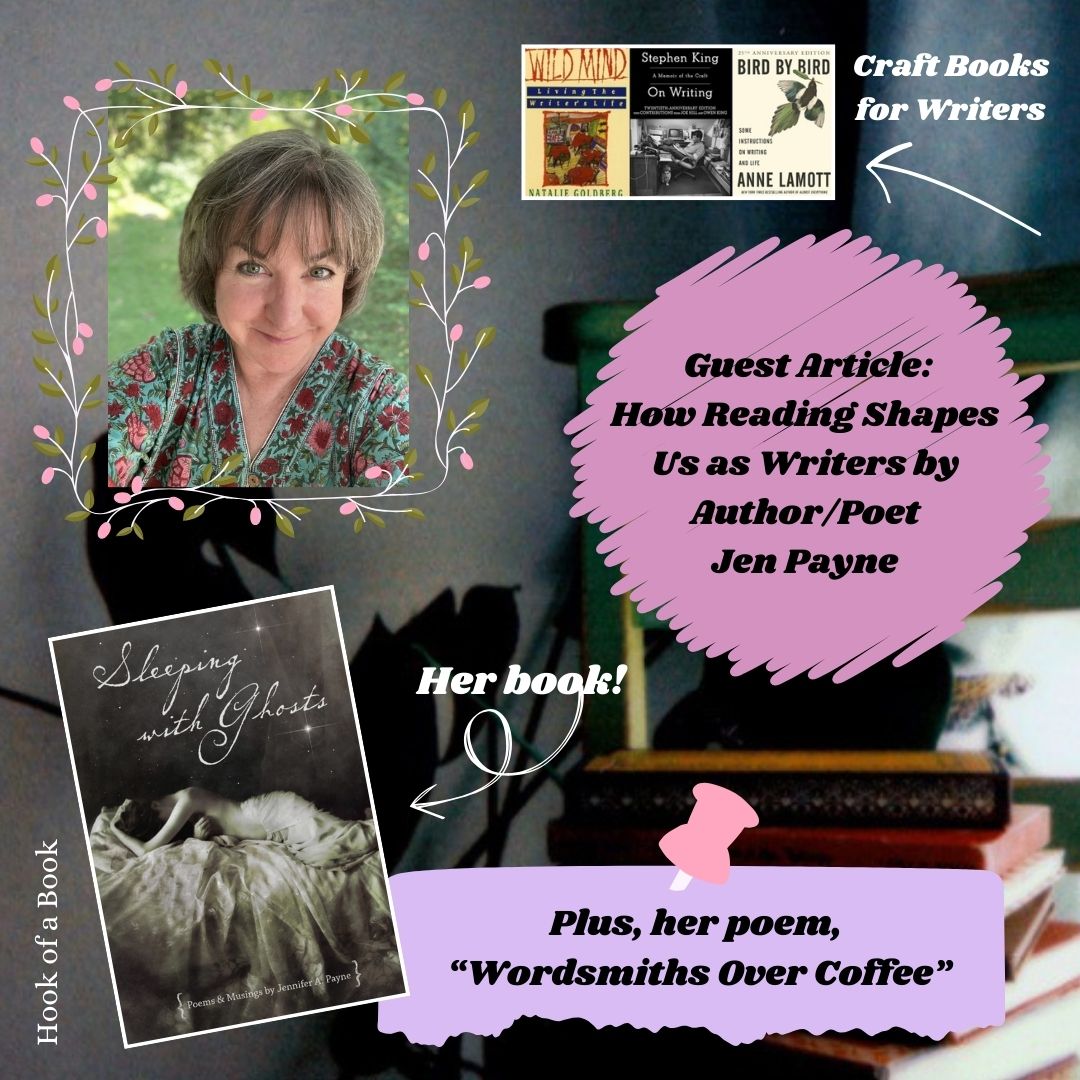
Today’s WOW! Blog Tour finds me over at Erin Al-Mehairi’s blog HOOK OF A BOOK! as a Guest Writer. There’s also a poem preview and some reading recommendations. Check it out!
People often comment about the visual nature of my creative work, and how my writing is usually accompanied by photography or artwork.
As a graphic designer, artist, and writer, I firmly believe that partnering visuals and words layers the intentions of my work and makes the communication more palpable.
Two of my previous books, Look Up! Musings on the Nature of Mindfulness and Evidence of Flossing: What We Leave Behind, were as much about the color photographs as they were about the essays and poems. As a matter of fact, the whole concept of the poems in Evidence of Flossing was inspired by a series of photographs I took showing discarded dental flossers in random places.
Odd, I know, but they spoke to the message — our disrespect of nature — in a necessary and immediate way. Sometimes writing takes a while to be absorbed, while images have a speedy hook!
LOOK: THIS IS WHAT I WANT TO TELL YOU! (Read More)
I love that the cover of my new book, Sleeping with Ghosts, does exactly that: it grabs your attention!
The cover photograph is by Polish artist Malgorzata Maj, who I connected with online back in 2015. (Yes, I’ve known the book’s title and have had that photo saved for nine years!)
Małgorzata is a contemporary painter and photographer known for her symbolic nighttime landscapes and ethereal portraits exploring the world of the Unknown. She graduated in 2004 (Olsztyn/Poland) with the title of Master in Arts. Influenced by 19th-century symbolism, her photographic works feature a bold painterly approach to the compositions she depicts. She has exhibited in galleries across the U.S. and Europe, and published her works on numerous book covers and magazines. Today she mostly focuses on traditional media such as oil painting and continues to explore themes and ideas less accessible for photographic medium.
In a bit of happenstance, on her website, Malgorzata says she “explores haunted places, past memories, and hidden feelings and symbols,” which really is the essence of Sleeping with Ghosts.
“Photography has this unique quality of something real and intangible,” she says, “…something that I find difficult to speak about. It is the language of ghosts.”
For the cover, I accented Malgorzata’s photograph with a cluster of stardust that appears in several places within the book. It’s from a series of images in a Lunar Calendar collection by Lana Elanor that includes stars, moons, and constellations.
Elanor is an independent artist from Ukraine who now lives in Tulum, Mexico. She is “a meditative person passionate about art, travel, and the study of the conscious and unconscious mind.”
About her work she says, “I’ve loved creating art for as long as I can remember myself. Only beauty itself is a catalyst for the awakening of this world, so I’m totally in love with the concept to make this place more beautiful than it was when we got here.”
The illustrations that introduce each chapter, and entice the reader from the Table of Contents, are by Ukrainian artist Michael Rayback. I connected with Michael about his art in 2022, and we were both excited to include his work in my book. But Michael lives in Kyiv, and our last correspondence was several months after Russia invaded Ukraine.
I check his social media from time to time, to see if he is back online, but unfortunately, we have not reconnected. When I think of him, I remember this quote I saw on one of his sites:
“Art is self-expression, therefore all that you see here is a part of me. I know many languages of self-expression. I like drawing, I love photo art, cinema is one of the main parts of my life, I like cooking tasty and healthy food. I wake up at five in the morning to be alone and tune in for a new day, and the sun tells me that I’m doing everything right and inspires me to new creativity. I do yoga and meditate. All this helps me to explore myself, I learn something new every day, and every day I try to be a little better.”
Something we can all aspire to, right?
I do hope you appreciate the collaborative nature of Sleeping with Ghosts. Please visit these artists online and discover more of their work!
My mother, who is easily insulted, often remembers the time a therapist called her a storyteller. Mom recounts the comment as one might an injustice, and she twists and elongates the word “storyteller” to make it sound as painful as it felt for her.
What’s the old saying? The truth hurts.
That’s the funny thing about my mother’s story — she IS a storyteller. Long before neurodivergent was a word, my mother was making her way through life with the only tools she had, and one of those was storytelling. Often and on repeat. It’s how she relates to the world and people around her.
I have a friend whose mother was also a storyteller. She had a degree in drama, was in numerous theatrical productions, taught children how to act and perform, and went on to start a successful annual storytelling festival. She also found connection in telling stories.
The act of storytelling is as diverse as these two examples and includes four primary forms: oral, visual, written, and digital. Within each of those forms, there are a myriad of vehicles: books and magazines, visual arts, stage, radio, film, television, video, internet.
Consider all of the ways storytelling comes into your own life! It’s part of the fabric of who we are. Think about it! What would we be without our fairytales, folktales, fables, religions, and mythologies? We are built on story!
And quite literally. This is what social scientist Brené Brown, says about storytelling in her book Rising Strong: How the Ability to Reset Transforms the Way We Live, Love, Parent, and Lead.
“We are wired for story. In a culture of scarcity and perfectionism, there’s a surprisingly simple reason we want to own, integrate, and share our stories….We do this because we feel the most alive when we’re connecting with others and being brave with our stories — it’s in our biology. The idea of storytelling has become ubiquitous. It’s a platform for everything from creative movements to marketing strategies. But the idea that we’re “wired for story” is more than a catchy phrase. Neuroeconomist Paul Zack has found that hearing a story — a narrative with a beginning, middle, and end — causes our brains to release cortisol and oxytocin. These chemicals trigger the uniquely human ability to connect, empathize, and make meaning. Story is literally in our DNA.”
Like my mother, I’m also a storyteller. I frequently use analogy and story not only to talk about my own experiences, but to say, “I understand yours, too. Let’s talk about it.” It was Brené Brown who gave me the courage to tell those stories on paper, and who inspired several of my books, including my new collection of poems, Sleeping with Ghosts.
That book, Rising Strong, still sits on my coffee table — dogeared and well-worn — as a reminder to be brave, to show up, and to keep telling my stories. The book ends with her “Manifesto of the Brave and Brokenhearted,” which I’ll share with you here as inspiration for you to tell your own stories because what you have to say — no matter how you say it — is important!
Photo by Kool Shooters/Pexels.Brown, Brené. Rising Strong: How the Ability to Reset Transforms the Way We Live, Love, Parent, and Lead. United States: Random House Publishing Group, 2017.
Today, the Sleeping with Ghosts WOW! Women on Writing Blog Tour stop features a really thoughtful BOOK REVIEW by Kaecey McCormick:
If you’re ready to take a thoughtful, heartfelt stroll through memory and meaning, Sleeping with Ghosts is absolutely worth your time. Jen’s gentle but honest voice will stay with you long after the last page is turned.
For the poet is a light and winged and holy thing, and there is no invention in him until he has been inspired and is out of his senses, and the mind is no longer in him… — Plato
Ghosts, Muses, Inspiration, Universe, God. Call it what you will — there is another layer of this world that we live in, and if you can quiet your mind, sometimes, you can hear it and be inspired by it!
As I was finishing up the manuscript for Sleeping with Ghosts, my editor and I both agreed something was missing. While I loved the final poem “Missing Banksy,” its alluded message about impermanence wasn’t quite strong enough to hold up the end of the book. But what would? I had no idea!
When I get stuck like that and can’t find answers — about my writing or about life in general — I like to walk in the woods. It’s where I can settle my mind, slow down the busy-ness, and sometimes…sometimes…hear ghosts.
On this particular walk, I started out at the trailhead by asking the Universe to help me find a final poem, a final message for the book. Often, I can entice Inspiration with a request like that, and this time, it responded in the voice of my Dad.
It’s not the first time my Dad’s ghost has spoken to me. He told me to PAY ATTENTION on I-95 once and saved me from a pretty awful accident; he often shows up unexpectedly as a hawk with a call of I AM HERE; and he responded to my poem query with a series of questions that became the poem “The Final Ghost.”
But connecting with our ghosts can be challenging! There is so much noise in the world today — we’re busier than ever, more distracted by things, more seduced by technologies. There are so many things demanding our attention, how can we possibly hear Ghosts, listen to Muses, or tune into our Inspiration?
One of my all-time favorite movies is Contact with Jodi Foster. The scene I think about often is when she is in the portal pod that’s been reconfigured with an anchored chair and seat belt — things to keep her rooted in place as she travels across space through wormholes. But as she starts her journey, the chair and seat belt cause more harm than good. She may be OK to Go, but they keep her too firmly in place. It’s only when she releases what holds her down that she projects openly forward.
In the same way, listening to your Ghosts requires that you release what’s holding you back.
For Jodi Foster’s character Ellie Arroway, what was holding her back was physically obvious. For me, I know that my biggest obstacle is technology and how it eats up my time and siphons my attention span.
So, what gets in the way of listening to your Ghosts?
Just this weekend, I talked with a woman who told me in a whispered voice how she stopped listening to her Ghosts because it seemed a little scary. And I have a friend who is a phenomenal painter, but she often ignores her Inspiration because it feels too powerful, almost possibly un-godlike.
But the idea of listening to Ghosts or Inspiration or Muses reaches far back into human history.
Did you know that “the word inspiration ultimately derives from the Greek for ‘God-breathed’ or ‘divinely breathed into.’ In Greek myth, inspiration is a gift of the muses, the nine daughters of Zeus and Mnemosyne (Memory).”
Similarly, “the Oxford English Dictionary defines inspiration as “a breathing in or infusion of some idea, purpose, etc. into the mind; the suggestion, awakening, or creation of some feeling or impulse, especially of an exalted kind.”
In his article “How to Find Inspiration, the Psychology and Philosophy of Inspiration,” writer and philosopher Neel Burton offers seven 7 simple strategies to encourage inspiration:
1. Wake up when your body tells you to. 2. Complete your dreams. 3. Eliminate distractions, especially the tedious ones. 4. Don’t try to rush or force things. 5. Be curious. 6. Break the routine. 7. Make a start.
Today, the Sleeping with Ghosts WOW! Women on Writing Blog Tour stop features a BOOK REVIEW by Beverley A Baird:
I would highly recommend Payne’s poetry memoir. Love fills its pages, and the words conjure intriguing images. There are so many special poems that I’m sure you will fall in love with, just as I did. So many lines as well, that you will remember and come back to.
I am a part of all that I have met; Yet all experience is an arch wherethro’ Gleams that untravell’d world whose margin fades For ever and forever when I move. How dull it is to pause, to make an end, To rust unburnish’d, not to shine in use! As tho’ to breathe were life! Life piled on life Were all too little, and of one to me Little remains: but every hour is saved From that eternal silence, something more, A bringer of new things…
We all have ghosts — those lingering memories that resurface when a song comes on, when a certain scent fills the air, or when we wander in our dreams. Those are the kinds of ghosts that appear in Sleeping with Ghosts — the memories of moments and people who have wandered into my own life, the lovers and soulmates and muses to whom the book is dedicated.
As I was gathering the poems for this book, I kept hearing the phrase “I am a part of all that I have met.” It’s a line from Alfred, Lord Tennyson’s poem “Ulysses,” in which the protagonist reflects on his life and sees the fabric that is woven between him and his experiences. That is the essence of Sleeping with Ghosts, we are all connected — by memory, by story, by experience. To emphasize that, readers will find common phrases, themes, and symbols repeated throughout the chapters and stories in the book — a weaving of love, hope, and loss. (Humor, too.)
In total, there are 14 chapters in the book, including seven primary ghosts about whom I’ve written most frequently. These are the stories that captured my attention (and my heart) and left a shadow of memory long enough for me to step into now and then, to revisit and repurpose them into poems. The seven ghosts include a first love, the last love, secret encounters, and those defining moments that come from living life with an open heart.
There are two chapters dedicated to my muses — the people who have inspired my life in a variety of ways, including life-long friends and cherished mentors — and a chapter that narrates the Ephemera of life’s encounters.
My favorite section of the book is called Dreamwork. It’s a collection of 12 poems presented like an inquiry or analysis with dated entries that note the particular ghosts as they reappear in dream form. These dream-ghosts are the wistful spirits of What If or Might Have Been, Ulysses’ “untravell’d world whose margin fades.” I truly believe that dreams offer all of us an opportunity to reconnect with our memories, heal old wounds, and reinterpret moments in new and helpful ways.
I hope this book, as a whole, offers readers a chance to see things in new ways. That in the shadowy corners of their own memories, they might conjure up the “something more, A bringer of new things…” for themselves.
Remember, we all have ghosts. Give them a direct line to your Muse, and you never know what will happen!
Time alone during a retreat on the shore of Cape Cod, MA.
If the world were a sound, it would be flipping through all of the channels on a radio really fast. Announcers and DJs, commercials and music genres overlapping in the same way our 21st-century tasks seem to layer upon themselves.
We’re always busy, there’s always something else to be managed, and the To Do list is never-ending — one crossed-off item seemingly births two or three more. Work, family, and home responsibilities line up like a song queue on a commercial-free weekend — endless.
If you’re a creative type, like I am, though, you need to turn down the volume sometimes. All of that noise — all of those weighty expectations —stifle our ideas and muffle our creative voice.
And while a Vacation can be helpful sometimes, that’s a different genre of time off, usually involving a barrage of activities, schedules, attractions, must-dos, and must-sees. What’s more beneficial to your creative spirit is a Retreat.
What’s the difference?
I like to think of Retreat as all about the R words, like: Relax, Rest, Regroup, Restore, Reflect, Reset, Roam, Read, Recharge, Replenish. Get the idea?
It’s time without any expectations or To Do lists, and time “off the grid,” if you can stand it.
According to an article by executive coach Rebecca Zucker in the Harvard Business Review, taking time off has reverberating positive effects on your sleep, memory, concentration, mood, and stress level.
Time off, she explains, “can allow you to tune out much of this external noise and tune back into your true self. You can start to separate the striver part of you, let go of your ego, and reacquaint yourself with the essence of who you really are…feel a sense of peace…and do things that bring you joy.”
How’s that for motivation?
For the last 12 years, I’ve taken a week-long Retreat on the shores of Cape Cod. I spend my time reading books, walking by the water, and taking long afternoon naps. I eat simple meals, spend time in nature, write some poetry, and remember how to breathe deeply again. I try to make it a quiet experience — time for rest and reflection, not a tourist jaunt or food tour.
Of course, not everyone has the time or resources to take off by themselves for a whole week. Sometimes I don’t either. Sometimes, an overnight at a hotel with a good book and a picnic basket of food is time enough. A Sunday drive down the highway with the radio on and the windows open can clear my head as much as a long walk by the ocean. And always, a morning hike in the quiet woods reminds me that somewhere beneath all the layers of noise, my creative voice is waiting for her opportunity to sing!
What’s your ideal Retreat? Can you think of two or three ways — grand and small — that you can tune back into your creative spirit?
Today’s WOW! Women on Writing Blog Tour stop features a BOOK REVIEW by Shoe’s Seeds & Stories:
These are poems to savor, even when they are heartbreaking, whether Payne is writing about New Hampshire in 1992 (I can picture the hidden meadow of lupines, the strawberry moon, the breathtaking stars), a terminal romance in “The Wrong Impression”, or baking a cake in “Real Plums, Imaginary Cake” (the title is a nod to novelist Mary McCarthy’s quote about writing: “I am putting real plums in an imaginary cake.’) I appreciate that Payne not only writes about lovers but also about friendship, such as in the poems “When the Mania Collapses in On Itself Again” and “Love They Neighbor as Thyself”. I enjoyed meeting the ghosts Payne introduces in the memoir, and I think you will too.
Today, I talk with more Charity Howard at Chit Chat with Charity. You might remember her from the “Power of Writing Through Poetry, Memories” review she did of Sleeping with Ghosts last week. Today, we chat interview-style. Check it out!
JEN: Hi Charity.
Thank you for being part of the WOW! Women on Writing blog tour for my book Sleeping with Ghosts, and for taking the time to ask some good questions!
What is your favorite part of your book and why?
JEN: I love that Sleeping with Ghosts is not just a book of poetry or a memoir, but it’s also a visual experience. The stunning cover photo, by Polish artist Malgorzata Maj, captures the mood of the book so perfectly. The artwork by Michael Rayback and Lana Elanor illustrates the themes of the individual chapters and adds a bit of whimsy to the pages.
And while I love all of the poems, I think my favorite part is the Table of Contents and how it tells the story of the book at a glance. I like how it’s not just a block of text with page numbers, but a cipher for how to read the book. It feels like one of those maps you find at the beginning of adventure books or a legend that tells you how to travel forward.
What is your biggest inspiration for this poetry and musings book? Or perhaps the poem that stands out the most for you?
JEN: First and foremost, I am a storyteller. It’s how I relate to the world, how I communicate experience and understanding. I talk in story…remember the time?
Many of the poems and musings in this book are stories that live inside me already. But it’s not like I am thinking about, or “dwelling on” things, all the time. The stories just get primed to come to the surface sometimes.
It’s like when you hear an old song on the radio or smell a certain perfume in the air, and it reminds you of a memory? As a writer, I am able to follow those memories and pull out a poem or a short story.
A good example of this, and one of my favorite poems in the book, is called “Chester, 1 a.m.” I was driving down the highway when the Jethro Tull song Bourée came on the radio, and I was immediately transported back many, many years to this short, sweet memory…
CHESTER, 1:00 A.M. You will always be blue flannel, a plaid hard crush against skin, Bourée on a flute in the dark, and the taste of unseen spirits. Your sudden kiss, the punch-drunk dance against kitchen counter — what did you want from me in that brief romance? I still wonder.
That’s how inspiration works for me. My muse shows up in many forms with suggestions for which way to take my writing next. And I follow.
What is your advice for poets as they write their inspired work?
JEN: Listen to your Muses, not your Critics!
Your Critics are going to tell you how to write and what to write. They’ll tell you what’s good and bad, correct and incorrect. They’ll be rather black-and-white about things.
Your Muses, on the other hand, are creative and wild, and they love to color outside of the lines. Play with that and with them, and just follow your heart.
Be brave enough to tell your story the way you want to tell it!
What do you feel is the most important part of your writing process?
JEN: Making time for it. Period.
We’re all so busy with so many things that need to get done in a day. But that creative process, the process of expression, is so important to our well-being. As important as movement or rest or nourishment.
And just like those things, you have to make time for your creative work.
I am a notoriously early riser, and I will often spend the first few hours of my day writing. I love the quiet of the early morning before everything is awake and noisy again.
A 3 a.m. start works really well for me, but you have to find what works for you. Maybe it’s the other side of the clock midnight-writing, or an hour at a coffee shop with your laptop.
Remember, your creativity is a gift, and it’s important that you give it time to exist and prosper.
What would you say to describe your book to help entice readers to pick it up?
JEN: One of my readers — who is also a ghost in the book — once said my writing is “funny, sad, sexy, maddening.”
Sleeping with Ghosts is a time-traveling memoir that introduces readers to some charming characters — star-crossed teenagers, secret lovers, and long-term loves. It’s about romance, heartbreak, dreams, found love and lost love, memories. It’s also a book filled with story, inspiration, creativity, and pages and pages of beautiful muses without whom this book (and I) might not exist.
Today, I talk with Kaecey McCormick at Some Thoughts: Everything Creativity, who writes: “I’m thrilled to bring author Jen Payne to the blog today in an interview to discuss life, writing, and her new book, Sleeping with Ghosts. Earlier this month, I hosted a Community Poetry & Prose Night with the theme “The Ghosts We Carry,” and Jen’s book is a wonderful example of how we can be “haunted” by so much and how these “ghosts” show up in our writing.
Kaecey: Jen, welcome! I’m thrilled to chat about your new book, SleepingwithGhosts. The way you blend genres in this collection is fascinating. Sleeping with Ghosts is described as a ‘time-traveling memoir’ into the heart and mind of a poet. What inspired you to choose this format, and what challenges did you face in crafting such a unique narrative?
Jen: Hi Kaecey. Thanks for being part of the Sleeping with Ghosts blog tour!
Like you, I’m not only a writer and poet, I’m also a blogger. I’ve been writing and creating at Random Acts of Writing (randomactsofwriting.net) since 2010. That name, it turns out, was spot-on! My creative work shifts from poetry and flash nonfiction, to essay and photo essay.
As readers will find in Sleeping with Ghosts, I also write a lot of memoir pieces.
The poems in the book have been written over the past 10-15 years, but they cover a time span of 40! From that perspective, time traveling becomes a natural consequence! (It helps that I’m also a closet Trekkie and a bit of a sci-fi nerd.)
I find I have an acute memory for what I call “defining moments” — those places in time when something shifts or changes, times that you bookmark to remember. I am easily able to slip back into those moments and recall the feelings, the conversations, my surroundings. And then I write!
As happened in my previous books of poetry, Evidence of Flossing and Waiting Out the Storm, the poems in Sleeping with Ghosts gathered themselves quite naturally. As soon as I set the intention to create this book, the poems and chapters, and their organization was very clear. The biggest challenge, I suppose, was making sure that the ghosts each got their own say, and that their stories were told to completion.
Kaecey: I can imagine that covering a time span of 40 years meant some “ghostly” challenges! You did a wonderful job making sure each voice was heard. Much of your writing in this collection reflects on past relationships or experiences. I’m wondering, was there a defining memory or experience that sparked the creation of Sleeping with Ghosts? How did it start and how did the concept evolve from that initial inspiration?
Jen: Indirectly, yes.
I’ve been a writer all my life: journalist, copy editor, freelance writer, marketing wordsmith. I started my own graphic design and marketing business, Words by Jen, when I was 27, and spent a great deal of time writing for other people.
But the year I turned 40, I reconnected with someone I had been deeply, crazy in love with. We hadn’t spoken in 15 years, and our reconnection felt monumental and…karmic.
When it didn’t work out (again), everything broke wide open for me. I had to find a way to write from that place, from that broken-hearted, emotional, vulnerable place. That’s really when I began writing the good stuff!
(Actually, you can read about the whole experience in my book Water Under the Bridge: A Sort-of Love Story.)
Kaecey: It’s amazing how those difficult experiences can spark our creativity. And speaking of difficult, your work often explores themes of memory, creativity, and loss. How do you navigate writing about such personal experiences while still making them resonate universally? What advice do you have for poets and other writers who are tackling big themes like grief?
Jen: I think I write about my own experiences because I have to — it’s how I process things, how I connect with the world. Not to be cliche, but writing is my love language.
I’m a bit of an introvert, so writing and storytelling are my way of sharing, of having a conversation, of participating.
I’m not sure I intentionally try to make my work resonate universally, so much as the stories are universal. We all experience these moments —right? The broken heart, the unrequited love, the death of a friend, the relationship we need to leave.
But not everyone has the courage to talk about their experiences. It’s hard work talking about disappointment, broken hearts, loss, and grief.
What inspired me most to write from the heart, to be brave about it, was Brené Brown’s book Rising Strong. In it, she writes, “When we deny our stories, they define us. When we own our stories, we get to write the ending.”
So my advice to writers tackling the big life themes would be a) read Brené’sbook, and then b) be brave and write!
Kaecey: Love that. I’m a Brené Brown fan! So yes! And I appreciate what you just said about our stories as universal human experiences. You’ve also written about our connection to the natural world, and in previous interviews, you mentioned the “alchemy” of emotions, nature, and creativity. I’m hoping you can elaborate on how this idea informs your writing, whether that’s in the language and imagery itself or as part of your process, particularly in this new book, Sleeping with Ghosts?
Jen: There is a certain kind of magic that happens when we can step out of our day-to-day and let new information come in. For me, that very often happens when I walk in the woods or on the beach. For others, the magic happens in meditation or after physical activity.
We’re all so busy these days. And when we’re not busy with actual work — job, house, family, life — we’re regularly seduced by technology and our scrolling, binging culture. Creativity requires us to get away from all of that. How can we hear our Muses when everything else is demanding our attention?
I think it’s important for writers and artists to find those things that let them reconnect with their creative voice. One poet I know recently went on a week-long silent mediation, and when I marveled at that to his wife, she said “That’s him. I prefer moving meditation, like tai chi or yoga.”
For me, being in nature is a critical component of my writing. Whether it’s a regular walk at my favorite nature preserve or a week-long writing retreat by the water — I need that time away to process through the stories and the things I want to say.
And yes, very often there is an overlap of my connection with nature and the imagery and language in my writing, including Sleeping with Ghosts. Of course!
My book Waiting Out the Storm was a very personal tribute to a dear friend who died suddenly. I found the most comfort being in nature, and witnessing how life and death and rebirth play out all around us. Nature was my solace.
That’s what I mean by alchemy — we are part of a much larger universe than our day-to-day. If we can be open to that, give ourselves time and space to come back to our awareness of that, it can infuse our writing and our sense of self in pretty amazing ways!
Kaecey: Beautifully put, Jen. And so helpful for other writers to read about that part of the process. Speaking of process, I feel like, as writers, we’re often surprised by something in our work or in the process itself. Maybe you start a poem about the lipstick case you lost and end up writing about the death of your cat. Maybe you want to write about the sunlight and you end up writing about your toddler’s whining. (Or maybe that’s just me!) In looking back at your journey with Sleeping with Ghosts, what has been the most surprising or rewarding aspect of creating this collection and sharing it with others?
Jen: This is a great question. Our writing can come as a surprise sometimes, can’t it?
One of the most surprising things about Sleeping with Ghosts for me has been how these poems assume their own personality, and almost innately tell the story of each particular ghost…despite the fact that they were written at different times over the past 15 years.
The ghost in I Am a Rock/I Am an Island is unrequited loved no matter when I write about it — in the moment or 10 years later. The ghost in Seeing Red is angry all the time — then and even now.
The other surprising thing — and probably my favorite part about writing this book — is that the ghosts found ways to speak to me. They often showed up to remind me about a moment or a conversation that should be included. Sometimes they needed a final say — and they would chime in while I was on a walk or they’d show up in a dream. “Sleeping in Truro” was one ghost’s final say-so, and “Dear Jenny” was a ghost who appeared just months before the book went to press. When I asked the ghosts to give me a final poem for the book, they sent my Dad who asked, “Did you love?”
I did, I have…and now I get to share that with my readers!
Kaecey: “Did you love?” What a beautiful question and how wonderful to be able to answer in the way that you did! Jen, thank you so much for being here with me today. It’s be a joy to talk to you about writing, life, and your inspiration!
Jen: Kaecey, thank you for these thoughtful questions and the chance to dig a little deeper into the inspiration and ghosts in Sleeping with Ghosts! I appreciate it!
I have a confession to make. For the past six months, I have been disappearing down a rabbit hole, crawling to the backside of the wardrobe, hitching a ride on a tornado…and making my way to the empire of Une Belle Ville.
It started innocently enough — my nephew on his tablet in the backseat on our way home from an adventure.
“What’s that?” I asked, hearing huzzahs and sing-song chimes.
“Forge of Empires,” he said.
“A video game?”
“Yea, it’s cool. You build a city by collecting resources and building an army. I’m in the Stone Age still.”
When we got home, we sat on the couch together and he showed me his city. Just a few random huts, some dirt trails, an obelisk — but it had me at sing-song. So I loaded it on my iphone and away we went, my nephew and me sharing our cities and achievements.
“I’m in the Iron Age!” he announced.
“Me, too!”
“You caught up with me. I have three archers!”
“I built a fruit farm!”
We went on like this for a few weeks, comparing notes as we played dueling technologies. And then one day, I started hearing zap-zap-zap and kaboom instead of huzzah and sing-song, sing-song.
“What age are you in now?” I asked, curiously.
“I’m playing Minecraft.”
“Not Forge of Empire?”
“No. It was too boring. This is better, see…”
And so our paths diverged. He and his kabooms went one way, and I skipped along with my huzzahs from the Bronze age straight on through to the Industrial.
Ok, maybe it seems a little silly. It’s also one of those nefarious escape mechanisms that gets you strung out on dopamine. But given the state of the world (and the state of my family of late)? I’m all in for an extra hit of dopamine thank you very much.
The funny thing is, my city — Une Belle Ville — is exactly the kind of place I’d like to spend my time if the rabbit hole jumping, wardrobe crawling, tornado clinging thing actually worked. My fellow villagers and I rank high in enthusiasm and participate happily as members of the local Guild. We trade instead of battle, we polish instead of plunder, we explore the world and give aid when we can. We have lots of trees and gardens, a rosarium and a butterfly house. There’s a mountain preserve, a Celtic farmstead, and a vineyard. We can see the Oracle of Delphi, the Arc de Triomphe, the Lighthouse of Alexandria, Notre Dame, and a Statue of Zeus all in an afternoon’s walk. We can visit the zoo, laugh on the ferris wheel, take a hot air balloon ride, or climb the steps of the Observatory to see the stars.
So far, I’ve built a paper mill, am working towards a print shop, and look forward to the day I can build a library for my city, because we all need books, don’t we? Those other things that give us a beautiful out, an “I’ll be right back” excuse to leave the 21st century messes and remember what’s possible with a little bit of imagination and some escapism-flavored dopamine. Huzzah!
Did you know that each issue of MANIFEST (zine) includes a Spotify playlist especially curated for readers? For the CRICKETS issue, I had fun playing off the themes of silence, finding one’s voice, and creating from the heart. It features an eclectic set of songs by artists like Disturbed, Grace Carter, Barry Manilow, John Mayer, Natasha Bedingfield, and Brandi Carlile. Take a listen now!
IMAGE: Midsummer Frolic, British Library Digital Library, When Life is Young, Mary Elizabeth Mapes Dodge, 1894.
Storytelling is in our DNA says Brené Brown in her book Rising Strong. We share our stories because “we feel most alive when we’re connecting with others and being brave with our stories.” That process, she explains, causes our brains to release cortisol and oxytocin, the chemicals that “trigger the uniquely human ability to connect, empathize, and make meaning.” So we write. And we create. No matter who listens or responds. Crickets be damned.
MANIFEST (zine): Crickets is a riff and a rant about the consequences of creative bravery. It’s a 24-page, full color booklet that includes a curated Spotify playlist for your listening pleasure.
INGREDIENTS: appropriation art, black-out poetry, collaged elements, color copies, colored markers, ephemera, hand-drawn fonts, ink jet copies, laser prints, vintage illustrations, watercolor paints, and “11 Cute Facts About Crickets.”
With THANKS to to the British Library Digital Library, Brené Brown, Leonard Cohen, Carlo Collodi, Francis Crick, Charles Dickens, Mary Elizabeth Mapes Dodge, Natalie Goldberg, Charles d. Orbigny, Pinocchio, George Selden, the Trustees of the British Museum, James Watson, and Margaret J. Wheatley.
Issue #4, Crickets 24-page, full-color 4.25 x 5.5, Cost: $6.00
In her heartbreakingly wonderful book This I Know: Notes on Unraveling the Heart, photographer Susannah Conway explains that writing is “a vocation that pays out twice: first to you as the detective unraveling your heart and then again to the reader who consumes your work.”
This echoes a conversation I had recently with my dear friend Judith who reminded me that the life-changing moment for a writer is not necessarily being published, or even being read. The life-changing moment is the creative spark, that white hot moment of inspiration.
The rest, as they say, is gravy. More or less… (Read More)
Storytelling is in our DNA says Brené Brown in her book Rising Strong. We share our stories because “we feel most alive when we’re connecting with others and being brave with our stories.” That process, she explains, causes our brains to release cortisol and oxytocin, the chemicals that “trigger the uniquely human ability to connect, empathize, and make meaning.” So we write. And we create. No matter who listens or responds. Crickets be damned.
MANIFEST (zine): Crickets is a riff and a rant about the consequences of creative bravery. It’s a 24-page, full color booklet that includes a curated Spotify playlist for your listening pleasure.
INGREDIENTS: appropriation art, black-out poetry, collaged elements, color copies, colored markers, ephemera, hand-drawn fonts, ink jet copies, laser prints, vintage illustrations, watercolor paints, and “11 Cute Facts About Crickets.”
With THANKS to to the British Library Digital Library, Brené Brown, Leonard Cohen, Carlo Collodi, Francis Crick, Charles Dickens, Mary Elizabeth Mapes Dodge, Natalie Goldberg, Charles d. Orbigny, Pinocchio, George Selden, the Trustees of the British Museum, James Watson, and Margaret J. Wheatley.
Issue #4, Crickets 24-page, full-color 4.25 x 5.5, Cost: $6.00
Happy National Poetry Month! Here at Random Acts of Writing, we’re going to be writing a poem a day — #NaPoWriMo — so check back daily! But did you know that National Poetry Month was inaugurated by the Academy of American Poets in April 1996? Over the years, it has become the largest literary celebration in the world with schools, publishers, libraries, booksellers, and poets celebrating poetry’s vital place in our culture. Here are 30 ways you can participate…
Record yourself reading a poem, and share why you chose that work online using the hashtag #ShelterinPoems. Be sure to tag @poetsorg on twitter and instagram!
When I told a friend last spring that I was writing a poem a day for National Poetry Month and NaPoWriMo, she asked me how I found the inspiration for 30 poems.
“It’s like rummaging around in a junk drawer,” I told her. “You’re bound to put your hands on something!”
And sure enough, one April, I found inspiration from a seagull, bugs, a haiku class, a trip to the Dollar Store, and pizza. Among other things. (See the full tally here.)
Now granted, they are not all masterpieces. But that’s not the point. Like any writing challenge — NaNoWriMo, HistNoWriMo, SciFiWriMo — the goal is simply to get into the habit of writing.
“Simply” of course being somewhat of an issue if you are lacking inspiration. Which brings us back to that junk drawer. There are so many things in your junk drawer – think about it!
the first time you rode a bike
your best friend from kindergarten
your mother
what you had for breakfast
your first kiss
last night’s dream
what you saw on a hike last weekend
your favorite painting
the song you can’t get out of your head (and why)
an object sitting on your coffee table
So, GO! Rummage around — see what you can find. Reach way far back if you have to…and then CREATE! Describe, elaborate, enumerate, paint a picture with words (or even paint if you are so inclined). It doesn’t have to be perfect…as Nike says, JUST DO IT!
Here is some evidence of rummaging. This quirky little poem showed up from a post-it note I found on my desk one morning:
(Chinese Food)
The note says (Chinese Food)
but it is random
out of context on a piece of paper
in a stack of papers
at least 2 months passed
my past included (Chinese Food)
but what?
and with whom?
and what is the purpose
of this little clue
set out for me to follow
too early even for General Tso,
though I never met him personally
rumor has it, he was a press man…
as a proponent of the written word
do you think he rose early
to consider form and function,
rhyme, reason and rice —
like this poet now hungry
for the pork fried variety at 6?
But a fair warning about rummaging…you have to be brave. You have to be brave because you never know what you’re going to find in that drawer. Sometimes, it will be as benign as a post-it note about Chinese take-out. Other times, you may pull out a ghost, some long lost memory that needs to see the light of day.
Hans Christian Anderson is credited with saying: “Everything you look at can become a fairy tale, you can get a story from everything you touch.”
Ultimately, isn’t that our job as creatives? Telling the story. No matter our medium — poetry, painting, prose — we are charged with the task of putting our hands on the story and sharing it with others.
So, get in there! Rummage around for the inspiration. Reach way far back if you have to…and then TELL THE STORY!
You can read more of Jen Payne’s poetry in her books Evidence of Flossing: What We Leave Behind and Waiting Out the Storm, available from Three Chairs Publishing.