Categories
Creativity

Creatively Speaking: Choose Real Dopamine

SPRING 2025

Choose Real Dopamine

Phew! OK. Are we still breathing?

It’s been three months since the last issue of Creatively Speaking and Wow! OK, how ’bout them Eagles?

It’s been a pretty intense few months, and if you’re anything like me, it’s been hard to look away, right? And maybe you’re feeling a little over-stimulated, a little off-focus. Some of us are leaning into the dark side more often and feeling anxious, irritable, or depressed.

There’s a reason for this, and it might not be exactly what you think. The current chaotic state of affairs is asking us to be more alert, to pay more attention to what’s happening in the world. That alone is enough to kick in our fight-or-flight response. Then add in a layer of technology — constantly checking headlines, reading to stay informed, scrolling social media, keeping engaged with each other on our devices — and we’re literally flooding our system with both adrenaline and dopamine.

We are JACKED UP — can you feel it?

For me, it’s taking the shape of being a little attention-deficity, not super creative, tired, and a bit obsessed with Tony’s Chocolonely milk chocolate bars.

I’ve been thinking a lot about this lately. Particularly as it applies to dopamine, because the original inspiration for this newsletter was a video called Choose Real Dopamine:

Dopamine is a neurotransmitter, or chemical messenger, that regulates pleasure, motivation, and reward in the brain. It’s sometimes called the feel-good hormone, and it gets released when we do things we need to survive, like eat, drink, compete, and reproduce.
 
Our brains are hard-wired to seek out behaviors that release dopamine into our reward system, and with the right amount in our bodies, we can feel happy, motivated, alert, and focused. But when our dopamine levels are off-balance, our bodies start to struggle.
 
Ivette Lampl, M.S., LPC-S, LMFT-S write more about this in “The Effect of Cell Phones on Dopamine in the Brain”:

“The brain is wired to function like this: put in effort – achieve reward. Cook up a tasty snack? Enjoy the yummy treat. Hike up a steep hill? Take in the scenic view from the top. Effort – Reward….
 
Technology has allowed us to eliminate the effort part of the Effort – Reward cycle. No need to cook a meal – just have it delivered! No need to drive around town looking for the perfect dress for an upcoming event. Just open your favorite shopping app and several options can be at your front door by morning.
 
Now add in a layer of dopamine hits that we get from our minute-by-minute interactions with our devices. Likes, comments, notifications, messages – all of these are tiny doses of dopamine that we ingest all day long. When the brain senses that there is an abundance of pleasure without the effort/challenge to offset it, it decides that there is too much dopamine and it needs to produce less. And without the brain’s production of dopamine, we begin to seek out more dopamine from external sources, and this cycle continues.
 
Think of it like this. Let’s say you’ve gone on a long walk on a hot day, and you treat yourself to a scoop of ice cream. Amazing! The brain receives a dose of dopamine and all is well. Now let’s say you really enjoyed that ice cream, so the next day you help yourself to a large scoop while watching TV. No problem. But the next day, you crave ice cream so you eat it directly from the carton. By the end of the week, you’re eating a pint every day…[and] The ice cream is no longer pleasurable….”

You know as well as I do that it’s hard to put the phone down, to ignore the dings and buzzes from our various devices, to turn off notifications or gasp! turn off the phone itself. And it’s hard to recognize when our reward system is no longer enjoying our efforts.

Apparently, this attachment to our devices is something we’re all curious about. Do an internet search for “ways to reduce phone usage” and you’ll find pages and pages of results! Here are some of the top suggestions:

• turn off notifications
• put the phone on silent
• turn on airplane mode
• put your device in another room
• set time limits for when you use the device.
• consider doing a digital detox
• create a Dopamine Menu for alternative activities
• go outside and look up

Being a list person, I loved the idea of a Dopamine Menu! Curious? Check out “How to Make Your Own Dopamine Menu & Why It May Help Increase Happiness” by Elizabeth Shaw, M.S., RDN, CPT, Eating Well

Mine includes things like taking a walk in the woods, gathering things to donate to the thrift shop, watching a favorite old movie, meeting a friend for lunch, and working on my writing.

Now, you may ask what all of this has to do with Creatively Speaking, right? Well, I don’t know about you, but I find that there is a direct correlation between how much time I spend on my devices and how much time I allow for my creative work. When I’ve turned off my phone or given myself a digital detox day, I sleep better, get more things accomplished, and have an expanse of open space in my brain to contemplate things like a new poem, my next book, and other creative considerations.

Our technology is not going anywhere, so it’s on us to find a good balance between on and off, between all-consuming and moderation.

Wishing you balance, real dopamine, and a rewarding amount of ice cream.

Happy Spring!

Love, Jen ❤️


Creative Inspo

I was inspired by a DIY video to make this cell phone cubby for my phone. It hangs on the wall in my kitchen — ironically where the old corded landline used to hang. Before dinner, I put the phone on Airplane Mode and hide it away and out of reach. It’s not foolproof — I check it a few times before I go to bed — but it does keep me from going down the scrolling rabbit hole. Since I’ve been using the cubby, I notice I am more relaxed at the end of the day, I spend more time writing, reading, and making art, and I definitely get a better night’s sleep!


SOURCES:

The Effect of Cell Phones on Dopamine in the Brain, Momentous Institute, Ivette Lampl, M.S., LPC-S, LMFT-S, Experiential Group Therapy Program Manager

Dopamine and Adrenaline: The Dynamic Duo of Neurotransmitters, NeuroLaunch

Dopamine, Psychology Today

How to Tell If You Could Be Addicted to Your Phone, Rebecca Joy Stanborough, MFA

How to Make Your Own Dopamine Menu & Why It May Help Increase Happiness, Elizabeth Shaw, M.S., RDN, CPT, Eating Well
Categories
Creativity

Lean Into Each Other

After November, I took to re-binging one of my favorite television shows, and we just got to the season when COVID hits. It was actually filmed during COVID, which makes the episodes somehow more poignant.

As I’m watching the season unfold, I’m remembering those days when we really didn’t know what was going to happen, when people were suffering at ridiculous rates, when there was seemingly no end — or  hope — in sight.

I’m remembering how we hunkered down. How we embraced simple things like making bread and trying new recipes. How we found comfort in each other — even from six feet away. How we came together and sang from balconies.

I’m also remembering our feckless, reckless President — back then — so incompetent and uncaring at his job that it felt like we were on board a rudderless ship heading for the rocks.

It’s hard not to feel that way now, because here we are, back in a collective crisis, worried for our friends and family, worried for ourselves and our livelihoods. Furious about the lack of leadership, again, from that awful awful man and his minions.

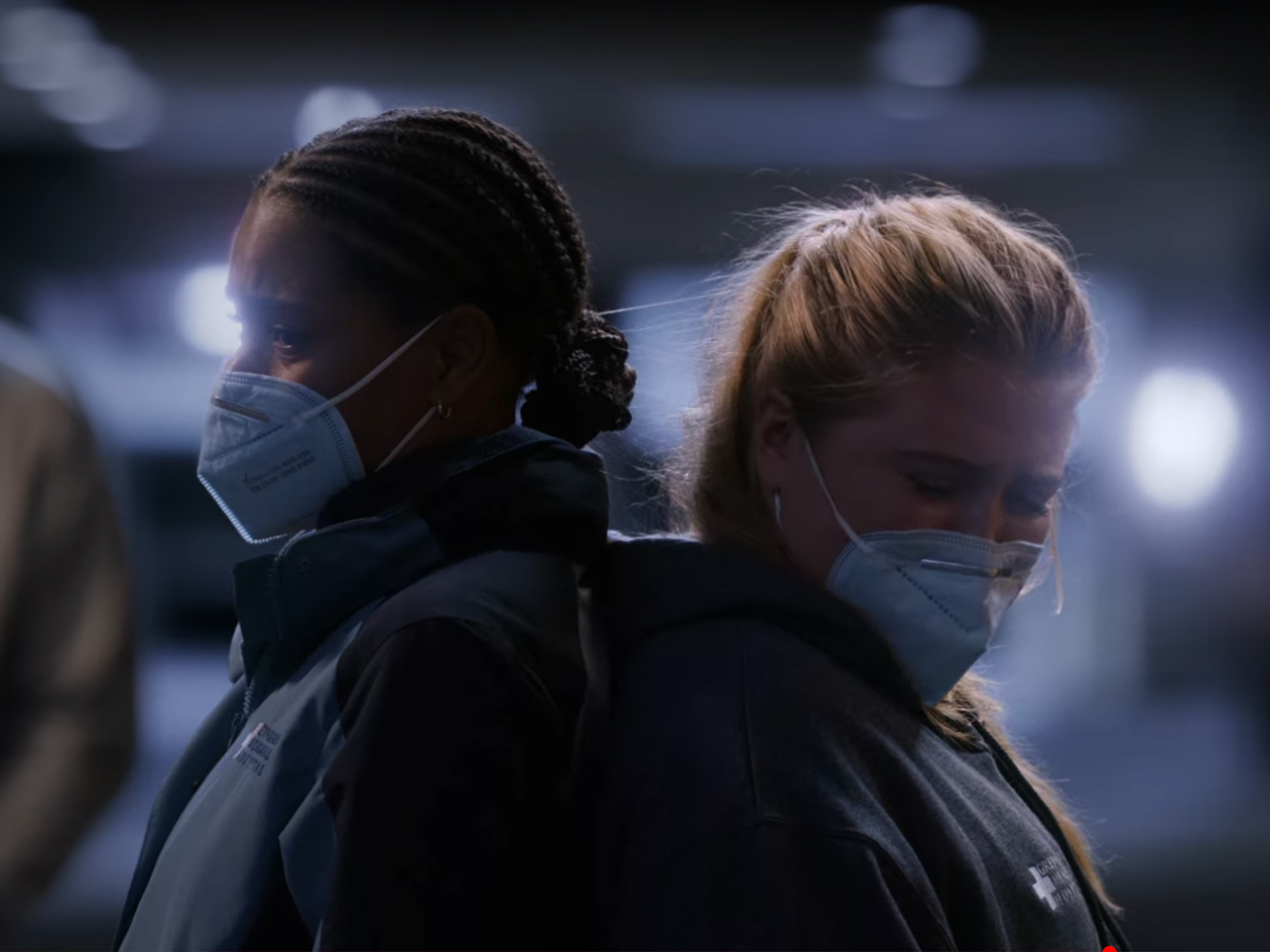
In the episode I watched last night, a young doctor was sitting outside the hospital in despair. She’d lost patients, run out of supplies, had been working non-stop, and worried that she might soon simply lose her mind.

But her friend finds her, allows her space to talk, shows her compassion, gives her comfort. They lean into each other for a while, and the despair eases.

It made me realize that the suffering we’re experiencing now is very much like the suffering we just experienced in the pandemic. Like then, there is so much that doesn’t make sense, so much to be afraid of, so many unknowns.

And, like then, we will get through this. We’ll be kind with each other. We’ll allow space to talk and to cry and to rage. We’ll be a little more compassionate, a little more gentle with other — and with ourselves. We’ll help each other cope, and we’ll dance it out when we just can’t cope anymore. We’ll take care of each other and lean into each other.

We’ve got this.

(©2025, Jen Payne)

Categories
Creativity

What’s Your Resilience Plan?

BY JEN PAYNE

These days, I wake up with a thin veil of hope. Before the All of it sets in. Again. Then I breathe and stretch. Light incense. Beseech saints and gods. And settle into the morning routine of cat feeding and coffee making — this is the Grounding.

When I am fortified enough, I glance at the headlines and subject lines. Read Jessica Craven’s latest Chop Wood, Carry Water to talk me off the ledge. Remind myself about Chaos Theory, and This Too Shall Pass. Recite the Serenity Prayer: serenity, courage, wisdom. Breathe.

I relay inspiring quotes about Resistance and Creativity and Hope on social media. Call and email my Senators and Representatives. Take small actions of Revolution before I settle into my day, which, for now, is same and sane and familiar.

Familiar enough that at some point, I shake off the Big World things and muck about in my own for a while. The usual: the house repairs, the bills, the client rubbing me the wrong way, that one thing that one person said that irritated the piss out of me, my mother’s caregiving, the impending knee surgery, on and on…

And on…while the world fucking burns outside my window. Literally. Figuratively. Absolutely.

Every time I find myself marinating about my Small World things, I hear Julia Roberts/Liz Gilbert in the opening monologue of the movie Eat, Pray, Love:

“l have a friend, Deborah, a psychologist, who was asked if she could offer psychological counseling to Cambodian refugees — boat people, who had recently arrived in the city. Deborah was daunted by the task. These Cambodians had suffered genocide, starvation, relatives murdered before their eyes, years in refugee camps, harrowing boat trips to the West. How could she relate to their suffering? How could she help these people? So guess what all these people wanted to talk about with my friend Deborah, the psychologist. lt was all, “l met this guy in the refugee camp. I thought he really loved me, but when we got separated, he took up with my cousin. Now he says he loves me, and keeps calling me. They’re married now. What should l do?” This is how we are.”

This is how we are, in part, because we are susceptible to what is called “Crisis Fatigue” — that feeling of overwhelm, lack of control, or the urgency of the next crisis.

And goodness knows, we’re like a Russian doll of crises these days! Everywhere you look, it’s crisis stacked upon crisis upon crisis.

So where is the fulcrum? How do we find a balance between staying informed and hiding under covers? Between revolutioning and resting?

Remember, this is a marathon, not a sprint. You need to make time to drink water, slow down a little, pace yourself.

In her article “When tragedy becomes banal: Why news consumers experience crisis fatigue,” Rebecca Rozelle-Stone , Professor of Philosophy, University of North Dakota asks, “How might we recover a capacity for meaningful attention and responses amid incessant, disjointed and overwhelming news?” and suggests, beyond reining in digital device usage, that we consider:

“Limiting the daily intake of news can help people become more attentive to particular issues of concern without feeling overwhelmed. Cultural theorist Yves Citton, in his book The Ecology of Attention, urges readers to “extract” themselves “from the hold of the alertness media regime.” According to him, the current media creates a state of “permanent alertness” through “crisis discourses, images of catastrophes, political scandals, and violent news items.” At the same time, reading long-form articles and essays can actually be a practice that helps with cultivating attentiveness.”

She also recommends a focus on “more solutions-based stories that capture the possibility of change. Avenues for action can be offered to readers to counteract paralysis in the face of tragedy. Amanda Ripley, a former Time magazine journalist, notes that “stories that offer hope, agency, and dignity feel like breaking news right now, because we are so overwhelmed with the opposite.”

So do that.

But remember…it’s OK to take a day off — from work, from social media, from headlines, from the Resistance.

It’s OK to eat ice cream or take a nap or laugh out loud. It’s OK to make plans, to look forward to things.

Do the things that keep you sane and keep you grounded. Revolution requires Resilience.

In Eat, Pray, Love, the medicine man Ketut suggests to Julia Roberts/Liz Gilbert:

Keep grounded so it’s like
you have four legs.
That way, you can stay in this world.
Also, no looking at world
through your head.
Look through your heart instead.
That way, you will know God.

That way, you will know Good.

Categories
Creativity

A Psychosomatic Response to 2025


The physical therapist
shows me exercises,
but I tell her I am
Stretched Too Thin
ENOUGH ALREADY!
So she digs into the mechanics
of my Bracing for the Worst
and attempts to allay the
places where I am
Holding on for Dear Life  —
god bless their
white-knuckle grip
and control efforts —
INCOMING!
My shoulders, for example,
find comfort near my ears these days
perhaps to hear
which of the Invading Forces
will surge today,
while my back has decided it —
and it alone —
will hold me upright and steady
so as not to fall headfirst
into the Thick of It All;
apparently my glutes
are sitting this one out,
and lord knows my knees
won’t hold us up —
they’ve just about given up or out,
having carried the burden of this
ALL OF THIS
for way too long;
even the feet are fed up
FUCK YOU!
says my big toe,
the Last Line of Defense;
the only Saving Grace these days
is way up at the top
where words and ideas and
creative Escape Routes
are lighting up the sky!


Poem ©2024, Jen Payne.

If you like this poem, you’ll love the poems in my new book

Categories
Creativity

This is Grieving

It occurred to me this morning — after I went back to bed for two hours because why not? and then spent the next hour filling up every space in my thinking with busyness so as not to actually think think  — that this is Grieving.

This is the day after Death.

This is the day after Death because yesterday you woke up to (mostly, sort of, relatively) normal, and today you know Death.

You not only know Death, you have spent the last day sparring with it. You have cried with it, made inappropriate jokes with it, yelled at it, cursed it, and feared what comes after it. You’ve thought about all of the things you were planning before Death, and tried not to think about all of the things that won’t happen after it.

This is Grief.

Grief is the emotional response to loss. And don’t underestimate it. Don’t think this Grief is somehow less than the Grief you knew when your loved one died or when your relationship ended. This Grief is just as big and real and significant.

Elisabeth Kübler-Ross is known for establishing the Five Stages of Grief: Denial, Anger, Bargaining, Depression, Acceptance. You might think this a chronological, step-by-step process. It’s actually what one would see if they looked at your psyche up-close in a microscope at any minute of the day right now. ALL of that — Denial, Anger, Bargaining, Depression, Acceptance — floating around in your cells 24/7.

In Judaism, Shiva is an honoring of Grief. It is the week-long period during which people mourn the loss of a loved one. They sit together, usually on low benches to symbolize their grief or “feeling low.” They avoid work and regular routines, talk quietly with family and friends. They don’t worry about their physical appearance, often wear old or torn clothes, light a candle in memory of the loss.

This is Mourning.

The seven days of Shiva are followed by 23 days of Mourning that include limited social activity, prayers, and other rituals. This period of 30 days is called Shloshim.

There are many ways to mourn and many rituals for Mourning. How you experience it depends on “your personality and coping style, your life experience, your faith, and how significant the loss was to you”

Inevitably, the grieving process takes time. Healing happens gradually; it can’t be forced or hurried—and there is no “normal” timetable for grieving. Some people start to feel better in weeks or months. For others, the grieving process is measured in years. Whatever your grief experience, it’s important to be patient with yourself and allow the process to naturally unfold.

This is Grieving.

Which does not mean we’ve stopped caring. Or stopped advocating. Or stopped working to make this world a better place for everyone.

There will be time for all of that again. And soon.

For now, practice self-care: exercise, meditate, eat healthy food, drink water, try to get enough sleep.

Find good things to occupy your time: read a book, spend time with a hobby, go for a long walk, take a drive.

Talk with friends. Follow a routine. Be easy with yourself.

For now, allow yourself the time to feel low. To be quiet. To rest.

This is Grieving.


For more about Grief, please read the following articles which were helpful in writing this essay.

“The Stages of Grief and What to Expect,” by Kimberly Holland,

“Death Rituals, Ceremonies & Traditions Around the World,” by Tracey Wallace

“Shiva, the First Seven Days of Mourning,” by Rabbi Joseph Telushkin,

“Coping with Grief and Loss, Stages of Grief, the Grieving Process, and Learning to Heal,” by Melinda Smith, M.A., Lawrence Robinson and Jeanne Segal, Ph.D.

©2024, Jen Payne. Photo by Ekaterina Astakhova.

Categories
Creativity

Finding Gratitude


People often ask why I get up so early, and I will tell you this…in the morning, in between midnight and dawn, there is a beautiful quiet. It is filled with all of the potential of a new day with none of the worry or flutter. It is a time of immense peace.

This morning at 3, for example, I did my yoga outside, under veiled stars, listening to the waves in the Sound, the bell buoy chiming, the unseen visitor in the yard stepping through autumn leaves. It was a blessing.

The only drawback to being an early rise occurs on days like today, when news headlines arrive in my sightline hours before many of you wake for the day.

And so this morning, I had the distressing task of holding the news by myself, its weight bearing on my chest so much I could barely breathe, its implications making my entire body numb.

The only glimmer was an email sitting in my In Box from an organization called Grateful Living. I’ve read it and read it again, and feel, deep deep inside a sense of the direction I must go. Of where I must travel now to find my way past the despair and grief of this day and this time in history.

Perhaps it is too soon for you. Or perhaps this is just what you need to get you through today…


“The end of an election season does not return a fractured society to civility. There does not exist an on and off switch to suddenly pivot us in the right direction after we’ve come this far. The more something is destroyed the longer it takes to rebuild. And rebuilding is the work of our time. This is the work of living gratefully.

Well before this election season began, we lost sight of what is most sacred for our survival: our shared humanity. We seem to have forgotten our interdependence and, as a result, have divided ourselves up by teams, where there are winners and losers. What is happening in communities across the globe is contrary to gratefulness.

The practice of grateful living teaches us that in order to reach our fullest capabilities as humans, we need to prepare banquet tables large enough to include those with divergent perspectives and lived experiences so that we might better understand. Instead, we find ourselves huddled around bistro tables where we can only hear those closest to us — those who think and live like us, those who value what we value. How are we to repair our communities and build a world worthy of our descendants if we don’t seek understanding? 

Fear is our greatest barrier to understanding because it separates us. It is a tool for distraction. We can no longer see clearly when we are terrified. We only see two paths: fight or flee. This is where gratitude goes to die because we can no longer perceive the abundant gifts life has to offer. Rather than being a people of possibility — a hopeful people — we become narrow, stingy, and impotent with scarcity guiding our hearts. 

The pervasiveness of fear is not new to humanity or these times. Fear and tribalism have always been present in the human story, but gratefulness is resistance to fear. It moves us forward and helps us pursue more compassionate and inclusive communities of belonging, where every human can arrive welcomed and worthy rather than discarded…. 

The work ahead for all of us will not be easy, but it begins by opening our hearts rather than sealing them off out of fear and disappointment — this is our grateful resistance in a time of othering.”

This was written by Joe Primo, CEO, Grateful Living. You can read more of the essay and learn more about Grateful Living here.

For now, and this morning, and this week, month, year…please know that I love you and am grateful for your presence in my life.