As part of its ongoing Fireside Chats program, the Blackstone Memorial Library welcomes Branford author Jen Payne for a poetry reading on Saturday, March 8, 1:00 – 3:00 p.m.
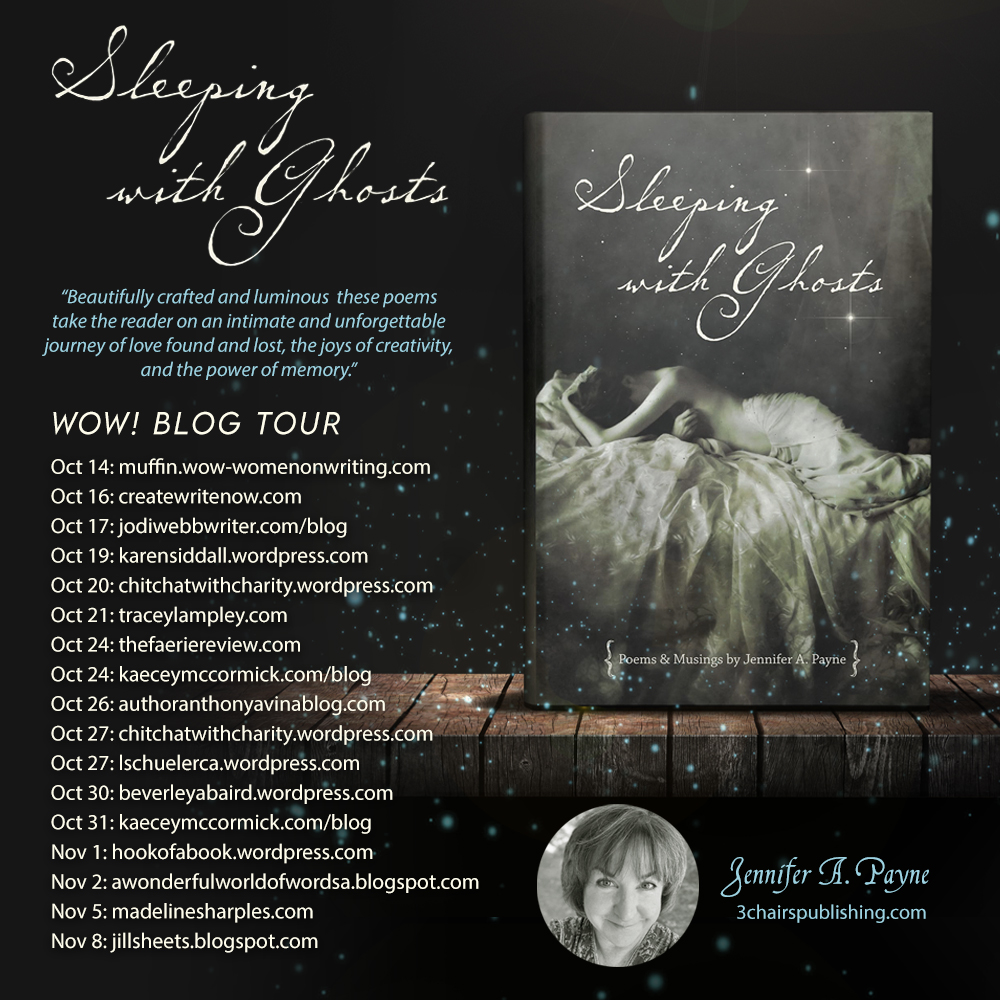
In honor of International Women’s Day, Jen will be reading from her new book, Sleeping with Ghosts, focusing on some of the women she’s written about — mentors and muses and friends. After the reading, Jen will be joined by Laura Noe for a conversation about how our relationships with women influence and inspire us. Laura, a local author as well, holds a master’s degree in Women’s and Gender Studies, and is currently teaching the Psychology of Women at SCSU. Attendees are welcome to bring a short (100 words or so) introduction about one important woman in your life to share with the group.
Copies of Sleeping with Ghosts will be available for sale during the event. Refreshments will be served.
This event is free and open to the public. No registration is required. The Blackstone Memorial Library is located at 758 Main Street, Branford. For more information, visit http://www.blackstonelibrary.org.
Jen Payne is a poet, author, photographer, and artist. She is inspired by those life moments that move us most — love and loss, joy and disappointment, milestones and turning points. Her writing serves as witness to these in the form of poetry, creative non-fiction, flash fiction and essay. When she is not exploring our connections with one another, she enjoys contemplating our relationships with nature, creativity, spirituality and our inner lives. Ultimately, she believes it is the alchemy of those things that helps us find balance in this frenetic, spinning world.
Her work has appeared in numerous publications including Sunspot Literary Journal, The Perch, and the 2024 Connecticut Literary Anthology. She has written five books: Look Up!, Evidence of Flossing, Waiting Out the Storm, Water Under the Bridge, and Sleeping with Ghosts, all of which are available to borrow from the Blackstone Library. They can also be purchased online at 3chairspublishing.com.
“They tried to bury us, but they didn’t know we were seeds.”
Yesterday, I had the privilege of attending the 40th annual MLK Breakfast, presented by the Rev. Dr. Martin Luther King, Jr. Heritage Foundation. It was a beautiful community event that included readings, music, and a presentation by Pulitzer Prize winning author Dr. Jeffrey C. Stewart who spoke about the history and importance of non-violence.
I went at the invitation of my friend Laura Noe, who has her finger on the pulse of activism in truly inspiring ways. She reads voraciously, volunteers liberally throughout town, and knows how to make good connections for others. She’s currently working towards her second Master’s Degree, in Public Health (her first was in Gender Studies), and she’s teaching two courses at Southern Connecticut State University this semester, Psychology of Women and Adolescent Development.
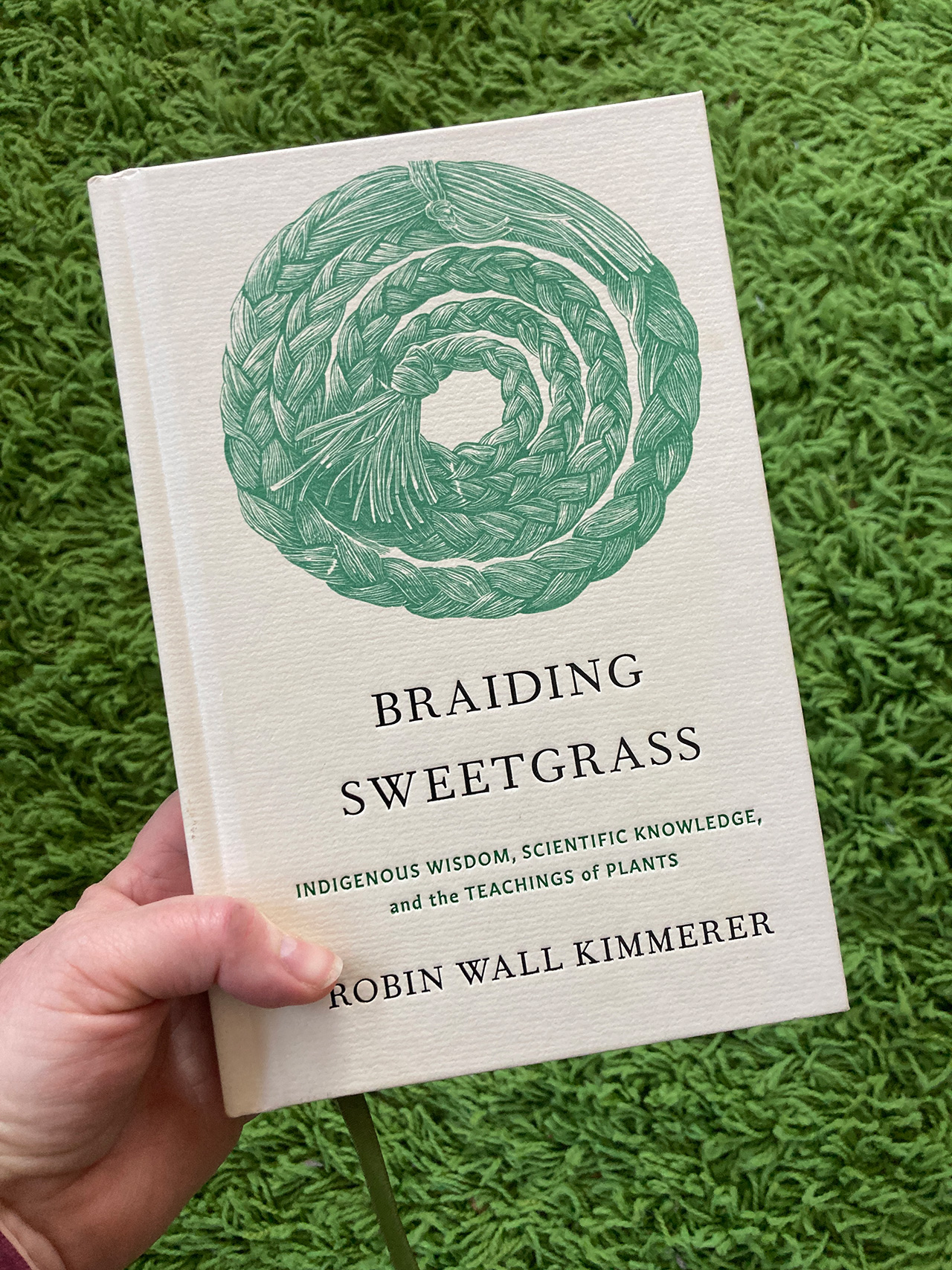
For several years, Laura has recommended I read the book Braiding Sweetgrass by Robin Wall Kimmerer, about the reciprocal relationships between humans and the land, with a focus on the role of plants and botany in both Native American and Western European traditions.
So yesterday afternoon, while the world around us marched to a seemingly different beat, I picked up my beautiful hardcover copy of Braiding Sweetgrass and began to read.
I suspect this was a divinely inspired moment — something somewhere knew it was exactly what I was supposed to be reading yesterday, the odd ironic day in 2025 when we simultaneously honored a great leader like Martin Luther King Jr. and inaugurated a demon and his minions.
I wanted to share with you this gorgeous passage from the new Introduction in the 2020 edition…it delivers, I think, beautiful blades of hope.
I began writing Braiding Sweetgrass in what seems, from this moment in the midst of a global pandemic and the upheavals it has generated, a more innocent time, when climate catastrophe was a hot glow on the horizon. We could smell smoke but our home was not yet engulfed in flames. There was guarded optimism for leadership on climate change and justice for land and people, human and otherwise.
A lot has happened since in climate urgency, with the political pain of vile Windigos come to office and all the wounds they have inflicted. I don’t need to say more. This evidence might suggest that the medicine of plant stories has not worked very well to heal our relationships with land and each other. The powerful purveyors of destruction are still in power, the skies darkening. But as always, I take my guidance from the forests, who teach us something about change. The forces of creation and destruction are so tightly linked that sometimes we can’t tell where one begins and the other leaves off. A long-lived overstory can dominate the forest for generations, setting the ecological conditions for its own thriving while suppressing others by exploiting all the resources with a self-serving dominance. But, all the while it sets the stage for what happens next and something always happens that is more powerful than that overstory: a fire, a windstorm, a disease. Eventually, the old forest is disrupted and replaced by the understory, by the buried seedbank that has been readying itself for this moment of transformation and renewal. A whole new ecosystem rises to replace that which no longer works in a changed world. Braiding Sweetgrass, I hope, is part of that understory, seeded by many thinkers and doers, filling the seedbank with diverse species, so that when the canopy falls, as it surely will, a new world is already rising. “New” and ancient, with its origins in the Indigenous worldview of right relation between land and people. What the “overstory” of colonialism tried to suppress is surging. It is the prophesied time of the Seventh Fire, a sacred time when the collective remembering transforms the world. A dark time and a time filled with light. We remember the oft-used words of resistance, “They tried to bury us, but they didn’t know we were seeds.”
Kimmerer, Robin Wall. Braiding Sweetgrass: Indigenous Wisdom, Scientific Knowledge, and the Teachings of Plants. United States: Milkweed Editions, 2020.
Today, the Sleeping with Ghosts WOW! Women on Writing Blog Tour stop features a really thoughtful BOOK REVIEW by Kaecey McCormick:
If you’re ready to take a thoughtful, heartfelt stroll through memory and meaning, Sleeping with Ghosts is absolutely worth your time. Jen’s gentle but honest voice will stay with you long after the last page is turned.
Today, the Sleeping with Ghosts WOW! Women on Writing Blog Tour stop features a BOOK REVIEW by Beverley A Baird:
I would highly recommend Payne’s poetry memoir. Love fills its pages, and the words conjure intriguing images. There are so many special poems that I’m sure you will fall in love with, just as I did. So many lines as well, that you will remember and come back to.
Today’s WOW! Women on Writing Blog Tour stop features a BOOK REVIEW by Shoe’s Seeds & Stories:
These are poems to savor, even when they are heartbreaking, whether Payne is writing about New Hampshire in 1992 (I can picture the hidden meadow of lupines, the strawberry moon, the breathtaking stars), a terminal romance in “The Wrong Impression”, or baking a cake in “Real Plums, Imaginary Cake” (the title is a nod to novelist Mary McCarthy’s quote about writing: “I am putting real plums in an imaginary cake.’) I appreciate that Payne not only writes about lovers but also about friendship, such as in the poems “When the Mania Collapses in On Itself Again” and “Love They Neighbor as Thyself”. I enjoyed meeting the ghosts Payne introduces in the memoir, and I think you will too.
I must confess, it doesn’t surprise me that this is the first time in five years I did not meet my personal reading goal of 50 books. There were long stretches of time in 2020 when sitting still was next to impossible, nevermind tasks that required focus and attention-spans.
Which is not to say I wasn’t reading at all or didn’t have a stack of books at the ready. There was always an active book or two — bookmarks holding my place until I returned — and a patient pile of bookshelf finds, Amazon impulses, and contactless library pick-ups sitting in wait.
At some point, I was able to settle back into a fairly regular reading habit — all 10,466 pages of 40 books according to Goodreads’ annual “My Year in Books” report (see below). At some point, I even slogged through The Goldfinch (Donna Tartt), only because I was determined to read the book before watching the movie.
As usual, my annual accounting of reads is a hodgepodge: old favorites, some young adult novels, poetry, a few lifestyle/inspiration books, and plenty of escapist fiction.
My favorites of the year? Where the Crawdads Sing (Delia Owens), The World That We Knew (Alice Hoffman), and The Conference of the Birds (Ransom Riggs).
My least favorite titles didn’t make the list, because I’ve implemented the Page 29 Rule which gives me permission to put down a book sooner rather than later.
I think it’s funny that I began this long, hard year reading My Year of Rest and Relaxation (Ottessa Moshfegh) and The Book of Speculation (Erika Swyler), and ended with Bryan Washington’s Memorial, about findings oneself at a crossroads.
Aren’t we all at some kind of crossroads, here at the end of 2020?
The good thing is that there will always be books. Come what may, there will always be that patient pile waiting for us, that bookmark holding a sacred space for when we return, the character who grabs our hand and says come with me for a while…and we do.









 randomactsofwriting.net